


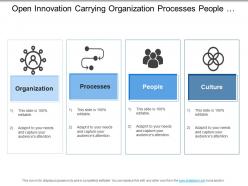
Open innovation carrying organization processes people and culture





Try Before you Buy Download Free Sample Product
 Impress Your
 Audience
 100%
100% Editable
 Save Hours
 of Time


Go deep into the heart of every aspect with our Open Innovation Carrying Organization Processes People And Culture. Be able to conduct intense discussions.
People who downloaded this PowerPoint presentation also viewed the following :
Open innovation carrying organization processes people and culture with all 5 slides:
Our Open Innovation Carrying Organization Processes People And Culture add a fresh dimension. Acquire the ability to diversify easily.




FAQs for Open innovation carrying organization processes
Open innovation is a collaborative approach where organizations leverage external ideas, technologies, and partnerships alongside internal R&D, contrasting with traditional closed models that rely solely on in-house capabilities. This strategic combination enables companies to accelerate product development, reduce costs, and access specialized expertise, with many tech firms and pharmaceutical companies finding that external partnerships deliver faster time-to-market and enhanced competitive advantage.
Organizations effectively implement open innovation strategies through structured partnerships with universities, startups, suppliers, and customers, establishing clear intellectual property frameworks, and creating dedicated innovation platforms or incubators. These approaches enhance collaboration by facilitating knowledge exchange, accelerating product development cycles, and reducing R&D costs, with many companies finding that external partnerships deliver breakthrough solutions and competitive advantages they couldn't achieve internally.
Open innovation practices deliver accelerated product development, reduced R&D costs, access to diverse expertise, enhanced market responsiveness, and increased competitive advantage. Through strategic partnerships and external collaboration, companies across sectors like pharmaceuticals, technology, and automotive streamline innovation cycles, minimize resource constraints, and ultimately achieve faster time-to-market while leveraging global talent pools for sustainable growth.
Intellectual property concerns significantly impact companies' open innovation participation by creating fears around patent disputes, trade secret exposure, and competitive advantage loss. However, many organizations overcome these challenges through strategic IP frameworks, clear collaboration agreements, and selective knowledge sharing, with sectors like pharmaceuticals and technology finding that structured approaches ultimately deliver greater innovation velocity and market opportunities.
Technology serves as the backbone of open innovation by enabling seamless collaboration through cloud platforms, AI-driven idea management systems, digital marketplaces, and real-time communication tools. These technologies streamline cross-industry partnerships by connecting diverse stakeholders, automating knowledge sharing, and accelerating prototype development, with sectors like pharmaceuticals, automotive, and financial services finding that digital ecosystems ultimately deliver faster innovation cycles and competitive advantages.
Startups can leverage open innovation by partnering with universities, established corporations, research institutions, and freelance experts to access external knowledge and resources. Through collaborative platforms, hackathons, and strategic alliances, startups accelerate development cycles, reduce R&D costs, and gain specialized expertise they couldn't afford internally, ultimately delivering innovative products faster while minimizing resource constraints.
IBM's partnership ecosystem with developers and startups, Procter & Gamble's Connect + Develop program sourcing external innovations, and LEGO's collaboration with user communities for product development represent successful open innovation models. These initiatives streamline product development, enhance market responsiveness, and accelerate time-to-market, with many organizations finding that strategic external partnerships ultimately deliver competitive advantages and breakthrough solutions.
Organizations face cultural resistance to external collaboration, intellectual property concerns, internal competition with external ideas, and difficulty aligning diverse innovation timelines with corporate processes. While traditional companies often struggle with transparency requirements and shared control, many find that gradual integration through pilot programs, clear IP frameworks, and employee engagement initiatives ultimately delivers enhanced creativity, accelerated development cycles, and stronger competitive positioning.
Organizations measure open innovation success through metrics like number of external partnerships formed, ideas generated from collaborations, time-to-market improvements, and revenue from co-developed products. These measurements enable companies to track collaboration effectiveness, optimize resource allocation, and demonstrate competitive advantage, with many finding that balanced scorecards combining quantitative outcomes and qualitative relationship assessments deliver the most comprehensive insights for strategic decision-making.
Businesses can cultivate innovator communities through strategic partnerships with universities and startups, collaborative online platforms, innovation challenges with meaningful incentives, and cross-industry knowledge exchanges. These approaches streamline talent acquisition, enhance creative problem-solving, and accelerate product development cycles, with many organizations finding that diverse external networks ultimately deliver breakthrough solutions and sustained competitive advantage.
Open innovation accelerates sustainable development by enabling cross-sector collaboration, knowledge sharing, and resource pooling to tackle complex global challenges like climate change, healthcare access, and food security. Through strategic partnerships between corporations, startups, universities, and governments, organizations can leverage diverse expertise, reduce development costs, and scale impactful solutions faster than traditional closed approaches.
Organizations should consider intellectual property rights, fair compensation for external contributors, data privacy protection, transparent collaboration terms, and equitable benefit-sharing when practicing open innovation. These ethical frameworks help build sustainable partnerships with startups, researchers, and communities, while ensuring responsible innovation practices that protect all stakeholders, ultimately delivering trust-based ecosystems and long-term competitive advantage.
Businesses manage open innovation flow through structured collaboration platforms, dedicated innovation teams, clear intellectual property frameworks, and systematic evaluation processes. These mechanisms streamline idea integration by establishing transparent communication channels, standardized assessment criteria, and strategic partnerships with external stakeholders, ultimately delivering faster innovation cycles and enhanced competitive advantage while maintaining organizational focus.
Employees in open innovation environments need collaborative mindsets, adaptability to external partnerships, cross-functional communication skills, and intellectual curiosity about emerging technologies and market trends. These capabilities enable seamless integration with external partners, facilitate knowledge transfer across organizational boundaries, and drive breakthrough solutions, with many companies finding that diverse, open-minded teams accelerate innovation cycles significantly.
Collaboration platforms enhance open innovation outcomes by streamlining communication between internal teams and external partners, centralizing idea management, and accelerating project timelines through real-time collaboration tools. These digital ecosystems enable organizations to track contributions more effectively, facilitate seamless knowledge sharing across geographical boundaries, and ultimately deliver faster innovation cycles with broader stakeholder engagement.
-
Best Representation of topics, really appreciable.
-
Innovative and Colorful designs.