


Operational efficiency indicator powerpoint presentation slides




Try Before you Buy Download Free Sample Product
 Impress Your
 Audience
 100%
100% Editable
 Save Hours
 of Time


Use content-ready Operational Efficiency Indicator PowerPoint Presentation Slides to ensure the business units are aligned in an organization to achieve business goals. Incorporate professionally designed operational efficiency indicator PPT presentation templates and measure company’s performance against given indicators of effectiveness. This deck comprises of various templates that will help you provide direction for future strategic growth. Improve investment portfolios, streamline company’s core processes, minimize redundancy while leveraging the resources which contribute to its success using ready-made operational efficiency indicator PowerPoint slideshow. Use this deck and ensure high quality products, services and support. Not just this, have lower operational risk, lower operating costs and increased revenues as compared to the competitor. Create value for customers and shareholders using ready-to-use operational efficiency indicator PowerPoint presentation slides. These templates are editable. Customize color, text, icon and font size as per your requirement. Incorporate these templates to analyse operational cost of your business. Intellectuals are drawn to our Operational Efficiency Indicator Powerpoint Presentation Slides. They discover a lot of food for thought.
People who downloaded this PowerPoint presentation also viewed the following :
Content of this Powerpoint Presentation
Slide 1: This slide shows Operational Efficiency Indicator. State Your Company Name and begin.
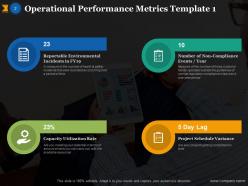
Slide 2: This slide presents Operational Performance Metrics Template 1. This slide also includes several parameters with which you can use as per requirement.
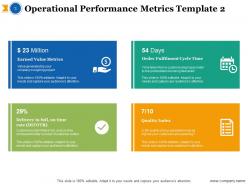
Slide 3: This slide shows Operational Performance Metrics Template 2 with four parameters for measuring performance.
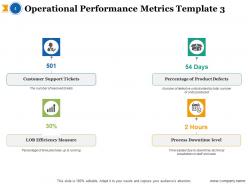
Slide 4: This slide showcases Operational Performance Metrics Template 3 with four kind of measurement factors.
Slide 5: This slide is a Operational Performance Metrics Icon which have various number of icon you can use.
Slide 6: This slide is a Coffee Break image for a halt.
Slide 7: This slide forwards to Charts & Graphs.
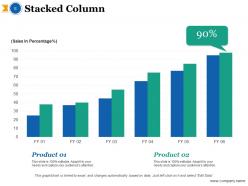
Slide 8: This slide shows a Stacked Line graph in terms of percentage and years for comparison of Product 01, Product 02, Product 03 etc.
Slide 9: This is an Area Chart slide for product/entity comparison.
Slide 10: This slide is titled Additional Slides to move forward.
Slide 11: This is an About Us slide showing Our Company, Value Client, and Premium services as examples.
Slide 12: This slide represents Our Mission. State your mission, goals etc.
Slide 13: This slide showcases Our Team with Name and Designation to fill.
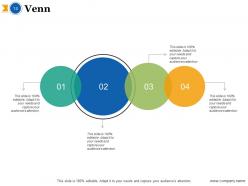
Slide 14: This is a Venn diagram image slide to show information, specifications etc.
Slide 15: This is a Bulb Or Idea image slide to show information, innovative aspects etc.
Slide 16: This is a Thank You image slide with Address, Email and Contact number.
Operational efficiency indicator powerpoint presentation slides with all 16 slides:
Our Operational Efficiency Indicator Powerpoint Presentation Slides ensure that they keep coming back. Their appetites will get a boost.








FAQs for Operational efficiency indicator
Key operational efficiency KPIs include asset turnover ratios, cycle times, cost per unit, resource utilization rates, and throughput metrics, with industry-specific variations like bed occupancy in healthcare or inventory turnover in retail. These indicators enable organizations to streamline processes, minimize waste, and enhance productivity, while manufacturing companies increasingly find that combining multiple KPIs delivers comprehensive visibility into operational performance and competitive advantage.
Organizations can effectively track operational efficiency indicators through automated dashboard systems, regular performance audits, trend analysis tools, and benchmarking against industry standards. By implementing real-time monitoring platforms and establishing quarterly review cycles, companies streamline data collection, identify improvement opportunities faster, and maintain competitive advantage through consistent operational optimization and strategic resource allocation.
Technology streamlines operational efficiency metrics by automating data collection, providing real-time analytics, and enabling predictive insights for proactive decision-making. Through advanced systems like IoT sensors, AI-powered dashboards, and integrated ERP platforms, organizations enhance accuracy, reduce manual errors, and accelerate response times, ultimately delivering improved resource allocation and competitive advantage.
Businesses can benchmark operational efficiency by analyzing key performance indicators like cost per unit, productivity ratios, cycle times, resource utilization rates, and customer satisfaction scores against industry databases and competitor reports. Through benchmarking platforms, industry associations, and performance analytics tools, organizations identify improvement opportunities, streamline processes, and enhance competitive positioning, ultimately delivering cost reductions and operational excellence.
Common pitfalls include selecting vanity metrics over meaningful measures, implementing too many indicators simultaneously, lacking clear baselines, and failing to align metrics with strategic objectives. Many organizations also struggle with insufficient employee training, inadequate data quality, and resistance to change, ultimately discovering that successful implementation requires gradual rollout, stakeholder buy-in, and consistent communication across departments.
Operational efficiency indicators directly impact profitability by identifying cost reduction opportunities, streamlining resource allocation, and minimizing operational waste across departments. Through performance metrics like cycle time, resource utilization, and process automation rates, organizations enhance productivity, reduce overhead expenses, and accelerate service delivery, with many companies finding that optimized operational efficiency translates to significantly improved profit margins.
Qualitative factors include employee satisfaction, customer experience quality, stakeholder communication effectiveness, process adaptability, and organizational culture alignment. While quantitative metrics reveal performance numbers, these qualitative elements determine sustainability and scalability, with many organizations finding that engaged employees and satisfied customers ultimately drive stronger operational outcomes and competitive advantage.
Small businesses can leverage operational efficiency indicators by focusing on cost per acquisition, inventory turnover, employee productivity ratios, and customer lifetime value to identify improvement opportunities. These metrics enable smaller companies to streamline operations, reduce waste, and optimize resource allocation more quickly than larger enterprises, ultimately delivering competitive advantages through agility and responsiveness.
Organizations can improve operational efficiency scores by implementing process automation, adopting lean methodologies, optimizing resource allocation, leveraging data analytics for decision-making, and establishing performance measurement systems. These strategies streamline workflows, eliminate redundancies, and enhance productivity across departments, with many companies in manufacturing and financial services finding that strategic combinations of technology and process improvements deliver significant cost reductions and faster service delivery.
Employee engagement levels significantly influence operational efficiency by affecting productivity rates, quality metrics, absenteeism costs, and turnover expenses within efficiency calculations. Engaged employees typically deliver faster task completion, reduced error rates, and lower recruitment costs, with many organizations finding that highly engaged teams achieve 23% higher profitability and substantially improved operational performance metrics.
Enterprise resource planning (ERP) systems, business intelligence platforms, dashboard software, process mining tools, and performance management systems are most effective for monitoring operational efficiency indicators. These technologies streamline data collection, automate reporting, and provide real-time analytics, with many organizations finding that integrated platforms like SAP, Tableau, and Microsoft Power BI ultimately deliver comprehensive visibility and faster decision-making capabilities.
Organizations align operational efficiency indicators with strategic goals by establishing clear connections between metrics and business objectives, regularly reviewing performance dashboards, and involving cross-functional teams in indicator selection. This strategic alignment enables companies to track meaningful progress, optimize resource allocation, and make data-driven decisions that directly support long-term growth, with many finding that integrated measurement systems ultimately deliver enhanced competitive advantage and sustainable operational excellence.
Supply chain management significantly impacts operational efficiency indicators by reducing inventory costs, minimizing lead times, improving delivery performance, and enhancing resource utilization across operations. Through strategic supplier partnerships and automated logistics systems, organizations streamline procurement processes, accelerate production cycles, and deliver better customer experiences, with many manufacturing and retail companies finding that optimized supply chains ultimately reduce operational costs by 15-25%.
External market conditions significantly influence operational efficiency metrics by shifting priorities during economic downturns, supply chain disruptions, inflation periods, and competitive pressures. Companies in volatile sectors like retail, manufacturing, and financial services increasingly emphasize cost-reduction metrics during recessions while focusing on speed-to-market indicators during growth phases, ultimately requiring dynamic metric selection for sustained competitive advantage.
Operational efficiency indicators inform decision-making by identifying bottlenecks, measuring resource utilization, tracking performance trends, and highlighting areas requiring immediate attention or strategic investment. These metrics enable organizations to streamline workflows, optimize resource allocation, and enhance productivity across departments, with many companies finding that data-driven decisions ultimately deliver faster operations and improved competitive advantage.
-
Attractive design and informative presentation.
-
Easily Understandable slides.