


Optimizing Omnichannel Strategy To Enhance Customer Experience Powerpoint Presentation Slides





Try Before you Buy Download Free Sample Product
 Impress Your
 Audience
 100%
100% Editable
 Save Hours
 of Time


Enhancing customer experience through optimized omnichannel strategies is the primary focus of this deck. Here is a competently designed Optimizing Omnichannel Strategy to Enhance Customer Experience deck that aims to drive customer satisfaction, loyalty, and overall business growth. Moreover, Social Media Strategies deck includes an analysis of the current customer experience, highlighting its impact on company performance. Furthermore, Client Feedback also addresses customer complaints, gathers valuable insights, takes action, and implements impactful changes. Also, the Omnichannel Strategy PowerPoint presentation equips you with the ability to assess customer behavior trends, understand the buyer journey, and identify customer expectations. Lastly, the CX Enhancement deck includes a customer support executive job description template outlining the necessary knowledge, education, skills, and abilities. Download this PowerPoint presentation now to implement effective social media strategies, analyze customer behavior, gather client feedback, and optimize your omnichannel strategy.
People who downloaded this PowerPoint presentation also viewed the following :
Content of this Powerpoint Presentation
Slide 1: This slide displays Optimizing Omnichannel Strategy to Enhance Customer Experience.
Slide 2: This slide displays the title Agenda.
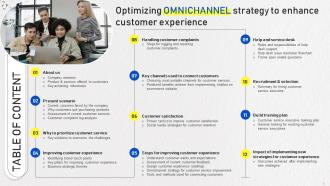
Slide 3: This slide exhibit table of content.
Slide 4: This slide exhibit table of content- About Us.
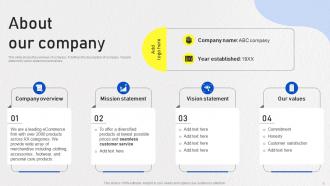
Slide 5: This slide shows the overview of company. It defines the description of company, mission statement, vision statement and values.
Slide 6: This slide highlights the various products offering to the customers based on different categories and product portfolio.
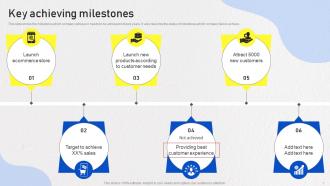
Slide 7: This slide shows the milestones which company achieve or needs to be achieved in future years.
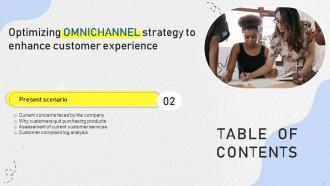
Slide 8: This slide exhibit table of content- Present Scenario.
Slide 9: This slide represent the issues faced by the company due to poor customer services.
Slide 10: This slide represents the key reasons due to which customers fails to purchase the products from the website.
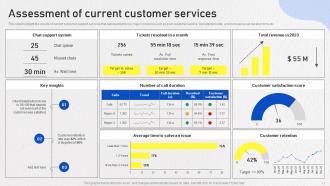
Slide 11: This slide highlight the results of current customer support services that represents the key major concerns.
Slide 12: This slide shows the complaint log table.
Slide 13: This slide exhibit table of content- Why to Prioritize Customer Service.
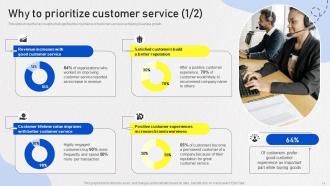
Slide 14: This slide shows the key insights that signifies the importance of customer service in achieving business growth.
Slide 15: This slide shows the key insights that signifies the importance of customer service in achieving business growth.
Slide 16: This slide shows the key challenges faced by the company.
Slide 17: This slide exhibit table of content- Improving Customer Experience.
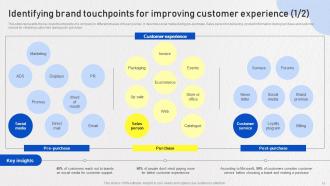
Slide 18: This slide represents the key brand touchpoints of a company in different phases of buyer journey.
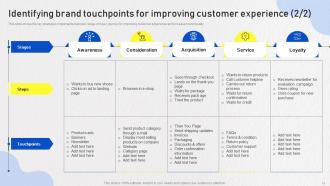
Slide 19: This slide shows the key strategies implemented at every stage of buyer journey for improving customer experience and increase brand loyalty.
Slide 20: This slide illustrates the key principles that helps in the building blocks for customer experience success.
Slide 21: This slide shows the key strategic prioritize that helps in evaluating the customer needs and requirements and delivers the same in an appropriate manner.
Slide 22: This slide exhibit table of content- Steps for Improving Customer Experience.
Slide 23: This slide frame the key steps for improving customer experience.
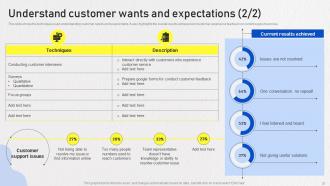
Slide 24: This slide shows the key insights of what customer wants and why they are frustrated from poor customer service.
Slide 25: This slide shows the techniques used understanding customer needs and requirements.
Slide 26: This slide shows the techniques used understanding customer needs and requirements.
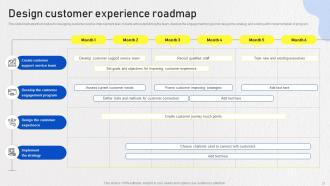
Slide 27: This slide illustrates the timeline for designing customer service improvement plan.
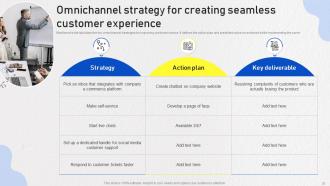
Slide 28: Mentioned slide tabulates the key omnichannel strategies for improving customer service.
Slide 29: This slide tabulates the mediums and methods used to connect with customers at different stages of purchase.
Slide 30: This slide exhibit table of content- Customer Satisfaction.
Slide 31: This slide outline the key strategies based on four categories, i.e. people, processes, and policies for delivering better customer experience.
Slide 32: This slide elaborated key social media hacks that helps to increase the customer retention rate.
Slide 33: This slide exhibit table of content- Key Channels used to Connect Customers.
Slide 34: This slide shows the key various channels used to connect with customers based on demographic data.
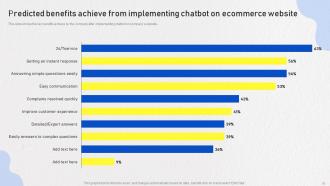
Slide 35: This slide shows the key benefits achieve by the company after implementing chatbot on company’s website.
Slide 36: This slide exhibit table of content- Handling Customer Complaints.
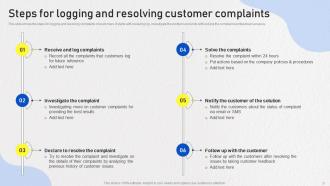
Slide 37: This slide shows the steps for logging and resolving complaints of customers.
Slide 38: This slide exhibit table of content- Help and Service Desk.
Slide 39: This slide tabulates the roles and responsibilities of a help desk service of different levels.
Slide 40: This slide shows the process flow of solving issues and skills required for solving the issue by the representatives.
Slide 41: This slide represents the FAQs for analysing customer satisfaction from company products and services.
Slide 42: This slide exhibit table of content- Recruitment & Selection.
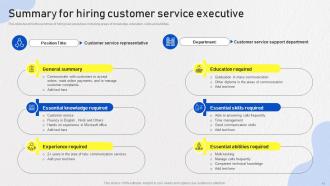
Slide 43: This slide describe the summary of hiring new executives including areas of knowledge, education, skills and abilities.
Slide 44: This slide tabulates the training plan for delivering qualitative customer service.
Slide 45: This slide shows the training plan providing for existing customer executives for enhancing skills and knowledge in their job area.
Slide 46: This slide exhibit table of content- Build Training Plan.
Slide 47: This slide tabulates the training plan for delivering qualitative customer service.
Slide 48: This slide showcase Forecasted outcomes achieved after implementing new strategies.
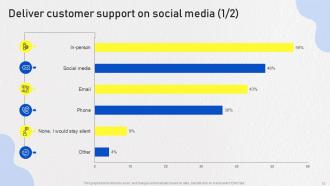
Slide 49: This slide showcase Deliver customer support on social media.
Slide 50: This slide showcase Deliver customer support on social media.
Slide 51: This slide showcase Top ecommerce survey questions.
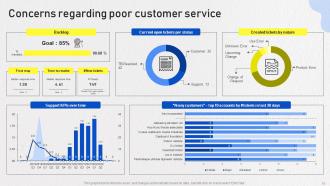
Slide 52: This slide showcase Concerns regarding poor customer service.
Slide 53: This slide showcase Concerns regarding poor customer service.
Slide 54: This slide showcase Concerns regarding poor customer service.
Slide 55: This is the icons slide.
Slide 56: This slide presents title for additional slides.
Slide 57: This slide display About us.
Slide 58: This slide presents Mind map.
Slide 59: This slide display Our goal.
Slide 60: This slide exhibits ideas generated.
Slide 61: This slide display Bulb and idea.
Slide 62: This slide depicts posts for past experiences of clients.
Slide 63: This slide showcase Stacked.
Slide 64: This slide depicts 30-60-90 days plan for projects.
Slide 65: This slide displays yearly bar graph for different products.
Slide 66: This slide displays Pie chart template.
Slide 67: This is the Comparison slide.
Slide 68: This slide shows Financial of the company.
Slide 69: This slide shows Private equity fund investment funnel.
Slide 70: This slide display Venn diagram.
Slide 71: This slide presents your company's vision, mission and goals.
Slide 72: This is the Comparison slide.
Slide 73: This slide shows details of team members like name, designation, etc.
Slide 74: This slide shows puzzle for displaying elements of company.
Slide 75: This slide shows roadmap of company.
Slide 76: This slide exhibits yearly timeline of company.
Slide 77: This is thank you slide & contains contact details of company like office address, phone no., etc.
Optimizing Omnichannel Strategy To Enhance Customer Experience Powerpoint Presentation Slides with all 71 slides:
Use our Optimizing Omnichannel Strategy To Enhance Customer Experience Powerpoint Presentation Slides to effectively help you save your valuable time. They are readymade to fit into any presentation structure.

































FAQs for Optimizing Omnichannel Strategy To Enhance Customer Experience
Key components of a successful omnichannel strategy include unified customer data platforms, consistent brand messaging across touchpoints, integrated inventory management, seamless channel transitions, and personalized customer experiences. These elements work together by breaking down silos between online and offline channels, enabling retailers and service providers to deliver cohesive customer journeys, ultimately driving higher satisfaction and loyalty.
Businesses can measure omnichannel effectiveness through customer lifetime value, cross-channel conversion rates, unified customer journey analytics, attribution modeling, and customer satisfaction scores across touchpoints. These metrics enable organizations to track seamless experiences, identify optimization opportunities, and demonstrate ROI, with many retailers and financial services firms finding that integrated measurement approaches ultimately deliver deeper customer insights and improved strategic decision-making.
Customer data serves as the foundation for omnichannel strategy development, enabling businesses to understand customer preferences, behaviors, purchase patterns, journey touchpoints, and engagement histories across all channels. This comprehensive data allows organizations to create personalized experiences, optimize channel integration, and deliver consistent messaging, with many retailers finding that data-driven omnichannel approaches significantly enhance customer satisfaction and loyalty.
An omnichannel approach enhances customer experience by creating seamless integration across all touchpoints, maintaining consistent messaging, and enabling customers to switch between channels without losing context or progress. Unlike traditional multichannel strategies that operate in silos, omnichannel delivers unified experiences, personalized interactions, and real-time data synchronization, ultimately driving higher satisfaction and loyalty.
Companies typically face data integration complexities, inconsistent customer experiences across channels, technology infrastructure limitations, organizational silos, and resource allocation challenges when implementing omnichannel strategies. While these obstacles present initial hurdles, many retailers and financial services firms find that strategic planning, cross-departmental collaboration, and phased implementation ultimately deliver seamless customer journeys and competitive advantage.
Technology facilitates omnichannel strategy execution through CRM systems, marketing automation platforms, inventory management software, data analytics tools, and integrated communication channels. These solutions streamline customer data synchronization, personalize cross-channel experiences, and optimize inventory allocation, with retail and financial services organizations finding that unified technology stacks ultimately deliver seamless customer journeys and competitive advantage.
Brands ensure messaging consistency through centralized content management systems, unified brand guidelines, cross-channel collaboration protocols, integrated marketing platforms, and regular auditing processes. These strategic approaches streamline communication by establishing single sources of truth, standardizing visual and verbal identity elements, and enabling real-time coordination across teams, ultimately delivering cohesive customer experiences while minimizing brand confusion.
Strategies include unified customer data platforms, consistent branding across touchpoints, cross-channel inventory management, integrated loyalty programs, and seamless payment systems. Through technologies like CRM integration and mobile apps, retailers enable customers to research online and purchase in-store, return products across channels, and access personalized experiences, ultimately delivering enhanced convenience and competitive advantage.
Personalized marketing through omnichannel approaches leverages unified customer data, behavioral tracking, cross-platform integration, and real-time analytics to deliver tailored experiences. By synchronizing touchpoints across email, social media, mobile apps, and physical stores, retailers create seamless personalized journeys, with many finding that consistent messaging increases conversion rates and customer loyalty significantly.
An omnichannel strategy significantly enhances customer loyalty and retention by delivering consistent, personalized experiences across all touchpoints, reducing friction in customer journeys, and enabling seamless channel switching. This strategic approach builds stronger emotional connections and trust, with retail and financial services companies finding that unified experiences increase repeat purchases, reduce churn rates, and ultimately drive higher customer lifetime value and competitive advantage.
Different industry sectors tailor omnichannel strategies to their unique customer journeys and operational requirements, with retail focusing on seamless online-offline integration, healthcare emphasizing patient portal connectivity, and financial services prioritizing secure cross-platform transactions. Banks streamline account management across mobile and branch channels, while retailers synchronize inventory systems, ultimately delivering consistent customer experiences that enhance satisfaction and competitive advantage.
Successful omnichannel strategies include Starbucks' integrated mobile app and loyalty program, Disney's seamless park-to-digital experiences, and Sephora's virtual try-on technology connecting online and in-store shopping. These companies streamline customer journeys by synchronizing inventory systems, personalizing interactions across touchpoints, and enabling flexible fulfillment options, ultimately delivering consistent brand experiences and increased customer lifetime value.
Social media integrates into omnichannel marketing by creating consistent messaging across platforms, enabling seamless customer transitions between channels, and providing real-time engagement touchpoints. Retail brands increasingly use social commerce features, targeted advertising, and customer service integration to connect social interactions with in-store experiences, ultimately delivering cohesive customer journeys and enhanced brand loyalty.
Mobile optimization serves as the cornerstone of omnichannel strategy, ensuring seamless customer experiences across smartphones, tablets, and mobile apps through responsive design, fast loading speeds, and intuitive navigation. With mobile commerce driving significant retail growth, organizations in banking, healthcare, and retail find that optimized mobile touchpoints enhance customer engagement, streamline purchasing processes, and ultimately deliver competitive advantage in an increasingly mobile-first marketplace.
Businesses can leverage customer feedback across channels by centralizing data collection, analyzing interaction patterns, identifying pain points, and implementing unified improvements. Through integrated feedback systems, companies streamline customer journeys, personalize experiences, and optimize touchpoint effectiveness, with many retailers and financial services finding that cross-channel insights ultimately deliver higher satisfaction and competitive advantage.
-
“Thank you to the SlideTeam. Your presentations look really skillful and have made my life so much easier.”
-
Fantastic and innovative graphics with useful content. The templates are the best and latest in the industry.