


Organization Theory Powerpoint Ppt Template Bundles




Try Before you Buy Download Free Sample Product
 Impress Your
 Audience
 100%
100% Editable
 Save Hours
 of Time


Our Organization Theory Powerpoint Ppt Template Bundles are topically designed to provide an attractive backdrop to any subject. Use them to look like a presentation pro.
People who downloaded this PowerPoint presentation also viewed the following :
Organization Theory Powerpoint Ppt Template Bundles with all 11 slides:
Use our Organization Theory Powerpoint Ppt Template Bundles to effectively help you save your valuable time. They are readymade to fit into any presentation structure.

FAQs for Organization Theory Powerpoint
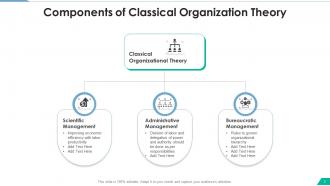
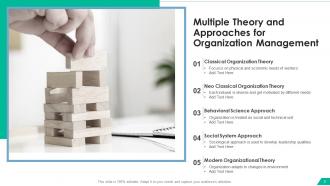
Classical organization theory principles include hierarchical structure, division of labor, centralized authority, formal rules and procedures, and merit-based advancement. While these foundations remain relevant in large corporations, government agencies, and manufacturing sectors, today's organizations increasingly blend them with flexible approaches, enabling streamlined operations and clear accountability while adapting to dynamic market conditions and collaborative work environments.
Modern organizational theories emphasize flexible, decentralized structures with cross-functional teams, adaptive hierarchies, and collaborative decision-making, while traditional approaches rely on rigid hierarchical chains, departmental silos, and top-down command structures. These contemporary frameworks enable organizations to respond faster to market changes, enhance employee engagement, and streamline innovation processes, ultimately delivering greater agility and competitive advantage.
Organizational culture significantly influences employee behavior through shared values, norms, and expectations that guide decision-making, collaboration, and work practices. Strong cultures enhance performance by improving employee engagement, retention, and alignment with strategic objectives, with companies like Google and Southwest Airlines demonstrating how culture-driven environments deliver competitive advantage and sustained growth.
Organizations can effectively implement change management by applying systems thinking to understand interconnections, leveraging network theory to identify key influencers, utilizing adaptive leadership approaches, and incorporating stakeholder engagement frameworks. Through these contemporary approaches, companies across sectors like healthcare, manufacturing, and financial services streamline transitions, minimize resistance, and enhance employee buy-in, ultimately delivering faster implementation timelines and sustainable organizational transformation.
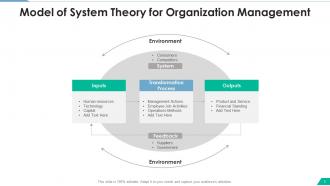
Systems theory reveals that organizational behavior emerges from interconnected relationships, feedback loops, environmental influences, and subsystem interactions rather than isolated individual actions. This perspective enables leaders to address root causes of performance issues, anticipate ripple effects of changes, and design interventions that enhance overall organizational effectiveness, with many companies finding that systems thinking ultimately delivers more sustainable solutions and competitive advantage.
Contingency theories address organizational complexities by emphasizing that optimal structures depend on environmental factors, technology requirements, organizational size, and strategic objectives rather than universal principles. These frameworks enable leaders to adapt structures based on market volatility, regulatory demands, and competitive pressures, with many organizations finding that flexible, context-specific approaches deliver enhanced operational efficiency and strategic responsiveness.
Organizational learning influences innovation by enabling firms to systematically capture knowledge, analyze market feedback, and adapt processes based on insights. Through continuous learning mechanisms, companies enhance their ability to identify emerging opportunities, streamline product development, and respond to competitive pressures, ultimately delivering faster innovation cycles and sustainable competitive advantage in increasingly dynamic markets.
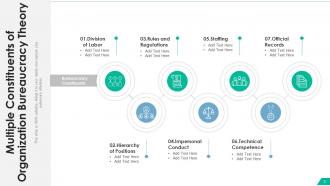
Bureaucratic structures deliver clear hierarchies, standardized procedures, predictable decision-making processes, consistent policy implementation, and efficient resource allocation across large organizations. While these systems enhance operational control and regulatory compliance, especially in government agencies and financial institutions, they can also slow innovation and reduce flexibility, with many organizations finding that hybrid approaches balance structure with adaptability in increasingly dynamic markets.
Sociotechnical systems theory enhances productivity and satisfaction by optimizing both technological capabilities and human factors through integrated design, participatory decision-making, and job enrichment strategies. Organizations implementing these principles, particularly in manufacturing and healthcare settings, achieve improved workflow efficiency, reduced employee turnover, and enhanced collaboration, with many finding that balanced human-technology integration ultimately delivers sustainable competitive advantage.
Digital transformation fundamentally reshapes organizational design through flattened hierarchies, cross-functional teams, agile workflows, data-driven decision making, and enhanced digital communication channels. These changes streamline operations by eliminating traditional silos, accelerating response times, and enabling real-time collaboration, with many organizations finding that remote-capable structures and automated processes ultimately deliver greater operational efficiency and competitive advantage.
Organizations can utilize network theory to improve collaboration by mapping communication patterns, identifying key connectors and knowledge brokers, strategically positioning collaborative hubs, and removing structural silos that impede information flow. Through network analysis tools, companies in sectors like consulting and technology streamline project coordination, accelerate decision-making, and enhance cross-departmental innovation, ultimately delivering faster problem-solving and competitive advantage.
Leadership styles significantly influence team effectiveness through various mechanisms, with transformational leadership fostering innovation and engagement, transactional leadership providing structure and accountability, and situational leadership adapting approaches to team maturity levels. These theories demonstrate that effective leaders enhance team performance by aligning their style with organizational culture, team dynamics, and strategic objectives, ultimately delivering improved collaboration, higher productivity, and competitive advantage across diverse business environments.
Ethical considerations shape organizational theory by influencing decision-making frameworks, stakeholder relationships, corporate governance structures, and cultural values within businesses. These principles guide how organizations balance profit motives with social responsibility, environmental stewardship, and employee welfare, with many companies finding that ethical practices ultimately enhance reputation, reduce regulatory risks, and deliver sustainable competitive advantage.
Globalization fundamentally reshapes organizational structures by driving flatter hierarchies, cross-cultural teams, decentralized decision-making, and matrix management systems to coordinate across multiple time zones and markets. These structural adaptations enable companies to leverage diverse talent pools, respond rapidly to regional customer needs, and maintain competitive advantage, with many multinational corporations finding that flexible, culturally-adaptive frameworks deliver superior market penetration and operational efficiency.
Understanding organizational theory aids conflict resolution by identifying structural causes like role ambiguity, communication breakdowns, and resource competition, while providing frameworks for systematic intervention. These theories enable leaders to address underlying organizational dynamics rather than surface symptoms, with many companies finding that structural adjustments, clearer hierarchies, and improved communication channels significantly reduce recurring conflicts and enhance collaborative outcomes.
-
Informative design.
-
Great designs, really helpful.
-
Great product with highly impressive and engaging designs.
-
Qualitative and comprehensive slides.
-
The Designed Graphic are very professional and classic.