


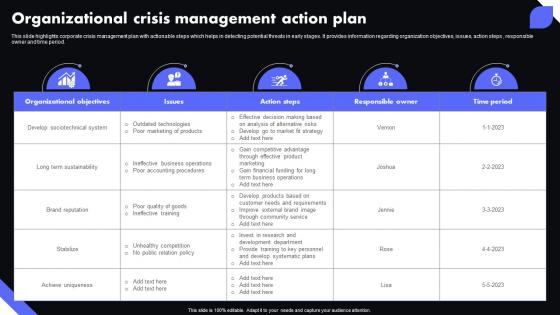
Organizational Crisis Management Action Plan




Try Before you Buy Download Free Sample Product
 Impress Your
 Audience
 100%
100% Editable
 Save Hours
 of Time


This slide highlights corporate crisis management plan with actionable steps which helps in detecting potential threats in early stages. It provides information regarding organization objectives, issues, action steps , responsible owner and time period.
People who downloaded this PowerPoint presentation also viewed the following :
Organizational Crisis Management Action Plan with all 6 slides:
Use our Organizational Crisis Management Action Plan to effectively help you save your valuable time. They are readymade to fit into any presentation structure.





FAQs for Organizational Crisis
**INPUT**: What are the key components of an effective crisis management plan? **OUTPUT**: Effective crisis management plans include risk assessment protocols, communication strategies, response team structures, stakeholder notification systems, and recovery procedures. These components work together by enabling rapid decision-making, maintaining transparent communication channels, and coordinating resources across departments, with many organizations finding that comprehensive planning significantly reduces response time and minimizes operational disruption during critical incidents. [Word count: 58 words]
Organizations identify potential crises through comprehensive risk assessment frameworks, real-time monitoring systems, stakeholder feedback mechanisms, early warning indicators, and systematic vulnerability audits. These proactive approaches enable companies to detect emerging threats across operational, financial, reputational, and regulatory domains, with many finding that consistent environmental scanning and cross-departmental communication ultimately prevent costly escalations.
Communication serves as the foundation of effective crisis management, enabling transparent information sharing, stakeholder coordination, timely decision-making, and trust preservation throughout the organization. Through strategic communication channels, organizations can minimize misinformation, align response efforts, and maintain operational continuity, with many companies finding that proactive, honest communication ultimately strengthens stakeholder relationships and competitive positioning.
Technology enhances crisis management through real-time monitoring systems, automated alert mechanisms, predictive analytics, and integrated communication platforms that enable rapid response coordination. These digital tools streamline information gathering, facilitate faster decision-making, and ensure consistent messaging across all stakeholders, with many organizations finding that automated systems significantly reduce response times while maintaining operational continuity during critical situations.
Best practices for training staff on crisis response protocols include regular simulation exercises, role-specific response procedures, clear communication hierarchies, scenario-based learning modules, and cross-departmental coordination drills. These training approaches enhance organizational preparedness by building muscle memory, improving decision-making speed, and ensuring seamless team coordination, with many companies finding that comprehensive crisis training significantly reduces response time and minimizes operational disruptions during actual emergencies.
Social media enables real-time communication, rapid information dissemination, stakeholder engagement, reputation monitoring, and direct customer support during crises. Through these platforms, organizations can address concerns immediately, correct misinformation, and maintain transparency, with many companies finding that proactive social media crisis management ultimately strengthens customer trust and competitive positioning.
Organizations should prioritize stakeholders by assessing impact severity, communication urgency, and business continuity requirements, typically focusing first on employee safety, customer retention, and regulatory compliance. Through strategic stakeholder mapping and transparent communication channels, companies can balance competing demands while maintaining operational stability, ultimately strengthening relationships and preserving long-term competitive advantage across all stakeholder groups.
Crisis management effectiveness can be evaluated through response time metrics, stakeholder communication reach, media sentiment analysis, operational recovery speed, and financial impact assessment. These measurements enable organizations to track resolution timelines, message penetration across affected audiences, and business continuity restoration, with many companies finding that comprehensive metric tracking ultimately delivers stronger crisis preparedness and competitive resilience.
Organizations can recover their reputation post-crisis through transparent communication, swift corrective actions, stakeholder engagement, consistent messaging, and demonstrating genuine accountability. Companies like Johnson & Johnson and Starbucks have successfully rebuilt trust by acknowledging mistakes, implementing systematic changes, and maintaining open dialogue with customers, ultimately strengthening brand loyalty and competitive positioning.
Common mistakes in crisis management include delayed response, lack of transparent communication, inadequate stakeholder engagement, poor resource allocation, and absence of predefined protocols. These missteps significantly impact organizational reputation and recovery, with many companies finding that proactive planning, clear communication channels, and swift decision-making ultimately deliver faster crisis resolution and stronger stakeholder trust.
Cultural differences significantly impact crisis management through varying communication styles, decision-making hierarchies, stakeholder expectations, and response timeframes across regions. Organizations operating globally must adapt their strategies accordingly, with companies in collectivist cultures emphasizing community consensus while individualist societies prioritize rapid executive decisions, ultimately requiring culturally-sensitive frameworks for effective international crisis response.
Crisis management must address stress responses, decision-making under pressure, communication anxiety, leadership visibility, and stakeholder trust dynamics. These psychological elements significantly impact organizational resilience, with many companies finding that proactive mental health support, clear communication protocols, and empathetic leadership ultimately enhance crisis response effectiveness and maintain stakeholder confidence.
Scenario planning enhances crisis readiness by identifying potential risks, developing response protocols, and testing organizational capabilities across multiple threat scenarios. Through structured simulations, companies strengthen decision-making processes, improve resource allocation strategies, and build stakeholder communication frameworks, with many organizations finding that regular scenario exercises ultimately deliver faster response times and more effective crisis containment.
Crisis management ethical considerations include transparency with stakeholders, protecting employee safety, ensuring equitable resource allocation, maintaining honest communications, and balancing organizational survival with social responsibility. These principles guide organizations through difficult decisions by prioritizing human welfare, preserving stakeholder trust, and maintaining long-term reputation, with many companies finding that ethical crisis responses ultimately strengthen customer loyalty and competitive positioning.
Post-crisis evaluations strengthen future strategies by identifying response gaps, analyzing decision-making effectiveness, and documenting lessons learned across all organizational levels. Through systematic assessment of communication protocols, resource allocation, and stakeholder management, businesses can refine contingency plans, enhance team preparedness, and build more resilient operational frameworks, ultimately delivering faster recovery times and competitive advantage.
-
“There is so much choice. At first, it seems like there isn't but you have to just keep looking, there are endless amounts to explore.”
-
“Thanks to SlideTeam. Now I can make smart presentations in a fraction of time without any hassle.”