


Organizational Formal Communication Guidance Action Plan




Try Before you Buy Download Free Sample Product
 Impress Your
 Audience
 100%
100% Editable
 Save Hours
 of Time


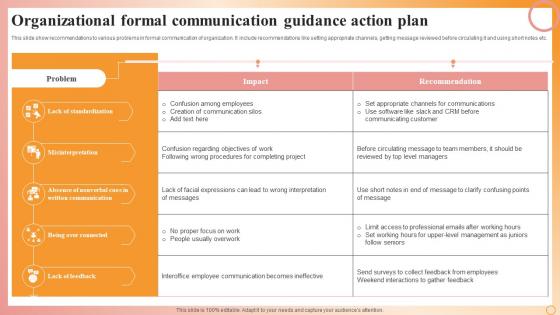
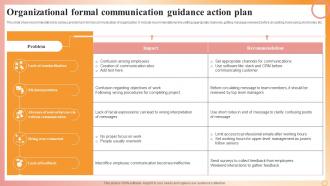
This slide show recommendations to various problems in formal communication of organization. It include recommendations like setting appropriate channels, getting message reviewed before circulating it and using short notes etc.
People who downloaded this PowerPoint presentation also viewed the following :
Organizational Formal Communication Guidance Action Plan with all 6 slides:
Use our Organizational Formal Communication Guidance Action Plan to effectively help you save your valuable time. They are readymade to fit into any presentation structure.





FAQs for Organizational Formal Communication
Key components of effective organizational communication include clear messaging, active listening, multiple communication channels, feedback mechanisms, and transparent leadership communication. These elements work together by ensuring information flows seamlessly across all organizational levels, fostering employee engagement and alignment, while ultimately delivering improved collaboration, faster decision-making, and enhanced operational efficiency that drives competitive advantage.
Organizational culture significantly influences communication by shaping interaction patterns, information flow, and employee engagement levels throughout the company. In hierarchical cultures, formal channels dominate with structured reporting, while collaborative cultures encourage open dialogue and cross-functional communication, with many organizations finding that aligned culture and communication strategies ultimately enhance productivity, employee satisfaction, and overall business performance.
Technology revolutionizes organizational communication by enabling instant messaging, video conferencing, collaborative platforms, cloud-based document sharing, and automated workflow systems. These digital tools streamline information flow, enhance remote collaboration, and break down geographical barriers, with many companies finding that integrated communication technologies significantly improve productivity, reduce response times, and ultimately deliver better employee engagement and operational efficiency.
Leaders can enhance team communication by implementing regular check-ins, creating open-door policies, utilizing collaborative platforms, establishing clear communication protocols, and fostering psychological safety for honest dialogue. These approaches streamline information flow, reduce misunderstandings, and build trust, with many organizations finding that structured communication frameworks ultimately deliver higher productivity, stronger team cohesion, and improved project outcomes.
Organizations can implement regular team meetings, digital collaboration platforms, transparent feedback systems, cross-departmental workshops, and open-door policies to enhance internal communication. These strategies streamline information flow by reducing silos, fostering collaboration, and building trust, with many companies finding that improved communication ultimately delivers higher employee engagement, faster decision-making, and enhanced operational efficiency.
Feedback significantly enhances organizational communication effectiveness by creating two-way dialogue, identifying communication gaps, and ensuring message clarity and understanding. Through regular feedback mechanisms, organizations streamline information flow, reduce misunderstandings, and improve decision-making processes, with many companies finding that structured feedback systems ultimately deliver better employee engagement and operational efficiency.
Organizational communication directly impacts employee engagement and morale by fostering transparency, enabling feedback loops, clarifying expectations, and building trust between leadership and staff. Companies with strategic communication practices see significantly higher retention rates, improved productivity, and enhanced workplace satisfaction, with many organizations finding that regular, clear communication ultimately delivers stronger team cohesion and competitive advantage.
Remote teams face challenges including time zone coordination difficulties, reduced non-verbal communication cues, technology barriers, informal interaction limitations, and cultural misunderstandings across distributed locations. These obstacles often result in delayed decision-making, decreased team cohesion, and project coordination complexities, with many organizations finding that implementing structured communication protocols and leveraging collaborative technologies ultimately enhances remote team effectiveness.
Poor organizational communication leads to decreased productivity, employee disengagement, increased turnover, project delays, and weakened team collaboration. These breakdowns create costly operational inefficiencies across departments, with many organizations finding that miscommunication results in duplicated efforts, missed deadlines, and ultimately diminished competitive advantage in increasingly fast-paced business environments.
Organizations measure communication effectiveness through employee surveys, engagement metrics, feedback response rates, message reach analytics, and behavioral change indicators. These assessment methods enable companies to track understanding levels, identify communication gaps, and optimize messaging strategies, with many businesses finding that regular measurement cycles ultimately deliver improved employee satisfaction, stronger alignment with organizational goals, and enhanced operational efficiency.
Visuals and presentation tools enhance organizational communication by simplifying complex information, increasing message retention, and ensuring consistent delivery across different audiences and channels. These tools enable leaders to present strategic initiatives, financial data, and operational updates more effectively, with many organizations finding that visual communication reduces misunderstandings while accelerating decision-making processes.
Diversity and inclusion initiatives enhance organizational communication by bringing varied perspectives, reducing groupthink, and fostering psychological safety across teams. These programs enable more comprehensive problem-solving, cultural sensitivity, and innovative solutions, with many organizations finding that diverse teams communicate more effectively, make better decisions, and ultimately deliver stronger business outcomes.
Common organizational communication barriers include hierarchical structures, information silos, cultural differences, technological gaps, and unclear messaging protocols. These obstacles often manifest in departments like finance and operations working independently, remote teams experiencing coordination challenges, and management layers filtering critical information, ultimately reducing operational efficiency and employee engagement while hindering strategic alignment across the organization.
Organizations create open communication cultures by establishing transparent leadership practices, implementing regular feedback mechanisms, encouraging cross-departmental collaboration, and recognizing employees who share ideas constructively. Through structured town halls, anonymous suggestion systems, and accessible management approaches, companies like tech startups and healthcare institutions streamline information flow, enhance employee engagement, and ultimately deliver improved decision-making and innovation outcomes.
Organizational communication significantly influences change management success by building employee trust, reducing resistance, and ensuring clear understanding of transformation goals and timelines. Through strategic messaging and transparent dialogue, organizations facilitate smoother transitions, enhance stakeholder buy-in, and accelerate adoption rates, with many companies finding that consistent communication reduces change-related disruptions by nearly fifty percent.
-
Been using SlideTeam for some time now…can’t imagine why I wasted all that time in front of the screen trying to make the perfect presentation.
-
If you are looking for satisfactory PowerPoint services, SlideTeam is your go-to place. I am fully contented with their research and development team.