


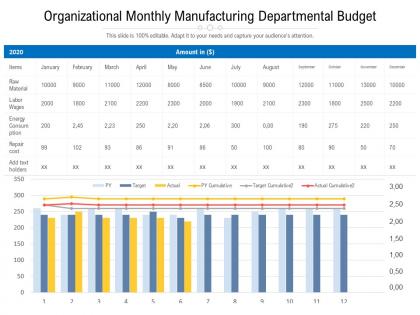
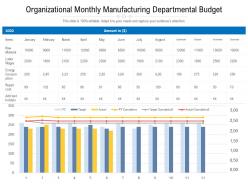
Organizational monthly manufacturing departmental budget




Try Before you Buy Download Free Sample Product
 Impress Your
 Audience
 100%
100% Editable
 Save Hours
 of Time


Our Organizational Monthly Manufacturing Departmental Budget are topically designed to provide an attractive backdrop to any subject. Use them to look like a presentation pro.
People who downloaded this PowerPoint presentation also viewed the following :
Organizational monthly manufacturing departmental budget with all 2 slides:
Use our Organizational Monthly Manufacturing Departmental Budget to effectively help you save your valuable time. They are readymade to fit into any presentation structure.
FAQs for Organizational monthly
Key manufacturing budget components include raw materials, direct labor, overhead costs, equipment maintenance, quality control measures, and capacity planning investments. These elements work together to optimize operational efficiency and cost management, with many manufacturers finding that strategic budget allocation across production, maintenance, and workforce development ultimately delivers improved margins and competitive advantage in increasingly demanding markets.
Variable and fixed costs fundamentally shape manufacturing budgets by determining cost structures, pricing strategies, and production flexibility. Fixed costs like equipment and facilities provide operational stability but require consistent volume to optimize per-unit economics, while variable costs including materials and labor directly correlate with production levels, enabling manufacturers to scale efficiently and adjust quickly to market demand fluctuations.
Forecasting serves as the foundation for manufacturing budgets by predicting demand patterns, material costs, labor requirements, and production capacity needs across upcoming periods. Through advanced analytics and historical data analysis, manufacturers can anticipate market fluctuations, seasonal variations, and supply chain disruptions, ultimately enabling more precise resource allocation and cost control strategies.
Lean manufacturing principles optimize budgets by eliminating waste, streamlining processes, reducing inventory costs, and improving operational efficiency through continuous improvement methodologies. These approaches enable manufacturers to minimize material waste, reduce labor costs, and accelerate production cycles, with many automotive and electronics companies finding that lean implementation delivers 15-30% cost reductions while enhancing quality.
Manufacturing budgeting challenges include fluctuating raw material costs, unpredictable demand patterns, equipment maintenance expenses, labor cost variations, and supply chain disruptions. These complexities often lead to budget overruns and planning difficulties, with many manufacturers finding that traditional forecasting methods struggle against volatile market conditions, ultimately requiring more adaptive financial strategies and real-time monitoring systems.
Raw material price fluctuations significantly impact manufacturing budgets by altering cost forecasts, profit margins, and production planning cycles. These variations force manufacturers to implement dynamic pricing strategies, flexible supplier agreements, and inventory optimization approaches, with many companies finding that strategic hedging and diversified sourcing ultimately deliver greater cost stability and competitive resilience.
Businesses can reduce manufacturing costs through lean manufacturing principles, automation technologies, supplier relationship optimization, waste reduction programs, and energy efficiency improvements. These strategies streamline operations by eliminating redundancies, accelerating production cycles, and minimizing resource consumption, with many manufacturers finding that strategic combinations ultimately deliver significant cost savings while maintaining product excellence and competitive advantage.
Manufacturing budgets should be reviewed monthly for operational variances and adjusted quarterly for strategic changes, with comprehensive annual reviews for long-term planning. Many manufacturers find that this tiered approach enables rapid response to supply chain disruptions, demand fluctuations, and cost variations, while maintaining strategic alignment and ultimately delivering enhanced operational efficiency and competitive positioning.
Key manufacturing budget performance metrics include variance analysis, cost per unit produced, labor efficiency ratios, material utilization rates, and overhead absorption percentages. These metrics enable manufacturers to identify cost overruns, optimize resource allocation, and streamline production processes, with many operations finding that regular monitoring delivers improved profitability and enhanced competitive positioning.
Manufacturing budget tools include ERP systems like SAP and Oracle, specialized software such as Anaplan and Adaptive Insights, and integrated platforms like Microsoft Dynamics and NetSuite. These solutions streamline budget creation by automating data collection, enabling real-time cost tracking, and providing predictive analytics, with many manufacturers finding that comprehensive platforms ultimately deliver enhanced accuracy and faster decision-making capabilities.
Workforce planning significantly influences manufacturing budgets by optimizing labor costs, reducing overtime expenses, and minimizing recruitment and training expenditures through strategic staffing forecasts. Through predictive analytics and demand planning, manufacturers can align workforce capacity with production schedules, ultimately reducing operational costs by 15-20% while maintaining productivity levels and avoiding costly production delays.
Capital expenditure considerations include equipment lifecycle costs, production capacity requirements, technology upgrade needs, maintenance expenses, and regulatory compliance investments. These strategic investments enhance operational efficiency by reducing downtime, improving product quality, and streamlining workflows, with many manufacturers finding that well-planned capital allocations ultimately deliver competitive advantages and sustainable cost reductions.
Manufacturing process choice significantly impacts budgeting through capital investment requirements, operational cost structures, labor allocation needs, and production volume economics. Batch processing typically requires lower initial investment but higher per-unit costs, while continuous manufacturing demands substantial upfront capital yet delivers economies of scale, with many manufacturers finding that continuous processes ultimately provide competitive advantages in high-volume markets.
Supply chain management significantly impacts manufacturing budgets by optimizing procurement costs, reducing inventory carrying expenses, minimizing production delays, and streamlining logistics operations. Effective supply chain strategies enable manufacturers to negotiate better supplier contracts, reduce waste through just-in-time delivery, and enhance operational efficiency, ultimately delivering cost savings of 15-25% while improving product quality and customer satisfaction.
Manufacturers can incorporate sustainability initiatives by allocating dedicated budget categories for energy-efficient equipment, waste reduction programs, renewable energy transitions, and sustainable material sourcing. These investments streamline operations while reducing long-term costs, with many manufacturing companies finding that sustainability budgets deliver operational savings, enhanced brand reputation, and competitive advantages in increasingly environmentally-conscious markets.
-
Awesome presentation, really professional and easy to edit.
-
Easy to edit slides with easy to understand instructions.
-
Understandable and informative presentation.
-
Excellent products for quick understanding.