


Organizing Anti Money Laundering Strategy To Reduce Financial Frauds Complete Deck





Try Before you Buy Download Free Sample Product
 Impress Your
 Audience
 100%
100% Editable
 Save Hours
 of Time


Anti-money laundering AML policies are implemented to deter criminals from integrating illicit funds into the financial system. Grab our blueprint for Organizing an Anti-Money Laundering Strategy to Reduce Financial Fraud. Quickly evaluating risk levels helps financial organizations know their customers and take legal action against any risk of money laundering or financial crime. The importance, advantages, process flow, and transaction monitoring industry data are covered in our AML System Deck, along with a timeline for implementation. Additionally, it covers a comparison of manual and automated methods of transaction monitoring. Further, our TM System PPT provides enhancement strategies for transaction monitoring systems that can assist businesses and financial organizations lower risks such as financial crimes and fraud. These include careful management, threshold management, behavioral analytics, suspected activity reporting SAR, anti-money laundering tactics, suspicious activity reporting SAR, and customer segmentation. The entire deck outlines the financial security departments roles, tasks, training schedule, communication schedule, etc. Lastly, our Automatic Transaction Monitoring module displays metrics, effect analysis, costs, and other transaction monitoring-related KPI dashboards. Get access right away.
People who downloaded this PowerPoint presentation also viewed the following :
Content of this Powerpoint Presentation
Slide 1: This slide introduces Organizing Anti Money Laundering Strategy to Reduce Financial Frauds. Commence by stating Your Company Name.
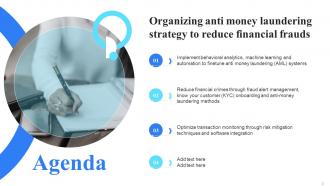
Slide 2: This slide depicts the Agenda of the presentation.
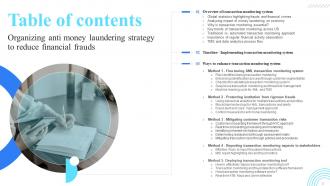
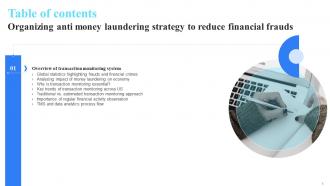
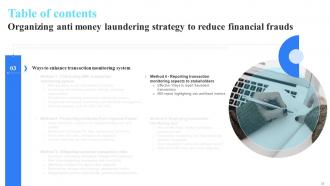
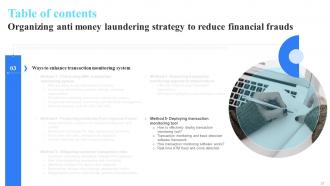
Slide 3: This slide incorporates the Table of contents.
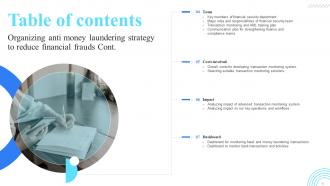
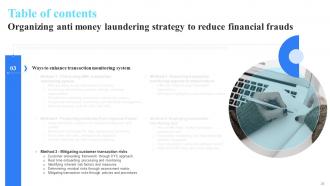
Slide 4: This slide continues the Table of contents.
Slide 5: This slide mentions the Heading for the Components to be discussed further.
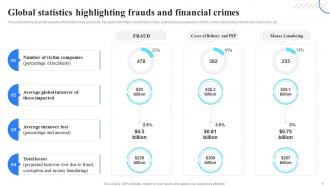
Slide 6: This slide showcases global scenario of financial crimes and frauds.
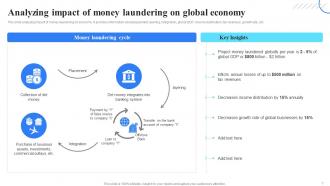
Slide 7: This slide deals with Analyzing impact of money laundering on global economy.
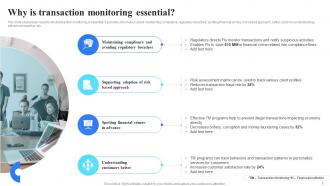
Slide 8: This slide shows the reasons why transaction monitoring is essential.
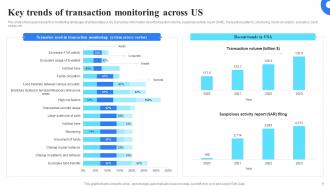
Slide 9: This slide exhibits the Key trends of transaction monitoring across US.
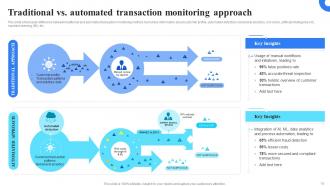
Slide 10: This slide showcases the difference between traditional and automated transaction monitoring method.
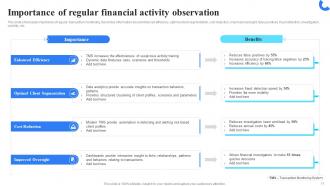
Slide 11: This slide states the Importance of regular financial activity observation.
Slide 12: This slide represents transaction monitoring system process flow.
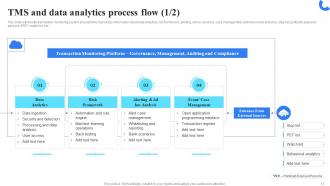
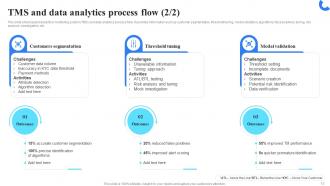
Slide 13: This slide continues the TMS and data analytics process flow.
Slide 14: This slide displays the Title for the Ideas to be covered further.
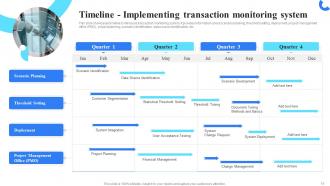
Slide 15: This slide showcases timeline to introduce transaction monitoring system.
Slide 16: This slide elucidates the Heading for the Ideas to be discussed in the following template.
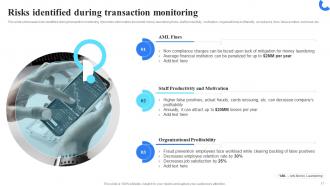
Slide 17: This slide portrays the Risks identified during transaction monitoring.
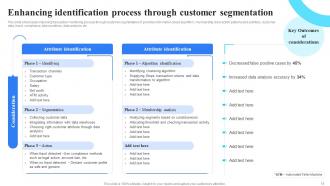
Slide 18: This slide deals with Enhancing identification process through customer segmentation.
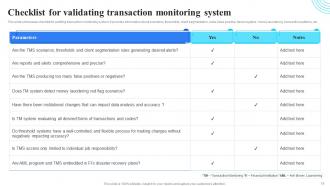
Slide 19: This slide exhibits the Checklist for validating transaction monitoring system.
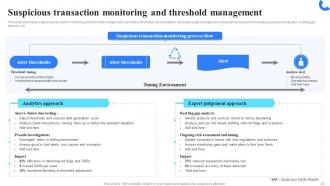
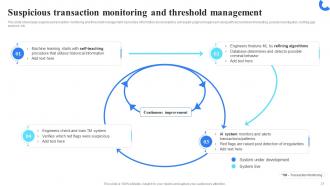
Slide 20: This slide showcases suspicious transaction monitoring and threshold management.
Slide 21: This slide talks about the Suspicious transaction monitoring and threshold management.
Slide 22: This slide reveals the Title for the Components to be covered further.
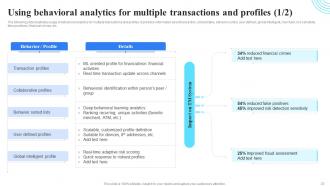
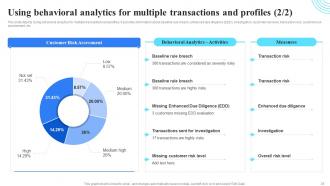
Slide 23: The following slide illustrates usage of behavioral analytics for multiple transactions and profiles.
Slide 24: This slide depicts Using behavioral analytics for multiple transactions and profiles.
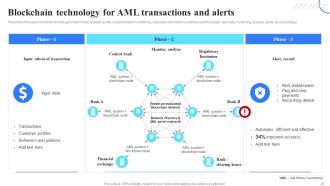
Slide 25: This slide shows blockchain technology for anti money laundering (AML) and transaction monitoring.
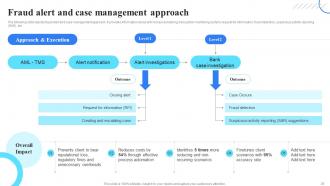
Slide 26: This slide displays the Fraud alert and case management approach.
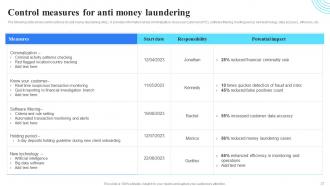
Slide 27: This slide shows the Control measures for anti money laundering.
Slide 28: This slide presents the Heading for the Topics to be discussed next.
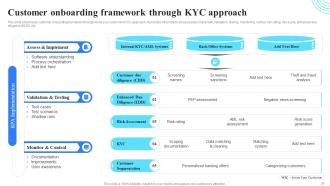
Slide 29: This slide illustrates the Customer onboarding framework through KYC approach.
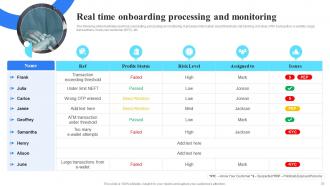
Slide 30: This slide reveals the Real time onboarding processing and monitoring.
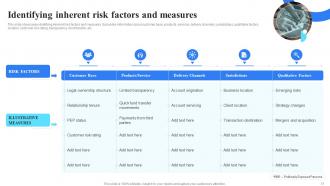
Slide 31: This slide focuses on Identifying inherent risk factors and measures.
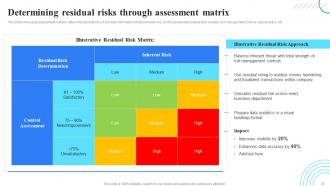
Slide 32: This slide deals with Determining residual risks through assessment matrix.
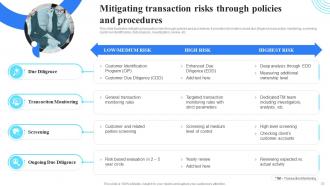
Slide 33: This slide shows the Mitigating transaction risks through policies and procedures.
Slide 34: This slide depicts the Title for the Ideas to be covered in the following template.
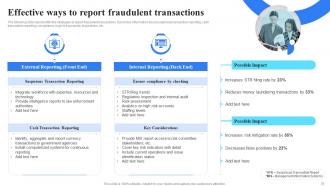
Slide 35: This slide states the Effective ways to report fraudulent transactions.
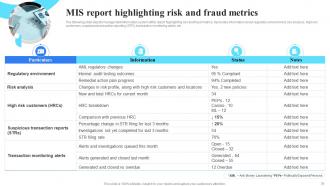
Slide 36: This slide reveals the MIS report highlighting risk and fraud metrics.
Slide 37: This slide exhibits the Heading for the Ideas to be discussed in the forth-coming template.
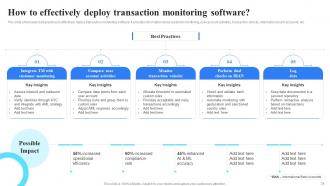
Slide 38: This slide showcases best practices to effectively deploy transaction monitoring software.
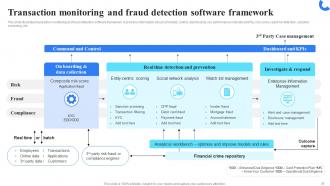
Slide 39: This slide illustrates transaction monitoring and fraud detection software framework.
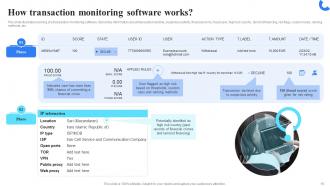
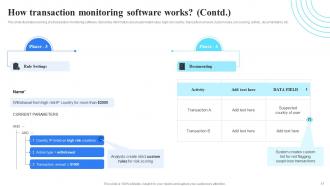
Slide 40: This slide reveals the working of a transaction monitoring software.
Slide 41: This slide continues the working of a transaction monitoring software.
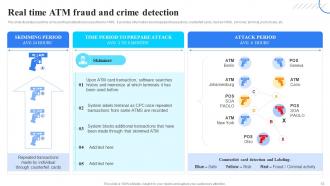
Slide 42: This slide mentions the Real time ATM fraud and crime detection.
Slide 43: This slide elucidates the Title for the Components to be discussed next.
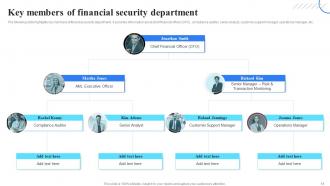
Slide 44: The following slide highlights key members of financial security department.
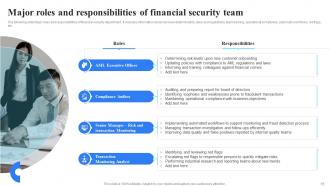
Slide 45: This slide exhibits the Major roles and responsibilities of financial security team.
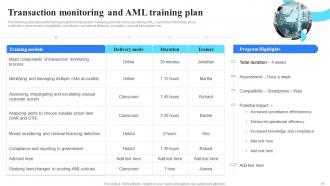
Slide 46: The following slide represents training program for transaction monitoring and anti money laundering (AML).
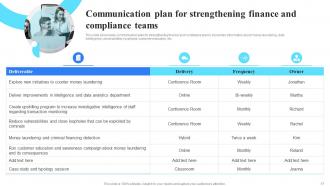
Slide 47: This slide showcases communication plan for strengthening finance and compliance teams.
Slide 48: This slide indicates the Heading for the Topics to be covered in the forth-coming template.
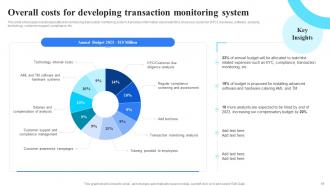
Slide 49: This slide presents the overall expenditure for enhancing transaction monitoring system.
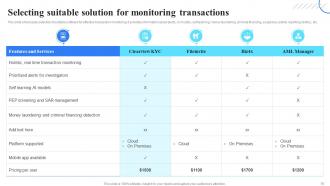
Slide 50: This slide focuses on Selecting suitable solution for monitoring transactions.
Slide 51: This slide incorporates the Title for the Topics to be covered next.
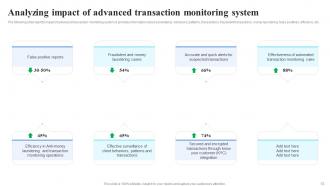
Slide 52: The following slide depicts impact of advanced transaction monitoring system.
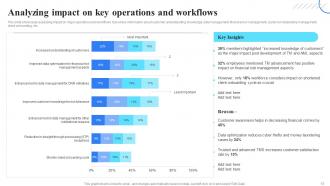
Slide 53: This slide mentions about assessing impact on major operations and workflows.
Slide 54: This slide contains the Heading for the Contents to be discussed further.
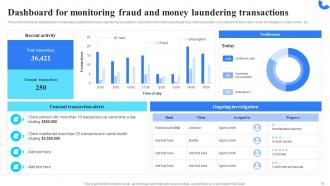
Slide 55: This slide illustrates the Dashboard for monitoring fraud and money laundering transactions.
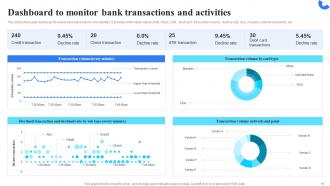
Slide 56: This slide indicates the Dashboard to monitor bank transactions and activities.
Slide 57: This is the Icons slide containing all the Icons used in the plan.
Slide 58: This slide is used for showcasing some Additional information.
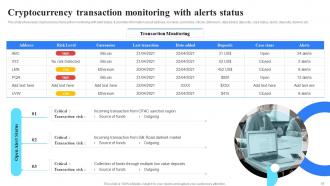
Slide 59: This slide emphasizes on Cryptocurrency transaction monitoring with alerts status.
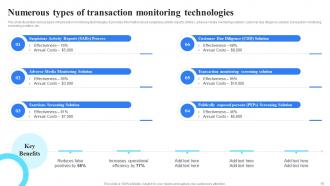
Slide 60: This slide states the various types of transaction monitoring technologies.
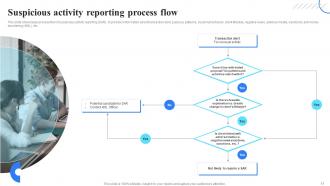
Slide 61: This slide presents the Suspicious activity reporting process flow.
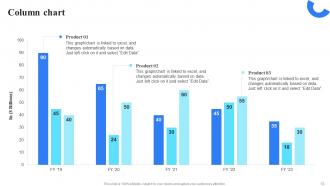
Slide 62: This slide represents the Column chart.
Slide 63: This is Our team slide. State your team-related information here.
Slide 64: This is the About us slide for depicting the company-related information.
Slide 65: This slide contains the Post it notes for reminders and deadlines.
Slide 66: This is the 30 60 90 days plan slide for efficient planning.
Slide 67: This is the Thank you slide for acknowledgement.
Organizing Anti Money Laundering Strategy To Reduce Financial Frauds Complete Deck with all 72 slides:
Use our Organizing Anti Money Laundering Strategy To Reduce Financial Frauds Complete Deck to effectively help you save your valuable time. They are readymade to fit into any presentation structure.








FAQs for Organizing Anti Money Laundering Strategy To Reduce Financial
Look, AML basically comes down to four things: know your customers (KYC), watch transactions, report sketchy stuff, and do risk checks regularly. Most places mess up the KYC part - they'll verify someone once then never update it again, which is nuts. Set up automated monitoring to catch weird patterns. When something feels off, file those SARs without hesitation. Oh, and train your team properly since they're gonna spot problems first. Honestly, just audit what you've got now and fix the worst gaps first. Don't try to overhaul everything at once.
Yeah so AML rules are all over the place depending where you're doing business. FinCEN makes US companies jump through tons of hoops with reporting. EU has their directives but honestly each country does their own thing with implementation. Singapore's pretty buttoned up, though the rest of Asia... well, let's just say it depends. Transaction limits differ, how deep they dig into customers varies, penalties range from slaps on the wrist to bankruptcy-level fines. Bottom line - you gotta follow whoever's strictest if you're working across borders. Can't just stick to your home country's playbook.
Look, AML tech is doing all the work humans can't handle anymore. AI scans millions of transactions instantly, catching weird patterns and suspicious amounts that would slip past manual reviews. Machine learning gets better at spotting new laundering tricks as criminals evolve their methods. Your compliance folks are probably glued to these systems - transaction monitoring, customer screening, generating SAR reports, the whole deal. Honestly can't believe we used to do this stuff by hand back in the day. Point is, you need solid AML technology now. It's not really a choice anymore.
Honestly, most people mess up CDD by stopping at basic identity checks. You'll want to layer in real-time transaction monitoring and better verification for your riskier customers. Don't just verify once at onboarding - keep updating those profiles regularly. Automate the easy stuff but have humans handle weird edge cases. Oh, and beneficial ownership gets super messy with complex corporate structures (that's where most gaps happen anyway). Build workflows that catch unusual patterns early. Make sure your team actually gets WHY they're collecting each piece of data, not just going through the motions.
Skip the generic compliance stuff - make training role-specific for what people actually deal with. Interactive scenarios work way better than boring slides (trust me on this one). Frontline staff need deep dives on customer due diligence and spotting sketchy activity. Back-office folks should focus more on reporting procedures. Don't forget regular refreshers since regs change all the time. Track who's completing what properly. But honestly? The biggest thing is creating a culture where people aren't scared to ask questions. That's where you catch problems early.
So basically, risk assessments help you figure out where to actually spend your time and money on AML stuff. You look at which customers, products, and locations are sketchy, then adjust your controls from there. High-risk areas get the full treatment - extra monitoring, tighter limits, all that. Lower-risk stuff just gets normal procedures. Think of it like hospital triage, honestly. You can't go crazy investigating every single transaction or you'll be buried in pointless alerts. Just make sure you're updating the assessment regularly as things change and actually USE the results to tweak your processes.
Look out for weird transaction patterns first - tons of cash deposits right under reporting limits, money ping-ponging between accounts, stuff that doesn't fit what the customer actually does. Wire transfers to sketchy countries are pretty obvious too. Trust your instincts though. If their story sounds fishy, it probably is. Customers who dodge paperwork or get weird about privacy? Major red flag. Oh and some people just give off that vibe, you know? Document anything strange and pass it up the chain when you're not sure.
Honestly, start with the basics - solid KYC processes, transaction monitoring, and training your team on current regs. I know, sounds boring as hell but regulators don't mess around. Keep tabs on FATF updates since they basically set the global playbook. Suspicious activity reporting is critical too. Here's what I'd do: map out what you're doing now against international standards first. That'll show you the gaps. Regular internal audits will save your butt - way better to catch issues yourself than have regulators find them. Oh, and don't skimp on staff training. People are usually the weakest link.
So basically, money laundering totally screws with a country's economy. Dirty money floods certain sectors and creates this unfair competition - criminals can run businesses at a loss while honest companies can't keep up. It's honestly like a rigged poker game. This whole mess scares off foreign investors (who wants to invest somewhere sketchy?), hurts tax revenue, and makes the financial system unstable. Banks get weaker too. Strong anti-money laundering rules aren't just bureaucratic nonsense - they actually protect the whole economic system from getting distorted.
Honestly, analytics is a total game-changer for AML stuff. Machine learning can catch sketchy transaction patterns way better than humans ever could. I'd start with algorithms that learn from your old SAR filings - they actually get smarter over time, which is pretty cool. Network analysis helps you spot those complex laundering schemes too. The best part? You're processing massive data volumes in real-time instead of dealing with those annoying rule-based systems that flag everything. Predictive models can even identify risky customers before they blow up. Trust me, it'll cut your investigation workload big time.
Dude, AML violations are no joke. Regulators will hit you with massive fines and possibly criminal charges. Your business license could get yanked, executives might face jail time, and honestly? The reputational damage alone will destroy you. Stock price tanks, customers bail - it's ugly. I've seen companies try to cut corners on compliance and it never ends well. The fines are always way more expensive than just building a solid AML program from day one. Don't risk it.
So here's the thing - public-private partnerships are honestly game changers for AML. Banks have all this transaction data and can spot weird patterns, but they're missing the bigger picture. Government agencies bring the threat intelligence and know what new schemes are popping up. It works both ways too - regulators get to see what's actually happening on the ground instead of just guessing. The trick is getting formal info-sharing agreements and joint task forces set up (which takes forever, but whatever). I'd start by figuring out which agencies in your area already do this stuff.
Honestly, whistleblower programs are pretty clutch for catching money laundering stuff. Your employees see the weird day-to-day patterns that computers miss. They get the context behind sketchy transactions too. But here's the thing - people won't speak up if they think they'll get fired for it. Protection policies have to actually work, not just exist on paper. Multiple reporting channels help. Anonymous tip lines too. I've seen cases where employees sat on red flags for months because they didn't know how to report safely. Make sure your team knows the process.
Your AML approach has to stay flexible - criminals adapt fast. AI and machine learning are game-changers for spotting suspicious patterns way quicker than old-school rule systems. Keep an eye on crypto, digital wallets, and P2P platforms too since bad actors jump on these newer channels. Honestly, fintech moves so fast it's exhausting sometimes! Build frameworks that can evolve instead of getting stuck with rigid processes. I'd run quarterly tech reviews to catch any gaps in your monitoring. The whole landscape shifts constantly, so adaptability beats perfection.
Honestly, you need to watch a bunch of different stuff to see if your AML program's actually working. SAR filing rates and false positive rates from transaction monitoring are huge - plus how you do on regulatory exams. I'd also check training completion and whether compliance people keep quitting (major red flag if they're bailing constantly). Customer onboarding times matter too, along with complaints about account closures. But here's the thing - how fast can you investigate alerts? That's where the rubber meets the road. Benchmark against other banks first, then set your own goals from there.
-
I looked at their huge selection of themes and designs. They appeared to be ideal for my profession. I'm sure I'll grab a few of them.
-
“Love it! I was able to grab an exciting proposal because of SlideTeam.”