


Overview Of Cyber Security Incident Response Plan Training PPT




Try Before you Buy Download Free Sample Product
 Impress Your
 Audience
 100%
100% Editable
 Save Hours
 of Time


This set of PPT slides details the process of developing an effective cybersecurity incident response plan to mitigate cyber-attacks.
People who downloaded this PowerPoint presentation also viewed the following :
Content of this Powerpoint Presentation
Slide 2
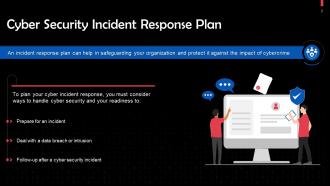
This slide gives an overview of cyber security incident response plan. To plan your cyber incident response, you must consider ways to handle cyber security and your readiness to handle an incident, deal with a data breach or intrusion, etc.
Slide 3
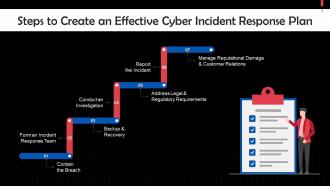
This slide highlights steps to create an effective cyber incident response plan. These steps are: Containing the breach, , forming an incident response team, recovering lost data from backup, conducting an investigation, addressing legal & regulatory requirements, reporting the incident, and managing reputational damage & customer relations.
Slide 4
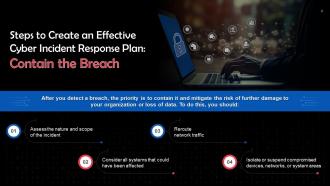
This slide discusses how to contain a data breach, which is the first step in creating an effective cyber incident response plan. After you detect a breach, the priority is to contain it and mitigate the risk of further damage to your organization or loss of data.
Instructor’s Notes: Sometimes, you may need to suspend your entire organization's network or website. If the breach is limited to certain aspects of your business, then determine which services, processes, and operations can continue without any risk, while you deal with the incident.
Slide 5
This slide gives information about the formation of a cyber incident response team. The team should comprise the following: Technical personnel, HR representatives, PR experts, data protection experts, etc.
Slide 6
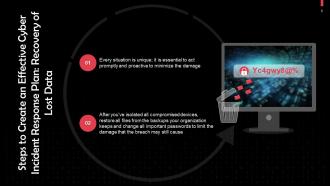
This slide discusses the importance of recovering lost data after a data breach. After you’ve isolated all compromised devices, you should restore all the files from the backups your organization keeps.
Slide 7
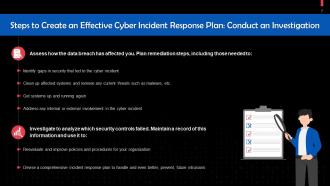
This slide discusses how to conduct an investigation, which is a crucial step to create an effective cyber incident response plan. Investigate to analyze which security controls failed and maintain a record of this information.
Slide 8
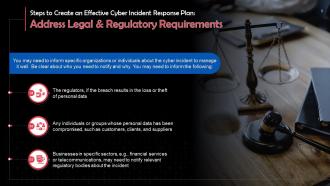
This slide talks about addressing legal and regulatory requirements when a cyber incident occurs. You may need to inform specific organizations or individuals about the cyber incident to manage the incident. Be clear about who you need to notify and why.
Slide 9
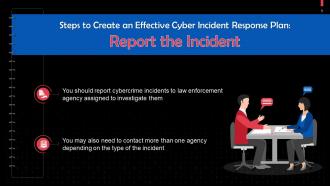
This slide discusses reporting an incident as a part of an effective cyber incident response plan. You should report cybercrime incidents to the law enforcement agency assigned to investigate these.
Slide 10
This slide talks about managing reputational damage and customer relations. If the harm to your reputation and business is severe, you might want to work with a crisis manager or a public relations professional to develop feasible solutions.
Overview Of Cyber Security Incident Response Plan Training PPT with all 29 slides:
Use our Overview Of Cyber Security Incident Response Plan Training PPT to effectively help you save your valuable time. They are readymade to fit into any presentation structure.

















FAQs for Overview Of Cyber Security Incident Response
So you'll want six main pieces for a decent incident response plan. Preparation is huge - get your policies, team roles, and tools sorted out ahead of time. Detection and analysis help you catch threats and figure out what's actually going on. Containment stops things from getting worse, then eradication wipes out the threat completely. Recovery gets everything back up and running safely. The lessons learned phase is honestly where most companies totally drop the ball, but don't skip it. Oh, and make sure you've got clear communication and escalation steps throughout. Run tabletop exercises regularly so your team isn't panicking when shit hits the fan.
First thing - do a full security audit of what you've got right now. Run some penetration tests and figure out where your weak spots are. Document all your critical assets too (seriously, you can't protect stuff you don't even know exists). Your team's security awareness matters just as much as the tech side - people click on dumb stuff all the time. Check your monitoring tools, backup systems, and whatever incident response stuff is already there. Honestly, getting this baseline right is everything. You need to know exactly where you stand before you can build any kind of decent response plan.
Training your team is huge - honestly, it's what separates plans that actually work from those binders collecting dust. Your people need to recognize incidents fast and know basic containment before the security folks show up. I can't tell you how many "disasters" I've seen that would've been nothing if someone just knew the right steps in those first critical minutes. Tabletop exercises every quarter help build that muscle memory. Plus it stops people from panicking and randomly unplugging stuff (which happens more than you'd think). Get everyone comfortable with escalation procedures now.
Test that plan quarterly minimum, but honestly? Monthly tabletop exercises are way better if you can manage it. They don't eat up your whole day and you'll catch stuff you'd never think of otherwise. Update it after every real incident - that's when you see what actually works vs what just sounds smart. Also update when your team changes or you get new systems. Oh, and don't let it collect dust on some server. These things only work if they're current. Schedule your next test right now before you forget about it.
Definitely document everything as it happens - timestamps, what you did, evidence you found. Trust me, you'll be kicking yourself later trying to remember if that server crash was Tuesday or Wednesday when you're writing up the report. Stick to facts in your initial reports and don't guess at causes until you actually know what went wrong. Keep updating people even if it's just "yeah, still looking into it." Templates help but don't get bogged down filling out forms when things are on fire. Oh, and assign someone to just handle the documentation so your tech people can focus on fixing stuff instead of writing novels.
Set up your communication plan way before anything bad happens. Make an escalation matrix showing who contacts who - execs, IT, legal, PR, the whole crew. Seriously, don't wait until you're in crisis mode to figure out the CEO's phone number! Pick one person to be your communication hub so messages don't get twisted like that old telephone game. Oh, and create standard templates for updates - keeps everyone on the same page. Practice this stuff during tabletop exercises too. When everything's hitting the fan and your heart's racing, you'll be glad you rehearsed it.
Not testing your plan enough is the biggest mistake - so many companies pull it out during a real crisis and realize all the contact info is ancient. Role confusion is huge too. Everyone thinks someone else is handling communications. Executive support disappears right when you need budget or resources. Oh, and teams get so focused on fixing the technical stuff they completely forget to update stakeholders. Legal requirements? Yeah, those usually get remembered way too late. Honestly, quarterly tabletop exercises are your best friend. Time everything out so you're not guessing.
Compliance totally shapes your incident response timelines and what you need to document. GDPR gives you 72 hours for breach notifications, but state laws are all over the map - honestly such a mess. You'll have to set up specific processes for notifying stakeholders, preserving evidence that meets legal standards, plus detailed logging. Healthcare deals with HIPAA rules, finance has SOX stuff. Different sectors, different headaches. Start by figuring out which regulations actually apply to you. Then build your response procedures around whatever has the tightest deadlines and harshest requirements.
For log analysis, grab something like Splunk or Elastic - they're solid for threat detection. CrowdStrike's great for endpoint visibility too. Oh, and definitely get forensics tools set up early (trust me on this one, you don't want to scramble for them mid-incident). Set up dedicated Slack or Teams channels for when shit hits the fan. Network monitoring helps catch lateral movement. Also keep backup systems ready since attackers always go after your main tools first - it's like they have a playbook or something. Start with these and expand based on what your environment actually needs.
Here's what I'd do - start by getting threat intel feeds that actually matter to your industry. Connect those directly to your incident response playbooks so you're not flying blind when stuff hits the fan. Your detection rules should automatically update when new attack patterns come in. Monthly briefings between your threat intel and IR teams work pretty well too. Honestly, most places collect tons of threat data but never actually use it when incidents happen, which is just wasteful. The trick is making sure that intelligence flows straight into your response procedures. Otherwise you'll be scrambling to research threats you already knew about.
Start with time metrics - MTTD, MTTR, and how fast you contain incidents. Those are gold. Track incident recurrence rates and costs too. Don't sleep on communication stuff like stakeholder notification times. Here's the thing though - consistency beats perfection. Pick 3-4 metrics that actually matter for your setup instead of going overboard. I've seen teams drown in dashboards they never look at. Focus on what drives real improvements. Oh, and document whether people actually follow your procedures - that one's huge but everyone forgets it.
Post-incident reviews are honestly worth doing even when you're exhausted from dealing with the mess. Yeah, they feel like just another meeting, but you'll catch stuff that would bite you later. Look at what actually worked, what was a total disaster, and where everyone got confused. Document the slow response times, communication fails, and any tools that crapped out on you. The trick is staying honest about screwups without making it a blame game - nobody learns anything that way. Then actually use what you found to fix your playbooks and train people on the gaps you discovered.
So basically, malware hits mean you gotta isolate those systems fast - like, drop everything fast - or it'll spread everywhere. DDoS is different though, you're scrambling to filter traffic and beef up resources so your site doesn't crash. Data breaches? That's a whole other nightmare where you're trying to figure out what got stolen. With malware you're digging through logs doing detective work. DDoS means you're probably on the phone with your ISP begging them to help reroute stuff. Honestly, having solid playbooks for each saves your butt when you're panicking.
Honestly, you've gotta get everyone bought into security, not just dump it all on IT. Skip the death-by-PowerPoint approach - nobody retains that stuff anyway. Build training around actual scenarios they'll face, like sketchy emails or random USB drives. Create a culture where people feel safe reporting weird things instead of staying quiet out of fear. New hires should get this from day one, then hit everyone with refreshers every few months. Oh, and make sure your incident response plan isn't just theoretical - people need to actually know what they're supposed to do when things go sideways. It's all about making security feel natural.
Look, the real problem is you don't have IT security people or budget for this stuff. Running your business already takes everything you've got. Incident response feels like some huge technical thing only corporations can handle, right? Most small businesses have no clue what threats to even worry about - ransomware, data breaches, system crashes? Pick your poison. You probably don't have those expensive monitoring tools either. Here's what I'd do: make a simple plan covering whatever hits your industry most, then pick someone to actually own it. Don't overthink it.
-
“Thank you to the SlideTeam. Your presentations look really skillful and have made my life so much easier.”
-
Best way of representation of the topic.