


Overview of unconscious bias stereotypes edu ppt




Try Before you Buy Download Free Sample Product
 Impress Your
 Audience
 100%
100% Editable
 Save Hours
 of Time


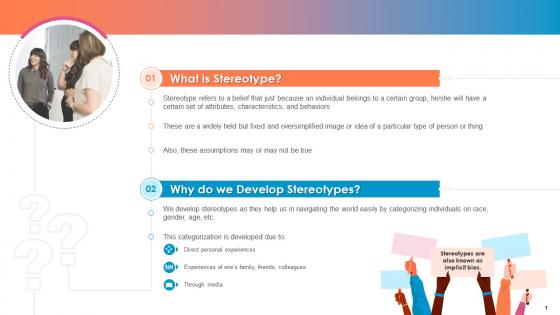
The purpose of the following slide is to provide an overview of implicit bias. It also contains details regarding ways through which this bias is developed, such as direct personal experiences, experiences of ones family members, friends, colleagues, and through media.
People who downloaded this PowerPoint presentation also viewed the following :
Overview of unconscious bias stereotypes edu ppt with all 16 slides:
Use our Overview Of Unconscious Bias Stereotypes Edu Ppt to effectively help you save your valuable time. They are readymade to fit into any presentation structure.








FAQs for Overview of unconscious bias
Unconscious bias significantly reinforces societal stereotypes by automatically categorizing individuals based on race, gender, age, and background, perpetuating systemic inequalities across institutions, workplaces, and communities. These ingrained mental shortcuts influence hiring decisions, educational opportunities, and social interactions, with many organizations finding that addressing unconscious bias through structured training and inclusive practices ultimately delivers more equitable outcomes and enhanced collaborative environments.
Organizations can identify unconscious bias through regular bias audits, anonymous employee surveys, diverse hiring panel reviews, and data analysis of promotion patterns across demographics. These approaches enable companies to address systemic inequities by implementing structured interview processes, bias training programs, and mentorship initiatives, ultimately delivering more inclusive workplaces and enhanced organizational performance.
Unconscious bias stereotypes influence hiring decisions through resume screening preferences, interview evaluation disparities, cultural fit assessments, and similarity-based selection processes. These biases can lead recruiters to unconsciously favor candidates who mirror existing team demographics while potentially overlooking qualified diverse talent, ultimately limiting organizational innovation and competitive advantage in increasingly diverse markets.
Common unconscious biases affecting interpersonal relationships include confirmation bias, affinity bias, halo effect, attribution bias, and stereotyping based on demographics or appearance. These biases significantly impact workplace dynamics, team collaboration, and leadership decisions across industries like healthcare, finance, and technology, with many organizations finding that addressing these patterns through awareness training and structured processes ultimately enhances team performance and creates more inclusive environments.
Media portrayal significantly reinforces unconscious bias stereotypes by repeatedly presenting limited, often skewed representations of different groups across news, entertainment, and advertising platforms. These consistent patterns shape public perception by normalizing certain assumptions about gender roles, racial characteristics, and professional capabilities, with many organizations finding that employees unconsciously carry these media-influenced biases into workplace decisions, ultimately affecting hiring, promotion, and collaboration processes.
Individuals can address unconscious biases through self-awareness training, diverse perspective seeking, mindfulness practices, structured decision-making frameworks, and regular bias interruption techniques. These strategies work by creating intentional reflection moments, expanding social and professional networks, and implementing systematic evaluation processes, with many organizations finding that employees who actively practice bias recognition demonstrate improved collaboration, fairer assessments, and enhanced team dynamics.
Cultural backgrounds shape unconscious biases by influencing our early social conditioning, media exposure, community norms, and historical narratives that create mental shortcuts about different groups. These deeply ingrained patterns affect workplace decision-making, hiring practices, and team dynamics across industries, with many organizations finding that cultural competency training and diverse leadership development help minimize bias impact while enhancing inclusive collaboration and innovation.
Unconscious bias training can effectively change long-term behavior when combined with ongoing reinforcement, practical application opportunities, and organizational culture shifts that support inclusive practices. While single training sessions show limited lasting impact, comprehensive programs incorporating regular skill-building, accountability measures, and leadership modeling deliver sustained behavioral changes, with many organizations finding measurable improvements in hiring, promotion decisions, and workplace interactions.
Unconscious biases form through cognitive shortcuts called heuristics, pattern recognition from repeated exposure, social conditioning, and emotional associations that bypass conscious reasoning. These psychological mechanisms help the brain process information quickly but can create workplace stereotypes, with many organizations finding that awareness training, structured decision-making processes, and diverse team compositions significantly reduce biased outcomes while enhancing organizational effectiveness.
Unconscious biases affect critical decision-making by creating cognitive shortcuts that override objective analysis, leading to systematic errors in judgment, risk assessment, and resource allocation. In high-pressure environments like emergency medical care, financial trading, and crisis management, these biases can result in delayed responses, misallocated resources, and compromised outcomes, with many organizations finding that structured decision frameworks help minimize these unconscious influences.
Technology can reduce unconscious bias through AI-powered recruitment tools, blind resume screening software, structured interview platforms, bias detection algorithms, and data analytics that identify discriminatory patterns. These solutions streamline hiring processes by removing identifying information, standardizing evaluations, and providing objective metrics, with many organizations finding that automated screening and structured assessments ultimately deliver more diverse talent pools and equitable decision-making outcomes.
Unconscious bias stereotypes significantly influence consumer behavior by shaping purchasing decisions, brand preferences, and product perceptions, while driving marketing strategies toward demographic targeting, cultural messaging, and inclusive representation. These biases create both challenges and opportunities for businesses, with many companies finding that addressing stereotypes through diverse campaigns, inclusive product development, and culturally sensitive messaging ultimately delivers broader market reach and enhanced customer loyalty.
Social networks and peer influences perpetuate unconscious biases by reinforcing shared stereotypes, creating echo chambers that limit diverse perspectives, and establishing group norms that discourage challenging existing assumptions. Within organizations, these dynamics manifest in hiring practices, promotion decisions, and team interactions, with many companies finding that structured diversity initiatives, cross-functional collaboration, and inclusive leadership training help break these cycles while enhancing decision-making quality and organizational performance.
Education plays a crucial role in combating unconscious bias stereotypes by introducing diverse perspectives, critical thinking skills, inclusive curricula, and empathy-building activities from early childhood development. Through structured diversity programs, multicultural learning experiences, and bias-awareness training, schools enable students to recognize stereotypical thinking patterns, challenge preconceived notions, and develop inclusive mindsets, ultimately creating more equitable learning environments and preparing future leaders for increasingly diverse workplaces.
Leaders can foster inclusive environments by implementing structured decision-making processes, promoting diverse representation in teams, conducting regular bias training, establishing clear accountability metrics, and creating psychological safety for open dialogue. Through blind recruitment practices, cross-functional collaboration, and transparent promotion criteria, organizations streamline fairness while enhancing innovation, with many companies finding that diverse leadership ultimately delivers stronger performance and competitive advantage.
-
Use of different colors is good. It's simple and attractive.
-
It saves your time and decrease your efforts in half.