


Payment Gateway Company Investor Funding Elevator Pitch Deck Ppt Template




Try Before you Buy Download Free Sample Product
 Impress Your
 Audience
 100%
100% Editable
 Save Hours
 of Time


Check out our competently designed Payment Gateway Company Investor Funding Elevator Pitch Deck that presents a digital payment firm summary to potential investors with details about its mission statement and services offered. It delivers critical statistics, target market, various offerings, and coverage areas of digital payment firm products. It caters to slides about payment processing faced by prospects and solutions offered by digital payment firms, and digital payment services pricing. It caters to details about the growth potential of the digital payment platform market, market share of digital payment platforms existing across the globe, the explosive growth of digital payment platforms, and various product promotion platforms utilized by digital payment firms. The pitch deck caters slides about SWOT analysis of the digital payment services sector, different metrics determining digital payment platform performance, the competitive landscape for significant players existing, and clients associated with the digital payment platform. It provides details about key members involved in the executive team, board of directors, and future initiatives by digital payment platform to leverage connection with potential stakeholders and the firms financial projections. Download the deck now.
People who downloaded this PowerPoint presentation also viewed the following :
Content of this Powerpoint Presentation
Slide 1: This slide introduces Payment Gateway Company Investor Funding Elevator Pitch Deck. State Your Company Name and begin.
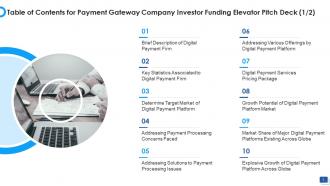
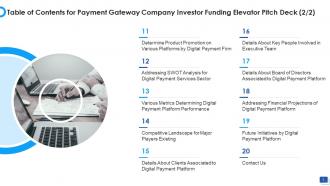
Slide 2: This slide presents Table of Content for the presentation.
Slide 3: This is another slide continuing Table of Content for the presentation.
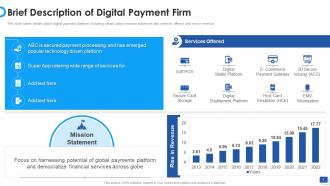
Slide 4: This slide caters details about digital payment platform including details about mission statement and services offered and rise in revenue.
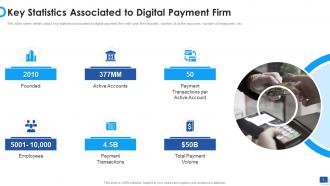
Slide 5: This slide caters details about key statistics associated to digital payment firm with year firm founded, number of active accounts, etc.
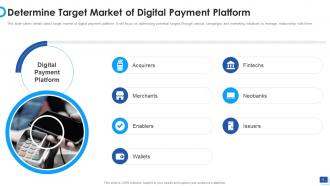
Slide 6: This slide caters details about target market of digital payment platform.
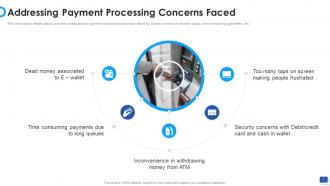
Slide 7: This slide caters details about concerns associated to payment processing procedure faced by clients in terms of security issues, etc.
Slide 8: This slide caters details about solutions in addressing payment processing concerns in terms of quick, secure payments.
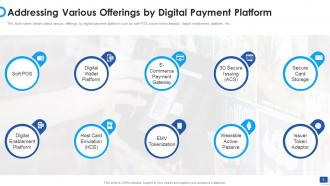
Slide 9: This slide caters details about various offerings by digital payment platform such as soft POS, issuer token adaptor, etc.
Slide 10: This slide caters details about pricing package of digital payment services rendered by firm.
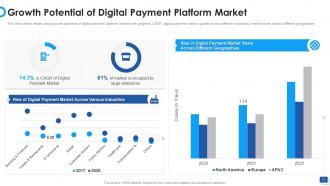
Slide 11: This slide caters details about growth potential of digital payment platform market with progress CAGR, etc.
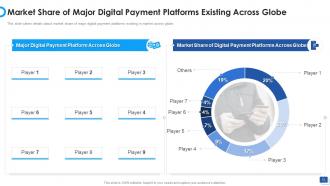
Slide 12: This slide caters details about market share of major digital payment platforms existing in market across globe.
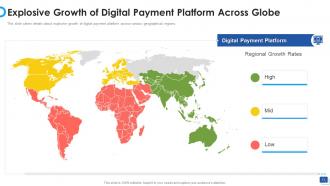
Slide 13: This slide caters details about explosive growth of digital payment platform across various geographical regions.
Slide 14: This slide caters details about promotion of various offerings on social media platforms by digital payment firm.
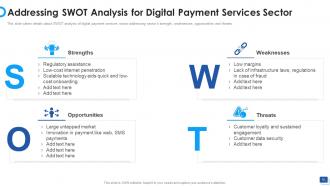
Slide 15: This slide caters details about SWOT analysis of digital payment services sector addressing sector’s strength, weaknesses, opportunities and threats.
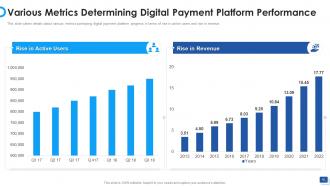
Slide 16: This slide caters details about various metrics portraying digital payment platform progress in terms of rise in active users and rise in revenue.
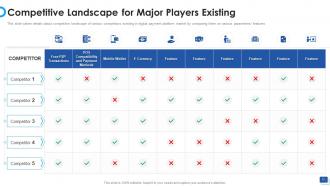
Slide 17: This slide caters details about competitive landscape of various competitors existing in digital payment platform market.
Slide 18: This slide caters details about clients associated to digital payment platform in terms of major clients and client testimonials.
Slide 19: This slide caters details about key people associated to executive team of digital payment firm responsible in making key strategic decisions.
Slide 20: This slide caters details about board of directors associated to digital payment platform.
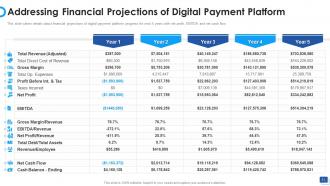
Slide 21: This slide caters details about financial projections of digital payment platform progress for next 5 years with net profit, EBITDA and net cash flow.
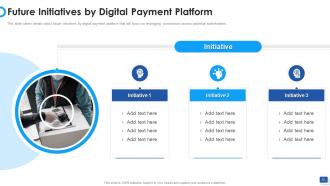
Slide 22: This slide caters details about future initiatives by digital payment platform that will focus on leveraging connections across potential stakeholders.
Slide 23: This slide presents contact details of the company.
Slide 24: This slide displays Icons for Payment Gateway Company Investor Funding Elevator Pitch Deck.
Slide 25: This slide is titled as Additional Slides for moving forward.
Slide 26: This is Our Mission slide with related imagery and text.
Slide 27: This is Our Team slide with names and designation.
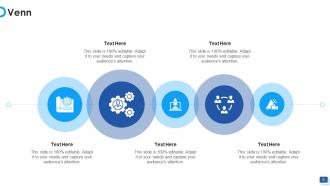
Slide 28: This slide depicts Venn diagram with text boxes.
Slide 29: This is Our Goal slide. State your firm's goals here.
Slide 30: This slide provides 30 60 90 Days Plan with text boxes.
Slide 31: This is a Comparison slide to state comparison between commodities, entities etc.
Slide 32: This slide presents Roadmap with additional textboxes.
Slide 33: This slide showcases Linear Diagram with related icons and text.
Slide 34: This slide shows Post It Notes. Post your important notes here.
Slide 35: This is a Thank You slide with address, contact numbers and email address.
Payment Gateway Company Investor Funding Elevator Pitch Deck Ppt Template with all 40 slides:
Use our Payment Gateway Company Investor Funding Elevator Pitch Deck Ppt Template to effectively help you save your valuable time. They are readymade to fit into any presentation structure.














FAQs for Payment Gateway Company Investor Funding Elevator Pitch
Honestly, compliance is what investors care about most - PCI DSS, money transmission licenses, all that regulatory stuff. One misstep and you're dead in the water. After that they'll dig into your transaction projections and how you plan to compete with Stripe (good luck lol). Security architecture is massive too since payments companies live or die by trust. Having a solid team helps because this space is brutal technically and legally. Oh and definitely get your compliance framework rock solid before any pitch meetings - I've seen way too many deals die there first.
So payment gateways basically need to pick their specialty to get investors interested. Most focus on weird niche industries, better tech, or specific regions. Like, you've got companies crushing it in high-risk stuff or B2B marketplaces where Stripe hasn't totally taken over yet. Others build amazing fraud detection or crazy fast settlements - anything that doesn't make merchants want to pull their hair out. Some just nail pricing for certain markets. Honestly, the geographic play can be huge if you know the local compliance stuff inside and out. Don't try competing everywhere though, that's a recipe for disaster.
Dude, transaction security can literally make or break your funding pitch. Investors are paranoid about this stuff - and honestly, they should be. One breach kills payment companies overnight. They'll dig deep into your PCI compliance, fraud detection, encryption, all of it. I've watched solid startups get rejected purely because their security docs looked sketchy. Customer trust, regulatory approval, revenue - it all flows from having bulletproof security. You need certifications, audit reports, incident response plans ready to go. Don't even think about pitching until your security house is in order. Trust me on this one.
So payment gateways can really impress investors by showing off their data game. Your fraud detection stats are pure gold - investors eat up those chargeback reduction numbers since they directly hit profits. Growth metrics from transaction volumes and customer retention tell your expansion story nicely. Plus, when you help merchants streamline their payment processes, they're way less likely to switch providers. The fraud prevention angle is honestly what gets VCs most excited because it's so tangible. Just make sure you've got clean dashboards that actually make sense - nobody wants to squint at messy charts during a pitch.
Dude, compliance isn't optional if you want payment gateway funding - VCs will literally run the other way without it. You'll need PCI DSS certification and solid KYC/AML processes. Financial licenses too, depending where you're operating. Investors check this stuff first because one compliance mess-up can kill your whole company overnight. It also proves you actually get how complex this industry is and won't do anything stupid while scaling. Oh, and budget big for compliance upfront - my cousin learned this the hard way. It's pricey but there's no way around it.
Right now everyone's throwing money at AI fraud detection stuff - that's where the real action is. Cross-border payments are huge too if you can make them faster/cheaper than the old systems. BNPL is still getting funding but honestly feels a bit overdone at this point. Blockchain payment tech and those embedded finance APIs are hot. Biometric authentication is solid too. Here's the thing though - investors want to see actual numbers. Like, can you prove your system cuts transaction time by 40%? Makes things 30% cheaper? That concrete stuff is what gets people to open their wallets, not just flashy tech demos.
Dude, UX is everything when it comes to getting investors interested. Nobody wants to back a payment gateway that's slow or confusing - merchants will just bounce to competitors. I've literally watched great payment companies fail because their checkout process was a nightmare. You need to show smooth flows, quick processing, and clean design. Cart abandonment kills profits, so if you can prove your UX actually improves conversion rates, investors will pay attention. Oh, and make sure you have real numbers to back it up when you pitch. They love concrete data.
Most payment startups go the equity route - you get ownership but won't see returns for like 5-7 years until someone buys them out. Revenue-based deals are becoming more common though, where you get a cut of their transaction fees as steady income. Some do convertible notes at first too. Here's the thing - these companies need massive upfront cash for compliance stuff and infrastructure. But honestly, once they scale up? The recurring revenue is pretty solid. I'd focus on ones that already have good regulatory standing and merchant connections locked down. Way less risky that way.
Dude, scalability is huge for payment gateway investors - honestly might be the biggest thing they care about. Your transaction volume could explode but your infrastructure costs can't explode with it, you know? That's the whole game. Show them you've got a real plan for handling like 10x growth without breaking the bank. Payment processing is basically all economies of scale anyway - more volume should mean lower costs per transaction, not higher. Investors eat that stuff up. Just don't wing it in your pitch, have actual numbers ready.
Look, embedded finance and BNPL integrations are where all the money's going right now. Cross-border payments too. Smart investors are throwing cash at anything that cuts fraud costs or makes settlements faster - which honestly makes sense. Regulatory compliance is massive since nobody wants to get blindsided by new rules. Real-time payments and crypto gateways aren't special anymore, they're just expected. Oh, and API quality matters way more than people think. Focus on platforms handling multiple payment methods smoothly. Those scale the fastest from what I've seen.
Dude, investors totally follow regional payment trends when funding gateways. Mobile wallets crush it in Southeast Asia, so that's where the money flows. Europe's obsessed with SEPA transfers and compliance stuff - kinda dry but makes bank. Cash still rules Latin America (crazy right?), so cash-to-digital platforms get the love there. The US stays laser-focused on credit cards and stopping fraud. Here's the thing though - you gotta research what payment methods actually dominate your target region first. Investors want proof you get how locals pay for stuff, not just your fancy tech details.
Look, investors get spooked by three big things with payment processing. Regulatory stuff is a total maze - one wrong move and you're screwed. Then there's competing against giants like Stripe, which honestly seems impossible sometimes. Security breaches? That's basically a death sentence. Here's what actually works though: nail your compliance early (PCI DSS isn't optional), pick a specific niche instead of trying to be everything to everyone, and build fortress-level security. Get some fintech veterans involved - their credibility helps tons. Most crucial part? Show solid unit economics. Yeah, margins are thin, but if you can prove you'll capture decent market share in your vertical, investors start listening.
Dude, partnering with banks is like getting a golden ticket. They've got all the regulatory stuff figured out, plus existing customers who already trust them. That credibility rubs off on you big time. The really smart move? Target smaller regional banks or credit unions first - they're way more flexible than the giants. Banks often have investment arms too, so they can connect you with VCs who actually get fintech. Honestly, in this industry where everyone's paranoid about compliance, having a bank basically say "yeah, these guys are legit" opens so many doors.
Investors are way more picky now because fintech startups keep eating everyone's lunch. These new companies move crazy fast and their apps actually don't suck, plus they're cheaper to run. Makes the old payment companies look kinda ancient, tbh. But traditional gateways aren't totally screwed - they've got solid enterprise clients and actually know how to deal with regulations without breaking things. When you're talking to investors, don't just list features that any dev team can build in six months. Focus on what genuinely makes you harder to copy or replace.
Alright so investors are gonna drill you on four main things. Transaction volume and growth rate first - they wanna see real money flowing through your system. Monthly recurring revenue is clutch because it shows predictable cash flow. The churn rate conversation is brutal but you gotta have those retention numbers ready. Your take rate matters too (what percentage you pocket per transaction) - compare it to Stripe or Square so you look competitive. Oh and definitely create a dashboard with 12-month trends. Investors get way more excited about consistent growth patterns than just current numbers. Makes the whole pitch feel more legit.
-
Great work on designing the presentation. I just loved it!
-
I discovered some really original and instructive business slides here. I found that they suited me well.