


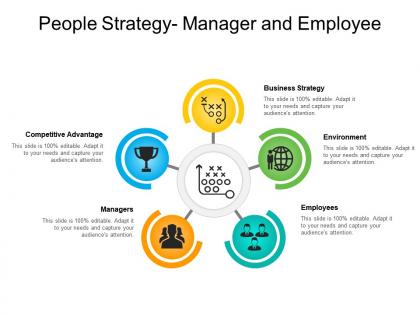
People strategy manager and employee




Try Before you Buy Download Free Sample Product
 Impress Your
 Audience
 100%
100% Editable
 Save Hours
 of Time


Canvass for your cause with our People Strategy Manager And Employee. They will help bring in the votes for you.
People who downloaded this PowerPoint presentation also viewed the following :
People strategy manager and employee with all 5 slides:
Engage our People Strategy Manager And Employee for your purpose. They will stay committed to their promise.


FAQs for People strategy
Key factors driving employee engagement include meaningful work, recognition and feedback, career development opportunities, flexible work arrangements, and strong leadership communication. These elements work together by fostering trust, autonomy, and purpose, with many organizations finding that companies prioritizing these factors experience significantly higher productivity, retention rates, and competitive advantage in talent acquisition.
Organizations can effectively measure employee engagement through pulse surveys, one-on-one meetings, performance metrics analysis, retention rates tracking, and 360-degree feedback systems. These measurement approaches enable companies to identify engagement gaps, monitor workforce satisfaction trends, and implement targeted interventions, with many organizations finding that regular assessment drives improved productivity and reduces costly turnover.
Leadership drives employee engagement through clear communication, recognition of achievements, professional development opportunities, and creating psychologically safe work environments. Effective leaders in organizations like tech companies and healthcare systems foster engagement by providing regular feedback, empowering decision-making autonomy, and aligning individual goals with company vision, ultimately delivering higher retention rates and improved performance.
Employee engagement significantly enhances organizational performance by increasing productivity, reducing turnover costs, and improving customer satisfaction scores. Engaged employees deliver higher quality work, generate more innovative solutions, and create better customer experiences, with many companies finding that highly engaged teams achieve 23% higher profitability and substantially lower absenteeism rates.
Remote work engagement strategies include flexible scheduling, virtual team building activities, regular one-on-one check-ins, collaborative digital platforms, and professional development opportunities. These approaches enhance communication, maintain company culture, and support work-life balance, with many organizations finding that combining structured feedback sessions with informal virtual interactions ultimately delivers higher productivity and employee satisfaction.
Feedback mechanisms enhance employee engagement by creating transparent communication channels, recognizing achievements regularly, and addressing concerns promptly. Through structured performance reviews, pulse surveys, and open-door policies, organizations streamline employee development, accelerate problem resolution, and ultimately deliver higher retention rates and productivity, with many companies finding that consistent feedback loops significantly strengthen workplace culture.
Common misconceptions about employee engagement include believing it's solely about employee happiness, that it's equivalent to job satisfaction, that perks and benefits drive engagement, that it's HR's responsibility alone, and that engagement surveys are sufficient measurement tools. These misunderstandings often lead organizations to implement surface-level solutions rather than addressing core engagement drivers like meaningful work, growth opportunities, and authentic leadership connections, ultimately missing opportunities for sustained productivity improvements and talent retention.
Diversity and inclusion initiatives significantly enhance employee engagement by creating psychological safety, fostering belonging, and leveraging diverse perspectives for innovation. These programs streamline collaboration across teams, reduce turnover costs, and accelerate decision-making processes, with many organizations finding that inclusive cultures ultimately deliver higher productivity, stronger talent retention, and improved competitive advantage in increasingly diverse markets.
Employee engagement and retention share a strong positive correlation, with engaged employees being significantly more likely to remain with their organizations long-term. Highly engaged workers demonstrate greater job satisfaction, emotional commitment, and alignment with company values, which naturally reduces turnover intentions and costs while enhancing organizational stability, institutional knowledge preservation, and competitive advantage in talent retention.
Training and development opportunities boost employee engagement by demonstrating organizational investment in career growth, providing clear advancement pathways, and enhancing job satisfaction through skill building. Companies implementing comprehensive learning programs experience reduced turnover, increased productivity, and stronger retention rates, with employees feeling more valued and motivated when organizations prioritize their professional development and future success.
Innovative employee engagement activities include gamified learning platforms, virtual reality team building, peer recognition apps, innovation hackathons, and flexible workspace initiatives. These approaches enhance collaboration, creativity, and job satisfaction by fostering continuous learning, cross-departmental connections, and personalized work experiences, with many organizations finding that such strategic investments ultimately deliver improved retention rates and competitive talent advantage.
Company culture shapes employee engagement by establishing shared values, creating psychological safety, and defining workplace expectations that directly influence motivation and commitment. Organizations with strong cultures see higher retention, improved performance, and increased productivity, with many companies finding that authentic leadership, recognition programs, and collaborative environments ultimately deliver competitive advantage through engaged workforces.
Recognition and rewards significantly enhance employee engagement by acknowledging contributions, reinforcing desired behaviors, motivating continued performance, and fostering emotional connection to organizational goals. Through strategic recognition programs, companies across sectors like healthcare, retail, and financial services streamline retention efforts while delivering improved productivity, reduced turnover costs, and stronger workplace culture, ultimately creating competitive advantage through engaged talent.
Technology enhances employee engagement through digital communication platforms, performance management systems, learning and development tools, recognition software, and data analytics platforms. These solutions streamline feedback processes, enable personalized career development, and facilitate real-time recognition, with many organizations finding that integrated technology approaches deliver improved retention rates and higher productivity levels.
Employee engagement significantly impacts customer satisfaction and loyalty by creating more motivated teams who deliver superior service experiences, respond more effectively to customer needs, and maintain consistent quality standards. Engaged employees in retail, hospitality, and financial services demonstrate greater problem-solving initiative, build stronger customer relationships, and reduce service errors, ultimately delivering higher retention rates and increased customer lifetime value for organizations.
-
Understandable and informative presentation.
-
The content is very helpful from business point of view.