


Performance management examples powerpoint ideas





Try Before you Buy Download Free Sample Product
 Impress Your
 Audience
 100%
100% Editable
 Save Hours
 of Time


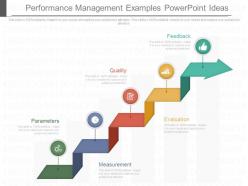
Get back to buoyant conditions with our Performance Management Examples Powerpoint Ideas. They help bring down deficits.
People who downloaded this PowerPoint presentation also viewed the following :
Performance management examples powerpoint ideas with all 5 slides:
Get feelings of hatred to disappear with our Performance Management Examples Powerpoint Ideas. They help bring back the harmony.

FAQs for Performance management
Effective KPIs for sales teams include revenue per representative, conversion rates, customer acquisition costs, average deal size, and sales cycle length. These metrics enable managers to assess individual productivity, identify coaching opportunities, and optimize territory allocation, with many organizations finding that combining activity-based measures with outcome-focused KPIs delivers comprehensive performance insights and drives competitive advantage.
Performance management systems for remote employees can be tailored through flexible goal-setting frameworks, digital check-in platforms, outcome-based evaluations, and virtual collaboration assessments. These approaches enhance remote workforce engagement by emphasizing results over hours worked, incorporating asynchronous feedback mechanisms, and measuring digital communication effectiveness, with many organizations finding that remote-specific metrics ultimately deliver greater employee satisfaction and productivity outcomes.
Continuous feedback enhances employee performance by providing real-time guidance, addressing issues immediately, and reinforcing positive behaviors consistently. Through regular check-ins and coaching conversations, organizations streamline development processes, accelerate skill building, and strengthen manager-employee relationships, with many companies finding that ongoing dialogue ultimately delivers higher engagement and improved business outcomes.
Organizations balance quantitative and qualitative measures by establishing weighted evaluation frameworks that combine measurable metrics like sales targets, productivity rates, and attendance with subjective assessments of leadership, communication, and teamwork skills. This strategic combination enables comprehensive employee reviews that capture both hard results and soft skills, with many companies finding that balanced scorecards ultimately deliver more accurate performance insights and better development outcomes.
Best practices for conducting performance appraisal meetings include preparing thoroughly with documented examples, creating a collaborative two-way dialogue, setting specific future goals, and focusing on development rather than criticism. These approaches enhance employee engagement by encouraging honest feedback, addressing concerns constructively, and establishing clear expectations, with many organizations finding that structured conversations improve retention and performance outcomes significantly.
Technology streamlines performance management through automated goal tracking, real-time feedback platforms, data analytics dashboards, and integrated communication tools. These systems enhance efficiency by eliminating manual processes, providing continuous performance insights, and enabling managers to make data-driven decisions, with many organizations finding that digital solutions ultimately deliver faster reviews and improved employee engagement across departments.
Common performance management pitfalls include unclear expectations, infrequent feedback, bias in evaluations, lack of goal alignment, and insufficient documentation. These challenges can be avoided by establishing clear objectives, conducting regular check-ins, implementing structured review processes, and providing comprehensive manager training, with many organizations finding that consistent communication and objective criteria ultimately enhance employee engagement and organizational performance.
Setting specific, measurable goals significantly enhances team motivation by providing clear direction, enabling progress tracking, and creating accountability frameworks that drive focused effort. Through transparent metrics and defined outcomes, teams experience increased engagement, improved collaboration, and stronger ownership of results, with many organizations finding that structured goal-setting delivers higher performance levels and sustained competitive advantage.
Managers can address underperformance through clear goal-setting, regular feedback sessions, skills assessments, targeted training programs, and performance improvement plans with specific timelines. These strategies enable organizations to identify root causes, provide necessary support, and establish measurable outcomes, with many companies finding that early intervention and consistent communication ultimately enhance employee development and retain valuable talent.
Peer feedback contributes to holistic performance evaluation by providing multiple perspectives on collaboration skills, teamwork effectiveness, communication abilities, and day-to-day work interactions that managers rarely observe directly. This 360-degree approach enables organizations to identify leadership potential, improve cross-functional relationships, and enhance overall team dynamics, ultimately delivering more accurate assessments and targeted professional development opportunities.
Organizations should handle performance reviews for diverse teams by implementing culturally sensitive evaluation criteria, providing cultural competency training for managers, and incorporating multiple feedback perspectives that account for different communication styles. Companies like Microsoft and Unilever have successfully adapted their review processes to include cultural context awareness, flexible communication approaches, and bias-reduction techniques, ultimately delivering more equitable assessments and enhanced team performance across global operations.
Aligning individual performance goals with business objectives ensures employees contribute directly to organizational success, creating unified direction, improved accountability, and measurable impact on strategic outcomes. This strategic alignment enhances employee engagement, streamlines resource allocation, and accelerates goal achievement, with many organizations finding that connected performance frameworks deliver significantly higher productivity and competitive advantage.
Self-assessments enhance performance management by encouraging employee reflection, identifying development areas, and creating more balanced evaluations through combined manager and self-perspectives. When integrated strategically, they streamline review conversations, increase employee engagement, and provide valuable insights into individual goals and challenges, with many organizations finding that this approach ultimately delivers more comprehensive performance discussions and stronger professional development outcomes.
Employee development serves as a cornerstone of effective performance management strategies, enabling skill enhancement, career progression, knowledge transfer, and succession planning within organizations. Through targeted training programs, mentorship initiatives, and cross-functional assignments, companies streamline talent retention while enhancing operational efficiency, with many financial services and healthcare institutions finding that strategic development investments ultimately deliver improved employee engagement and competitive market positioning.
Organizations ensure fairness and objectivity in performance ratings through standardized evaluation criteria, multiple reviewer perspectives, calibration sessions, and structured feedback processes. These approaches minimize bias by establishing clear performance metrics, incorporating peer and customer input, and conducting regular manager training on objective assessment techniques, ultimately delivering more accurate evaluations and enhanced employee trust.
-
The Designed Graphic are very professional and classic.
-
Thanks for all your great templates they have saved me lots of time and accelerate my presentations. Great product, keep them up!