


Performance metric powerpoint presentation slides




Try Before you Buy Download Free Sample Product
 Impress Your
 Audience
 100%
100% Editable
 Save Hours
 of Time


Get access to the best parameters to assess organizational ability using Performance Metrics PowerPoint Presentation. Use our performance measurement PPT theme to obtain stimulating visuals to represent your company appraisal. Managers and supervisors can take advantage of this performance management PowerPoint slideshow to demonstrate the use and implementation of performance evaluation. Our performance review PPT will help you elucidate the balanced scorecard strategy for operational assessment. You can use the graphics of performance metrics PPT theme to highlight sales metrics, financial metrics, and general business metrics. This business assessment PowerPoint template is an ideal way to emphasize the performance issues with your company and offer relief. Using the diagrams and flowcharts of this performance review PPT, you can compile an astounding and convincing presentation. Communicate various areas of evaluation and the performance metric involved only through this balanced scorecard strategy PowerPoint presentation. So, download the operational measurement PPT and develop your performance management strategy.
People who downloaded this PowerPoint presentation also viewed the following :
Content of this Powerpoint Presentation
Slide 1: This slide introduces Performance Metric. State your Company name and begin.
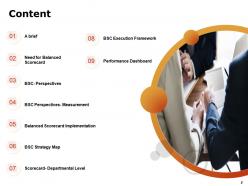
Slide 2: This slide displays the Content of the presentation.
Slide 3: This slide depicts Concept describing performance.
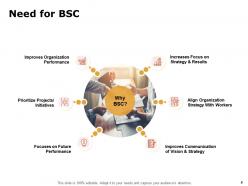
Slide 4: This slide showcases Need for BSC with related reasons.
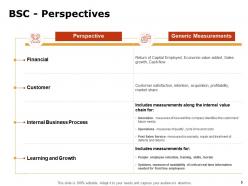
Slide 5: This slide showcases BSC - Perspectives with- Perspective, Generic Measurements.
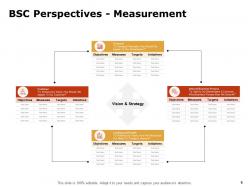
Slide 6: This slide showcases BSC Perspectives with Measurement, Vision & Strategy
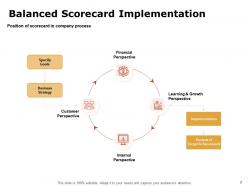
Slide 7: This slide showcases Balanced Scorecard Implementation.
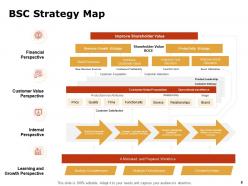
Slide 8: This slide showcases BSC Strategy Map
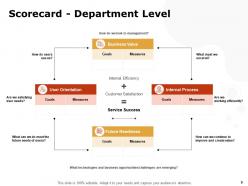
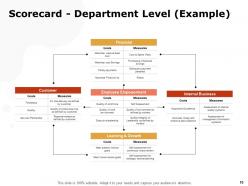
Slide 9: This slide depicts Scorecard - Department Level.
Slide 10: This slide showcases Scorecard - Department Level with Examples.
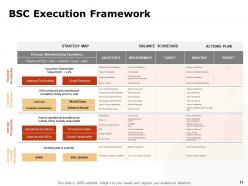
Slide 11: This slide showcases BSC Execution Framework.
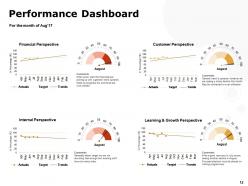
Slide 12: This slide depicts Performance Dashboard.
Slide 13: This slide shows Performance Metric Icons Slide.
Slide 14: This slide is titled as Additional Slides.
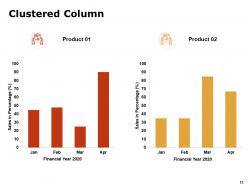
Slide 15: This slide showcases Clustered Column with products comparisons.
Slide 16: This is About Us slide to showcase Company specifications.
Slide 17: This is Our Awesome Team slide with names and designations.
Slide 18: This is Our Mission slide with Vision, Mission and Goals.
Slide 19: This is Thank You slide with Address, Email address and Contact number.
Performance metric powerpoint presentation slides with all 19 slides:
Use our Performance Metric Powerpoint Presentation Slides to effectively help you save your valuable time. They are readymade to fit into any presentation structure.







FAQs for Performance metric
Key performance metrics include revenue growth, customer acquisition cost, customer lifetime value, profit margins, and cash flow. These metrics streamline decision-making by providing comprehensive visibility into financial health, operational efficiency, and market position, with many organizations finding that tracking these fundamentals ultimately delivers competitive advantage and sustainable growth.
Qualitative metrics complement quantitative performance metrics by providing context, understanding stakeholder perceptions, and revealing the "why" behind numerical data through feedback, satisfaction surveys, and behavioral observations. While quantitative metrics deliver measurable outcomes like revenue growth and efficiency rates, qualitative insights enable organizations to understand customer experiences, employee engagement, and operational challenges, ultimately creating a comprehensive view that drives strategic decision-making and sustainable improvement.
Performance metrics drive strategic decision-making by providing data-driven insights for resource allocation, identifying growth opportunities, and measuring progress against organizational goals. Through comprehensive analytics dashboards, companies can pivot strategies, optimize operations, and allocate budgets more effectively, with many organizations finding that consistent metric tracking enables faster responses to market changes, ultimately delivering competitive advantage and sustainable growth.
Selecting relevant performance metrics requires analyzing your industry's core value drivers, customer expectations, regulatory requirements, and competitive landscape, while aligning with strategic business objectives. Industries like healthcare focus on patient outcomes and safety metrics, while retail emphasizes conversion rates and customer lifetime value, with successful organizations combining leading indicators with lagging results to drive meaningful performance improvements.
Benchmarking enables organizations to evaluate their performance metrics against industry standards, competitor practices, and best-in-class performers, providing crucial context for metric effectiveness. Through comparative analysis, companies identify gaps in their measurement approaches, validate metric relevance, and discover optimization opportunities, with many finding that external benchmarking transforms internal metrics from simple tracking tools into strategic competitive advantages.
Performance metrics help identify operational improvement areas by revealing bottlenecks, inefficiencies, resource allocation gaps, and process variations through data-driven analysis and benchmarking. These measurements enable organizations to pinpoint specific workflows, departments, or systems requiring attention, with many manufacturing and service companies finding that targeted metrics ultimately streamline operations, reduce costs, and enhance overall productivity.
Common pitfalls include focusing on vanity metrics without business impact, ignoring context and benchmarks, cherry-picking favorable data, and failing to consider external factors affecting results. While these mistakes can mislead strategic decisions, organizations implementing comprehensive metric frameworks with balanced scorecards and regular validation processes ultimately deliver more accurate insights, enabling better resource allocation and competitive advantage in increasingly data-driven markets.
Performance metrics should be reviewed monthly or quarterly for operational measures, while strategic metrics require quarterly or annual assessment depending on business cycles and industry dynamics. This balanced approach enables organizations to maintain agility in fast-changing markets, optimize resource allocation based on current data, and ensure metrics remain aligned with evolving business objectives, ultimately delivering sustained competitive advantage.
Employee performance metrics directly correlate with company performance through productivity measurement, goal alignment, quality control, and strategic execution tracking. When organizations systematically measure individual contributions, they enhance operational efficiency, accelerate decision-making, and optimize resource allocation, with many companies finding that comprehensive performance tracking ultimately delivers improved financial results and competitive advantage.
AI and machine learning enhance performance metrics analysis by automating data processing, identifying hidden patterns, and providing predictive insights that traditional methods miss. These technologies enable organizations to analyze vast datasets in real-time, detect anomalies automatically, and generate actionable recommendations, with many companies finding significantly faster decision-making and improved operational efficiency.
Performance metrics visualization best practices include using clear chart types, maintaining consistent color schemes, focusing on key trends rather than overwhelming detail, and ensuring data accuracy with proper scaling. These approaches enhance audience comprehension by presenting complex performance data through intuitive dashboards, comparative charts, and progressive disclosure techniques, ultimately delivering clearer insights and faster decision-making for stakeholders across organizations.
Performance metrics can be effectively communicated through visual dashboards, regular reporting cycles, contextualized presentations, and interactive data tools that translate complex data into actionable insights. Organizations across industries streamline stakeholder engagement by combining automated reporting with narrative explanations, ensuring metrics align with strategic objectives, and ultimately delivering enhanced transparency, improved decision-making, and stronger organizational alignment.
**INPUT**: What metrics are most useful in measuring customer satisfaction and loyalty? **OUTPUT**: Key metrics include Net Promoter Score (NPS), Customer Satisfaction Score (CSAT), Customer Effort Score (CES), retention rates, and lifetime value calculations. These measurements enable organizations to streamline customer experiences, enhance service delivery, and identify improvement opportunities, with many retail and financial services companies finding that combining multiple metrics delivers more comprehensive insights than relying on single indicators alone.
Social media performance metrics integrate into broader marketing strategies through attribution modeling, customer journey mapping, cross-channel performance analysis, and audience segmentation insights. These metrics enable marketers to optimize budget allocation across channels, refine targeting strategies, and measure comprehensive campaign ROI, with many organizations finding that integrated analytics ultimately deliver more cohesive customer experiences and strategic competitive advantage.
Ethical considerations include ensuring fairness across diverse employee groups, maintaining transparency in metric selection and evaluation processes, protecting employee privacy and data security, avoiding discriminatory bias in measurements, and preventing excessive surveillance that undermines trust. These practices enable organizations to build inclusive performance cultures while balancing accountability with employee well-being, ultimately delivering sustainable productivity and stronger workplace relationships.
-
Graphics are very appealing to eyes.
-
It saves your time and decrease your efforts in half.
-
Illustrative design with editable content. Exceptional value for money. Highly pleased with the product.
-
Unique design & color.