


Performance Planning Powerpoint Presentation Slides





Try Before you Buy Download Free Sample Product
 Impress Your
 Audience
 100%
100% Editable
 Save Hours
 of Time


Introducing Performance Planning PowerPoint Presentation Slides which helps you to increase your performance graph in the market. You can check the mistakes present in the project and remove them by using our performance review PowerPoint presentation decks. This performance management PPT presentation templates includes various steps such as monitoring the work of an employee, staff ability, audit programs, process documentation, grow sales, productivity, profitability, etc. which helps an organization to attain their target. The professionally designed performance coaching PowerPoint slideshow contains sixty-one slides to formulate the topic with sound understanding. This performance measurement PPT presentation includes ready-to-use PowerPoint templates on organizing frameworks like gathering, interpreting, reporting, and measuring the total productivity and economy of the project. Use charts, graphs, sheets, diagrams, slides given in performance review presentation decks to create your development plan in minutes. Therefore, download this ready-to-use operational performance management PPT deck and achieve your goal in an adequate manner.
People who downloaded this PowerPoint presentation also viewed the following :
Content of this Powerpoint Presentation
Slide 1: This slide introduces Performance Planning. State Your Company Name and begin.
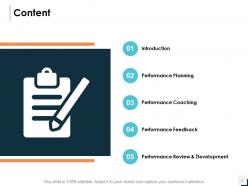
Slide 2: This slide shows Content of the presentation.
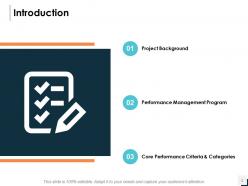
Slide 3: This is an Introduction slide describing- Project Background, Performance Management Program, Core Performance Criteria & Categories.
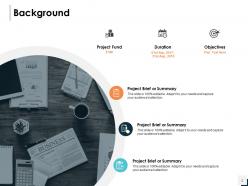
Slide 4: This slide showcases Background with- Project Fund, Duration, Objectives, Project Brief or Summary, Expected Outcomes, Core Performance Criteria & Categories.
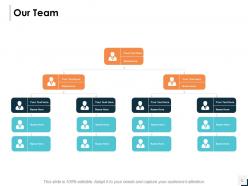
Slide 5: This is Our Team slide with names and designation.
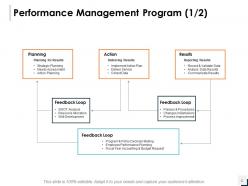
Slide 6: This slide shows Performance Management Program with- Planning, Action, Results, Feedback Loop.
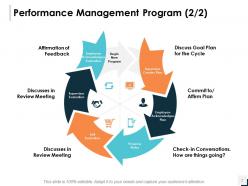
Slide 7: This is another slide describing Performance Management Program.
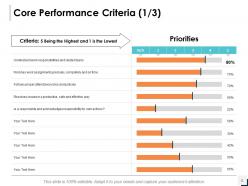
Slide 8: This slide presents Core Performance Criteria priority wise.
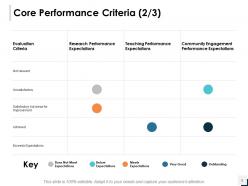
Slide 9: This slide displays Core Performance Criteria rating wise.
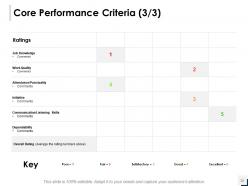
Slide 10: This is another slide on Core Performance Criteria. You can add or edit data as per requirements.
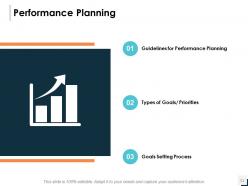
Slide 11: This slide represents Performance Planning describing- Guidelines for Performance Planning, Types of Goals/ Priorities, Goals Setting Process.
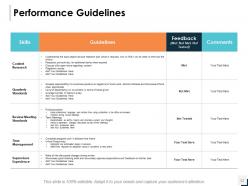
Slide 12: This slide shows Performance Guidelines in a tabular form.
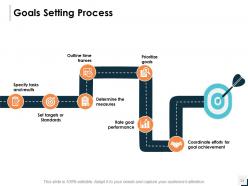
Slide 13: This slide displays Goals Setting Process describing- Specify Tasks and Results, Set Targets or Standards, Determine the Measures, Outline Time Frames, Rate Goal Performance, Coordinate Efforts for Goal Achievement, Prioritize Goals.
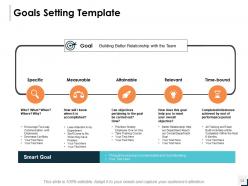
Slide 14: This slide represents Goals Setting Template describing- Specific, Measurable, Attainable, Relevant, Time-Bound.
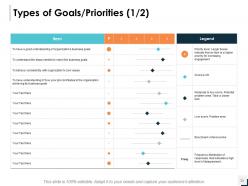
Slide 15: This slide presents Types of Goals/Priorities. You can add or edit goals and their priorities as per requirements.
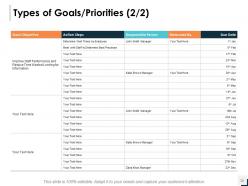
Slide 16: This is another slide describing Types of Goals/Priorities.
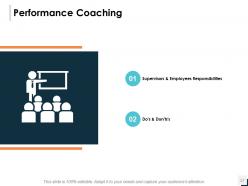
Slide 17: This slide displays Performance Coaching with related imagery.
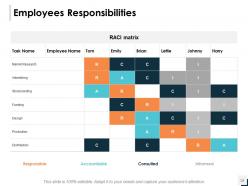
Slide 18: This slide represents Employees Responsibilities in a matrix form.
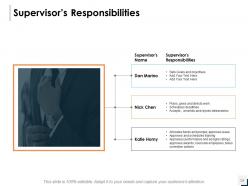
Slide 19: This slide showcases Supervisor’s Responsibilities in tabular form.
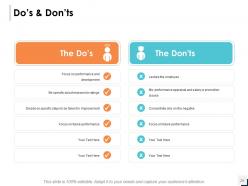
Slide 20: This slide shows Do’s & Don’ts. You can add or edit data as per requirements.
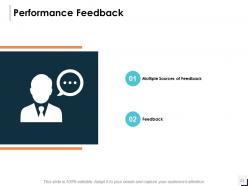
Slide 21: This slide presents Performance Feedback with related imagery.
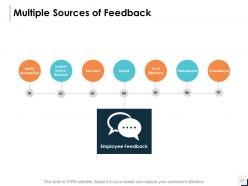
Slide 22: This slide displays Multiple Sources of Feedback as- Peers, Subordinates, Suppliers, Customers, Team Members, Line Managers, Direct Reports.
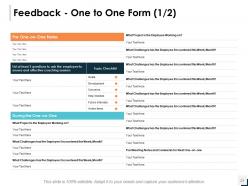
Slide 23: This slide represents Feedback - One to One Form. You can add or edit data as per requirements.
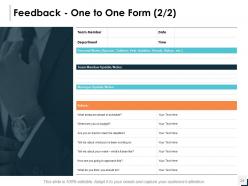
Slide 24: This is another slide for Feedback - One to One Form.
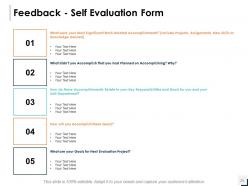
Slide 25: This slide showcases Feedback - Self Evaluation Form.
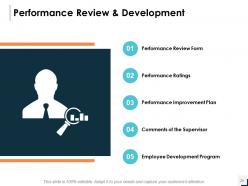
Slide 26: This slide displays Performance Review & Development with related imagery.
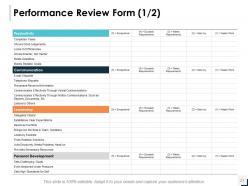
Slide 27: This slide shows Performance Review Form with categories as Productivity, Communication, Leadership and Personal development.
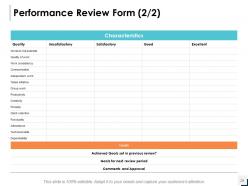
Slide 28: This is another slide with Performance Review Form describing characteristics.
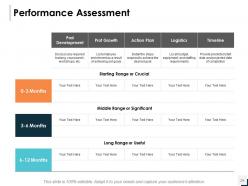
Slide 29: This slide presents Performance Assessment in a tabular form.
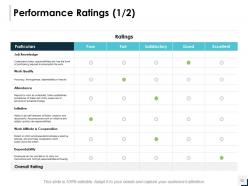
Slide 30: This slide displays Performance Ratings in a tabular form with rating scale from poor to excellent.
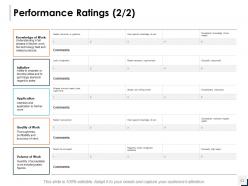
Slide 31: This is another slide on Performance Ratings. You can add or edit text as per requirements.
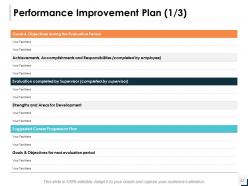
Slide 32: This slide represents Performance Improvement Plan in tabular form with additional text boxes.
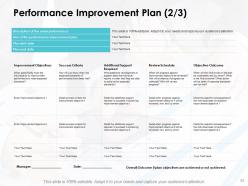
Slide 33: This slide showcases Performance Improvement Plan describing Improvement objectives, Success Criteria, Additional support required, review schedule and objective outcome.
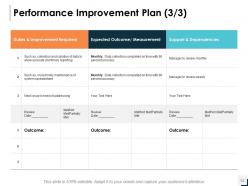
Slide 34: This slide shows Performance Improvement Plan with duties and improvement required, expected outcome/measurement, support and dependencies.
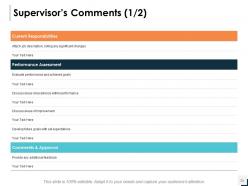
Slide 35: This slide presents Supervisor’s Comments with categories as Current responsibilities, Performance assessment. Comments & approval.
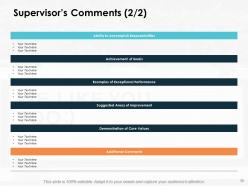
Slide 36: This is another slide on Supervisor’s Comments in tabular form.
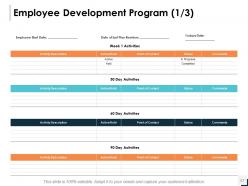
Slide 37: This slide displays Employee Development Program with weekly, 30 day, 60 day, and 90 day activities.
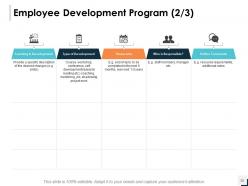
Slide 38: This is another slide on Employee Development Program with categories as Learning & development, Type of development, Timescales, person responsible, Comments.
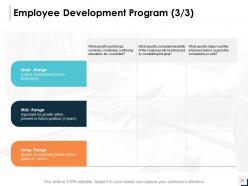
Slide 39: This is another slide on Employee Development Program in a matrix form.
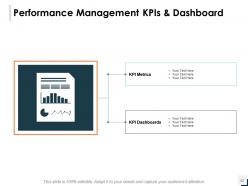
Slide 40: This slide displays Performance Management KPIs & Dashboard with related imagery.
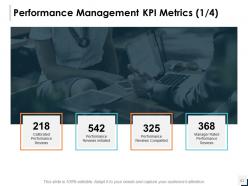
Slide 41: This slide shows Performance Management KPI Metrics with imagery and text.
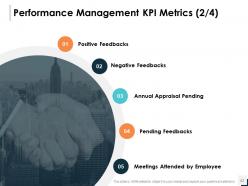
Slide 42: This slide presents Performance Management KPI Metrics describing- Positive Feedbacks, Negative Feedbacks, Annual Appraisal Pending, Pending Feedbacks, Meetings Attended by Employee.
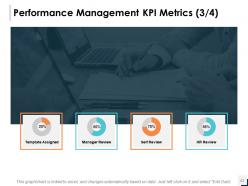
Slide 43: This is another slide on Performance Management KPI Metrics with donut pie chart.
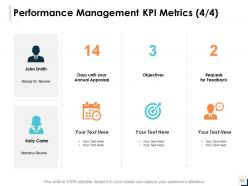
Slide 44: This slide represents Performance Management KPI Metrics with person for review and person who needs a review.
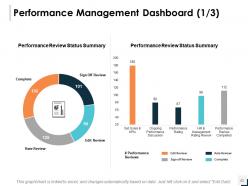
Slide 45: This slide showcases Performance Management Dashboard with donut pie chart and bar graph.
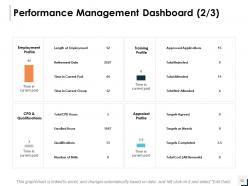
Slide 46: This slide shows Performance Management Dashboard with categories as- Employment Profile, Training Profile, CPD & Qualifications, Appraisal Profile.
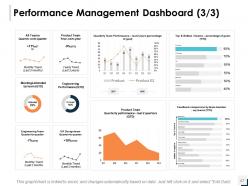
Slide 47: This slide presents Performance Management Dashboard with the help of graphs.
Slide 48: This slide displays Performance Appraisal Icons.
Slide 49: This slide is titled as Additional Slides for moving forward.
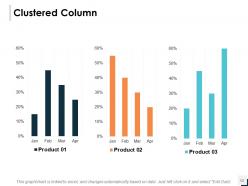
Slide 50: This slide shows Clustered Column chart with three products comparison.
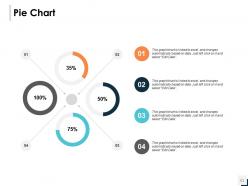
Slide 51: This slide displays Pie Chart with data in percentage.
Slide 52: This slide reminds about a Coffee Break.
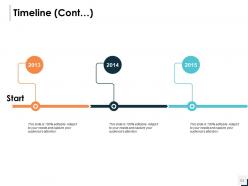
Slide 53: This is a Timeline slide to show information related with time period.
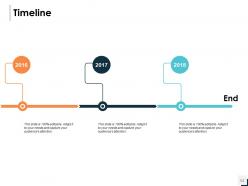
Slide 54: This is another slide continuing Timeline.
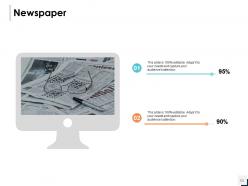
Slide 55: This slide shows Newspaper to show your firm's news.
Slide 56: This slide is titled as Post It Notes. Post your important notes here.
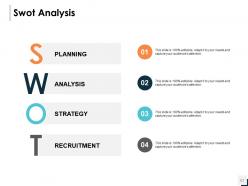
Slide 57: This slide shows Swot Analysis.
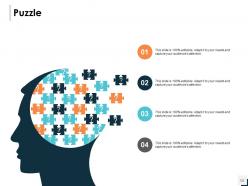
Slide 58: This is a Puzzle slide with text boxes.
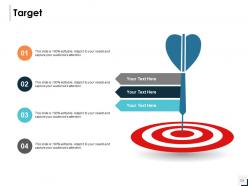
Slide 59: This is a Target slide. State your targets here.
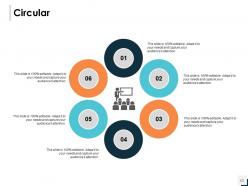
Slide 60: This slide shows Circular diagram with text boxes.
Slide 61: This is a Thank You slide with address, contact numbers and email address.
Performance Planning Powerpoint Presentation Slides with all 61 slides:
Use our Performance Planning Powerpoint Presentation Slides to effectively help you save your valuable time. They are readymade to fit into any presentation structure.



FAQs for Performance Planning
Okay so for your performance template, definitely throw in SMART goals - you know, the specific measurable stuff. I always mess up the "realistic" part too but whatever. Add sections for skills they need to work on, success metrics, and development opportunities. Oh and obstacles + how to deal with them, plus regular check-ins throughout the year. Honestly though? Keep it short - like one page max. Nobody wants to fill out a novel, and if it's too long people will just half-ass it. Focus on what actually moves the needle instead of creating more busy work.
Honestly, it's pretty straightforward - just connect what people do daily to what the company actually needs to hit. Break down those big strategic goals into stuff each person can realistically work toward. Don't get me wrong, quotas and metrics still count, but people need to see how their work moves things forward. Cascade everything from leadership down so nobody's going rogue. I'd say check in quarterly too - things change fast and you don't want everyone working toward outdated priorities. The key is making sure people can draw that line between their tasks and business results.
Here's what works best for me: pick 3-5 metrics that actually tie to business results, not just vanity numbers that sound cool. Mix hard data (sales, deadlines, quality scores) with softer stuff like how well they collaborate or adapt to changes. Honestly, I've seen too many people track metrics that look impressive but don't mean anything. Focus on what connects directly to their daily work and team impact. You want things that are realistic too - there's nothing worse than setting someone up to fail with impossible targets. Behavioral stuff matters just as much as the numbers btw.
So individual goals are super personal - like what skills you need to work on or where you want your career to go. Team and org goals are the big picture stuff that everyone's working toward together. Here's the thing though - your personal goals should actually connect to those bigger team targets, otherwise you're basically just doing random stuff. I always start with what the company needs, then figure out how my own development fits into that. Makes the whole process way less pointless than those performance reviews that feel like total busywork, you know?
Honestly, feedback from your team is what makes performance planning actually useful instead of just busywork. Get their input when you're setting goals - they know better than anyone what's realistic given their daily workload. Regular check-ins throughout the year help catch problems early too. The trick is making people feel safe to tell you the truth about what's blocking them or what help they need. I learned this the hard way at my last job - formal reviews without ongoing conversations are basically useless. Start doing brief weekly or bi-weekly touchpoints now if you can.
Honestly, tech makes performance planning way less of a headache. You can automate goal tracking and get real-time feedback instead of waiting months. Tools like BambooHR or 15Five let you set SMART goals and send automatic check-in reminders - which is clutch because we all forget otherwise. The analytics are actually pretty neat too. They'll spot patterns you'd totally miss on your own. Your team gets better visibility into what's expected, plus they can track their own progress. I'd say just pick one platform and digitize whatever process you're using now. You'll see the difference immediately.
Honestly, start with what your team actually pulled off last quarter, not what you were hoping for. I always build in extra time because something will definitely blow up - learned that the hard way. Break those massive goals down so you can pivot early when things get weird. Your team knows where the real problems are, so ask them first before making your fancy plans. Oh, and look back at your last few attempts - where did you totally miss the mark? I used to be way too optimistic about timelines. Use that reality check to fix your assumptions this time around.
Quarterly reviews are the bare minimum, but monthly check-ins work way better. I'd even do bi-weekly if you can swing it. Those formal quarterly ones help with big picture stuff and adjusting targets when priorities shift. The shorter meetings though? That's where you actually get stuff done - catch problems before they blow up, give kudos when people nail something. Honestly, waiting three months to address issues is just asking for trouble. Set a calendar reminder right now, even if it's just grabbing coffee for 15 minutes. Trust me on this one.
Honestly, most managers mess up by being way too vague or setting goals that are either ridiculously easy or impossible. Make them specific and measurable - something that'll actually push your person without crushing them. Don't forget the "how" part either, not just what needs doing. Timeline matters too obviously. The development piece gets ignored constantly which drives me nuts because that's where real growth happens. Oh and please don't wait until the review period ends to check in - build in regular touchpoints. Basically write something you'd actually want for yourself, you know?
Honestly, ditch the annual review thing - it's pretty much useless. Set up monthly or quarterly check-ins instead where you actually talk about what's working and what isn't. Create space where people can tell you when they're stuck without feeling judged. Ask what they need help with, then actually help them (obvious but you'd be surprised how many managers skip that part). Oh, and don't pretend you have it all figured out. Share your own goals and when you screw up. People respect that way more than the perfect boss act. Start booking those one-on-ones this week before you forget.
So performance planning basically shows people how their daily grind actually matters for the big picture. Clear expectations are everything - nobody wants to guess what success looks like. Regular check-ins make a huge difference too because people want to feel heard, not ignored. I've seen this work really well when you let employees help build their own plans instead of just dropping requirements on them. Growth opportunities that match what they actually want? That's gold for keeping people motivated. Honestly, the whole "collaborative approach" thing sounds cheesy but it works way better than the top-down stuff.
You need to actually match the performance plan to what each person does day-to-day. Individual contributors should focus on skills and project work. Managers? Team development and strategic stuff. Senior folks need vision-setting goals. Honestly, most companies just copy-paste the same template for everyone - it's lazy and doesn't work. Think about it - a salesperson's success metrics are totally different from an engineer's. Figure out what "crushing it" looks like for each role first, then work backwards. That's way more effective than some generic checklist that doesn't mean anything to anyone.
Honestly, the biggest thing is sticking to actual job stuff - don't let anything creep in about age, gender, race, that kind of thing. Make your goals measurable, not just "Sarah has a good attitude" or whatever. Document everything too, because you'll need that paper trail later. Being consistent across similar roles is huge - can't have different standards for the same job. Oh, and be upfront about how you're evaluating people. I know it sounds basic but seriously, so many managers mess this up without realizing it. Keep everything tied directly to what they actually need to do for work.
So here's the thing - regular performance reviews help you spot your future leaders way before you actually need them. You'll start noticing who's crushing their goals AND how they're doing it. That matters more than people realize. Instead of scrambling when someone leaves, you already know who's ready to step up and who needs more coaching first. I'd definitely track career goals during these conversations too, not just current performance. Makes promotion decisions so much easier when you have real data instead of just winging it based on whoever speaks up the most in meetings.
Honestly, the best thing you can do is set super clear goals upfront and figure out where people might struggle before it becomes a mess. I always build in regular check-ins - like every few weeks, not just those awful annual reviews. Make sure your team actually has what they need to do their jobs well. Sometimes what looks like underperformance is just you giving someone an impossible workload, you know? Regular coaching helps too. The whole point is catching problems early so you're not scrambling later trying to fix something that's been broken for months.
-
Excellent template with unique design.
-
Helpful product design for delivering presentation.
-
Awesome use of colors and designs in product templates.
-
Really like the color and design of the presentation.
-
Unique design & color.
-
Good
-
Good