


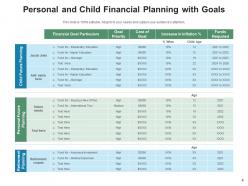
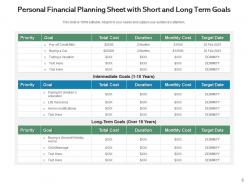
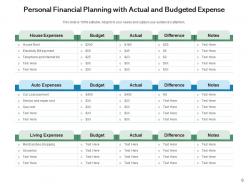
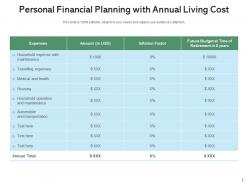
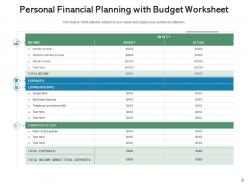
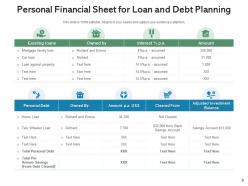
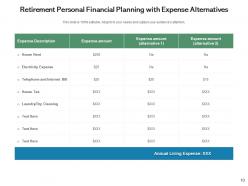
Personal financial planning income savings expenses goal priority amount




Try Before you Buy Download Free Sample Product
 Impress Your
 Audience
 100%
100% Editable
 Save Hours
 of Time


Our Personal Financial Planning Income Savings Expenses Goal Priority Amount are topically designed to provide an attractive backdrop to any subject. Use them to look like a presentation pro.
People who downloaded this PowerPoint presentation also viewed the following :
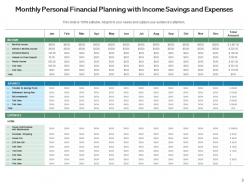
Personal financial planning income savings expenses goal priority amount with all 12 slides:
Use our Personal Financial Planning Income Savings Expenses Goal Priority Amount to effectively help you save your valuable time. They are readymade to fit into any presentation structure.

FAQs for Personal financial planning income savings expenses
Honestly, budgeting isn't rocket science - just track what comes in vs what goes out. Pay yourself first before you blow money on random stuff (trust me on this one). Build that emergency fund even if it's like $20 a month to start. Don't spend every penny you make, leave some breathing room. I'd write down where your money actually goes for a week - you'll probably hate what you find lol. Oh and automate everything you can, saves so much mental energy. Review monthly to see what's working.
Look, even $500 makes a huge difference when your car decides to die on you. I'd shoot for 3-6 months of expenses eventually, but don't stress about that number right now. Just start with whatever you can swing - $25 a week actually adds up faster than you think. Set up automatic transfers to a separate savings account so you won't accidentally blow it on takeout (guilty as charged). You probably have some random subscription you forgot about anyway - cancel that. Once you hit your first $1,000, it's honestly addictive. You'll want to keep building it.
So there's two ways people usually go about this - debt snowball or debt avalanche. Snowball means you knock out the smallest debts first, which feels pretty good honestly. Avalanche targets the highest interest rates instead, saves you more cash overall. I'd probably go avalanche route but whatever keeps you motivated, you know? Also dump any extra money you get into it - tax refunds, random bonuses, whatever. Oh and if you've got credit cards with crazy rates, maybe look into consolidating those. The trick is just sticking with whichever method you pick.
So investing can definitely help your money grow way faster than just leaving it in savings - plus it actually beats inflation over time. Compound growth is where the magic happens for building wealth. But real talk, there's risk involved. You could lose money, markets get crazy volatile sometimes. Biggest mistake newbies make? Panicking and selling when things dip, or thinking they can time the market perfectly (spoiler: they can't). I'd honestly start with index funds instead of picking random stocks - way less stressful and you don't need to research every company. Just make sure it's money you won't touch for like 5+ years minimum.
Honestly, just start now even if it's tiny amounts. Those 401k matches in your 20s? Pure gold with compound interest doing its thing. Once you hit your 40s, that's crunch time - max out everything and play catch-up if needed. I learned this the hard way watching my parents scramble. After 50, dial back the risky stuff and focus on protecting what you've built. Start thinking exit strategies too. The magic trick is automating contributions so you never miss them. Future you will thank present you, trust me.
Mint's probably your best bet - connects to your bank and does all the categorizing for you. YNAB is amazing if you want to get really into budgeting, but honestly it's kind of a pain to learn at first. PocketGuard and Goodbudget are way simpler if you don't want the headache. Or just use a spreadsheet like I do sometimes (when I remember to update it lol). The thing is, it doesn't matter which one's the "best" if you're just gonna download it and never open it again. Pick whatever seems least annoying and stick with it for a month.
Honestly, financial literacy is like having a bullshit detector for money stuff. You'll start seeing through all the marketing tricks once you get concepts like compound interest and how fees slowly drain your investments. Those "guaranteed returns" that sound amazing? Yeah, you'll spot those red flags from a mile away. The real game-changer though is understanding opportunity cost - it completely changes how you think about trade-offs. I always tell people to just learn one new thing each week, even if it's random Investopedia articles. Sounds boring but it actually makes a huge difference in avoiding dumb financial mistakes.
Think of your credit score like a grade that follows you around everywhere. Lenders check it before approving loans or credit cards, and a higher score gets you way better interest rates. Landlords peek at it too, which is kind of annoying but whatever. Even some employers look at it now. The biggest thing that helps? Just pay your bills on time - seriously, that matters more than anything else. I'd grab Credit Karma or something similar to keep tabs on yours. Better score means you save actual money on mortgages, car payments, all that stuff.
Honestly, the biggest myth is thinking you need the full amount saved upfront. Like, nobody has $200k just sitting around! You can mix savings with financial aid, scholarships, student loans - whatever works. Parents stress about this way too much. Another thing people get wrong is worrying that college savings will kill their financial aid chances. 529 plans barely affect aid calculations compared to other stuff. Look, even $50 a month helps. I know it doesn't feel like much, but compound growth is pretty solid over 10+ years. Start somewhere.
So that 50/30/20 thing actually works pretty well - half your income for needs, 30% for fun stuff, 20% for savings. Just be real about needs vs wants though. Your Starbucks addiction? Yeah, that's a want. I'd track everything for like a month first. You'll probably be horrified at where your money goes (I always am). Then figure out your fun budget - maybe $200 for restaurants or whatever makes you happy. Set up automatic savings transfers so you don't even think about it. Then spend the rest without feeling guilty about it.
Dude, inflation is sneaky. Your $10k today won't buy the same stuff in 20 years - maybe like half as much if we're talking typical 3% inflation rates. Pretty wild, right? That's why parking all your money in regular savings is kinda pointless long-term. You gotta beat inflation somehow. Stocks, index funds, bonds - whatever gets your money growing faster than prices are rising. I learned this the hard way watching my emergency fund just... sit there. Don't make the same mistake!
Dude, compound interest is basically financial magic. Your money makes money, then that money makes MORE money - it's wild. Starting early beats everything else. Like, putting away $100/month at 25 will crush saving $300/month at 35. I wish someone told me this sooner, honestly. Time matters way more than how much you start with. Even boring retirement accounts become exciting when you see the math. Those online calculators? Use them on your actual goals. The numbers will blow your mind and you'll want to start immediately. Seriously, even $50/month adds up crazy fast over decades.
Honestly, stick with the boring stuff - high-yield savings, CDs, money market accounts. Treasury bonds are pretty much bulletproof since the government backs them. I'd start with building up that emergency fund first, then maybe look into some dividend stocks from solid companies or those balanced funds that do half stocks, half bonds. The stock market's just too crazy if you can't handle losing sleep over your money. Oh, and don't feel bad about playing it safe - keeping what you have matters more than chasing big returns.
So basically you're spreading your money around so if one thing crashes, you don't lose everything. Mix up stocks, bonds, maybe some international stuff - when tech tanks (and it will), your bonds might actually hold steady. Different investments react totally differently to whatever chaos the market's going through. I always think of it like... don't bet everything on red at the casino, except this is actually smart. Start simple though - grab some domestic and international funds, throw in bonds with your stocks. You'll thank yourself later when everything's not moving in the same terrible direction.
So here's the deal with retirement accounts - traditional 401(k)s and IRAs let you deduct contributions now, but you'll pay taxes when you withdraw later. Roth accounts flip that around. No deduction upfront, but withdrawals are totally tax-free in retirement. HSAs are honestly amazing if you can get one - you deduct the contribution, it grows tax-free, AND you can withdraw tax-free for medical stuff. Triple win. The whole traditional vs Roth thing basically comes down to whether you think you'll be in a higher or lower tax bracket when you retire. I always overthink this part tbh.
-
Awesome use of colors and designs in product templates.
-
Excellent products for quick understanding.