


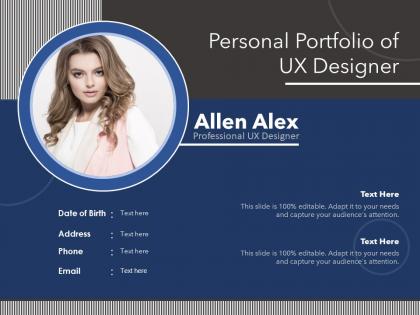
Personal portfolio of ux designer




Try Before you Buy Download Free Sample Product
 Impress Your
 Audience
 100%
100% Editable
 Save Hours
 of Time


Come across as factual and convincing with our Personal Portfolio Of Ux Designer. They help handle emerging concerns.
People who downloaded this PowerPoint presentation also viewed the following :
Personal portfolio of ux designer with all 6 slides:
Handle emerging doubts with our Personal Portfolio Of Ux Designer. All fears go flying away.


FAQs for Personal portfolio
A UX designer portfolio should include case studies showcasing problem-solving processes, user research methodologies, wireframes and prototypes, visual design samples, and measurable project outcomes. These elements demonstrate comprehensive design thinking through research analysis, iterative testing, and user-centered solutions, with many hiring managers finding that portfolios emphasizing process over aesthetics ultimately deliver stronger candidate differentiation.
Storytelling enhances UX design portfolios by transforming project presentations into compelling narratives that showcase problem-solving processes, user journey mapping, design thinking methodologies, and iterative improvements through clear beginning-middle-end structures. Through narrative frameworks, designers demonstrate strategic thinking, user empathy, and business impact more effectively than static visuals alone, with many hiring managers finding that story-driven portfolios better reveal a candidate's collaborative approach and design decision-making capabilities.
User research plays a foundational role in UX designer portfolios by demonstrating the designer's ability to understand user needs, validate design decisions, and create data-driven solutions through methods like interviews, usability testing, and behavioral analysis. It showcases the designer's strategic thinking and problem-solving approach, with many hiring managers finding that portfolios highlighting comprehensive research processes ultimately deliver stronger candidate credibility and competitive advantage.
UX designers can effectively showcase problem-solving skills by presenting clear case studies that detail their research process, user pain points identified, design iterations, and measurable outcomes achieved. These portfolios should demonstrate strategic thinking through before-and-after comparisons, usability testing results, and specific metrics like improved conversion rates or reduced task completion times, ultimately highlighting their ability to transform complex user challenges into streamlined, business-driving solutions.
Impactful UX portfolio case studies include end-to-end product redesigns, user research-driven solutions, accessibility improvements, mobile-first designs, and cross-platform experiences. These case studies enhance credibility by demonstrating problem-solving methodologies, user empathy, and measurable outcomes, with many design teams finding that portfolios showcasing diverse industries and clear business impact ultimately deliver stronger hiring results.
Visual design principles enhance portfolio presentation by establishing clear hierarchy, consistent typography, balanced layouts, strategic color usage, and appropriate white space management. These elements streamline navigation while showcasing work professionally, with many UX designers finding that cohesive visual systems significantly improve recruiter engagement and demonstrate their understanding of design fundamentals, ultimately delivering stronger interview opportunities.
Including both personal and collaborative projects demonstrates design versatility, problem-solving range, and real-world teamwork capabilities that employers seek. Personal projects showcase creative initiative, experimental approaches, and individual design thinking, while collaborative work highlights stakeholder management, cross-functional communication, and delivery within constraints, ultimately presenting a comprehensive skill set that spans independent innovation and professional execution.
UX designers should provide concise project overviews with key metrics and outcomes, while offering deeper dives into 2-3 signature projects that showcase problem-solving methodology, user research insights, and design rationale. This strategic combination enables hiring managers to quickly assess capabilities and explore detailed case studies, with many design teams finding that portfolios balancing accessibility with depth demonstrate both communication skills and design thinking maturity.
Metrics that strengthen UX designer portfolios include conversion rate improvements, user task completion increases, reduced bounce rates, decreased support tickets, and enhanced user satisfaction scores. These quantifiable outcomes demonstrate real business impact, with many designers finding that showcasing specific results like "increased checkout completion by 40%" or "reduced user errors by 60%" ultimately delivers credibility and competitive advantage.
UX designers can leverage feedback through regular portfolio reviews with peers, mentors, and potential employers, incorporating critiques about project presentation, case study clarity, and skill demonstration. This iterative approach enables designers to refine their storytelling, update outdated work, and align their portfolio with industry trends, ultimately delivering stronger narratives that showcase problem-solving capabilities and enhance their competitive advantage in an increasingly demanding market.
Common mistakes include overcomplicating navigation, lacking clear case study structure, omitting process documentation, failing to showcase problem-solving methodology, and neglecting mobile responsiveness. These oversights often result in recruiters struggling to assess capabilities, with many design professionals finding that streamlined presentations, detailed project walkthroughs, and accessible formats ultimately deliver stronger interview opportunities and career advancement.
A portfolio reflects a UX designer's unique style through consistent visual presentation, distinctive problem-solving methodologies, and personalized case study narratives that showcase their design philosophy. By curating projects that demonstrate their specific approach to user research, wireframing techniques, and design iterations, designers create compelling narratives that differentiate them in an increasingly competitive market, ultimately delivering memorable impressions to potential employers and clients.
**INPUT**: What platforms or tools are recommended for building and presenting a digital UX portfolio? **OUTPUT**: Recommended platforms include Behance, Dribbble, Adobe Portfolio, Webflow, Squarespace, personal websites, and specialized tools like UXFolio or Semplice. These platforms enable designers to showcase interactive prototypes, case studies, and design processes seamlessly, with many UX professionals finding that custom websites deliver greater flexibility and personal branding control, ultimately enhancing career opportunities and client engagement. **Word count: 59 words**
Tailoring your UX portfolio for specific job applications is crucial for demonstrating relevant skills, aligning with company culture, and addressing particular role requirements. This strategic approach enables designers to highlight pertinent projects, showcase industry-specific expertise, and emphasize methodologies that resonate with hiring managers, ultimately delivering stronger interview prospects and competitive advantage in an increasingly specialized market.
UX designers can maintain current portfolios by regularly updating case studies with recent projects, showcasing emerging design systems like atomic design principles, incorporating accessibility standards, and highlighting cross-platform experiences including mobile-first and voice interfaces. These strategies demonstrate evolving expertise while positioning designers competitively, with many agencies and tech companies increasingly seeking portfolios that reflect contemporary user behaviors and design methodologies.
No Reviews