


Philanthropy Advocacy Playbook Powerpoint Presentation Slides




Try Before you Buy Download Free Sample Product
 Impress Your
 Audience
 100%
100% Editable
 Save Hours
 of Time


Agile processes promote sustainable development and harness change for the clients competitive advantage. These principles shorten the development cycles to change quickly at a low cost. The agile manifesto comprises four foundational values and supporting principles that lead to software development. The four values of the agile manifesto, such as individuals and interactions over processes and tools, working software over comprehensive documentation, customer collaboration over contract negotiation, and responding to change over the following plan, are covered here. Check out our professionally designed Manifesto for Agile Software Development template that will help you process defer decisions. The agile movement methodologies include customer satisfaction with continuous delivery, accommodating changing requirements, frequent delivery of working software, the collaboration between stakeholders, support, trust and motivate people, enabling face to face interactions, measuring software progress, agile process to support consistent development, designing enhances agility, simplicity, self organizing teams, regular reflections for becoming more effective, has been outlined in this template along with the ways it can be performed within the organization. Download the 100 percent editable template and get access now
People who downloaded this PowerPoint presentation also viewed the following :
Content of this Powerpoint Presentation
Slide 1: This slide displays title i.e. 'Philanthropy Advocacy Playbook' and your Company Name.
Slide 2: This slide presents purpose of the playbook.
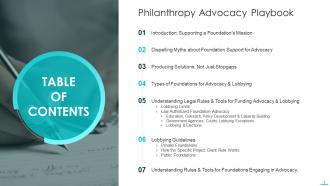
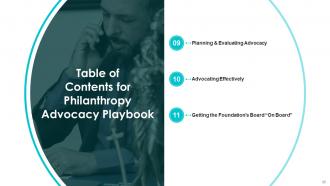
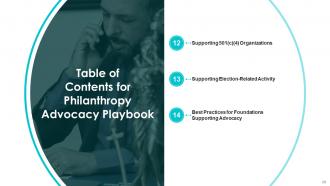
Slide 3: This slide exhibits table of contents.
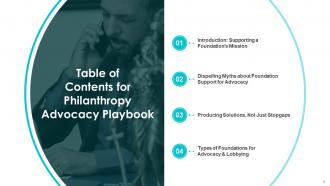
Slide 4: This slide also shows table of contents.
Slide 5: This slide depicts title for four topics that are to be covered next in the template.
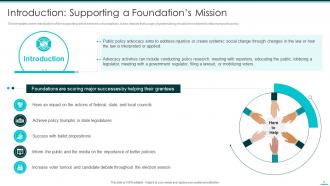
Slide 6: This slide covers introduction of the supporting direct services or foundations.
Slide 7: This slide covers the guidelines for the foundations supporting advocacy.
Slide 8: This slide depicts that supporting advocacy is an important grantmaking strategy for many foundations because it has many multiplier and spillover effects.
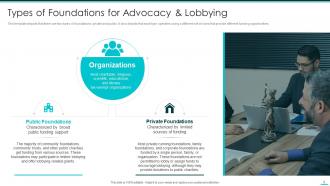
Slide 9: This slide depicts that there are two types of foundations: private and public.
Slide 10: This slide depicts title for five topics that are to be covered next in the template.
Slide 11: This slide covers advocacy & lobbying rules for private and public foundations.
Slide 12: This slide summarizes the rules for private and public foundations in supporting or conducting various kinds of advocacy.
Slide 13: This slide covers permissible for public & private foundation, on different advocacies such as education, outreach, policy development & capacity building.
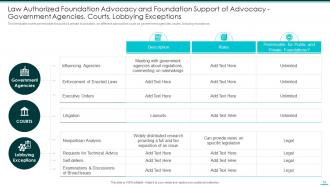
Slide 14: This slide covers permissible for public & private foundation, on different advocacies such as government agencies, courts, lobbying exceptions.
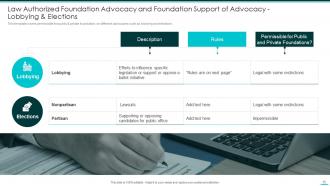
Slide 15: This slide covers permissible for public & private foundation, on different advocacies such as lobbying and elections.
Slide 16: This slide depicts title for three topics that are to be covered next in the template.
Slide 17: This slide covers the advocacy lobbying guideline checklist for private foundations.
Slide 18: This slide covers project grant rule scenarios for private organizations.
Slide 19: This slide covers the advocacy lobbying guideline checklist for public foundations.
Slide 20: This slide depicts title for four topics that are to be covered next in the template.
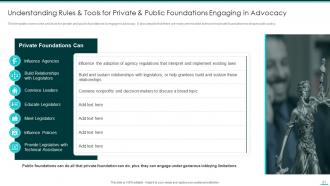
Slide 21: This slide covers rules and tools for private and public foundations to engage in advocacy.
Slide 22: This slide covers advocacy approaches for the organizations such as working along the advocacy continuum and moving along the advocacy continuum.
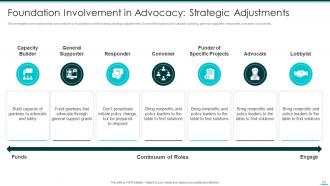
Slide 23: This slide covers factors that are consider by foundations while making strategic adjustments.
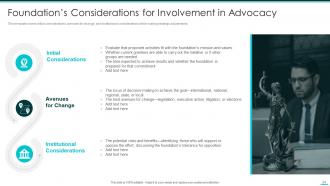
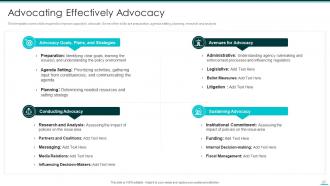
Slide 24: This slide covers initial considerations, avenues for change, and institutional considerations while making strategic adjustments.
Slide 25: This slide depicts title for three topics that are to be covered next in the template.
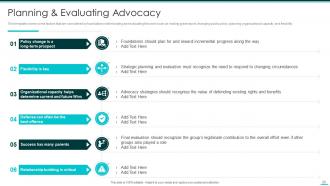
Slide 26: This slide covers some factors that are considered by foundations while funding and evaluating this work such as making grant report, etc.
Slide 27: This slide covers skills required to improve capacity to advocate.
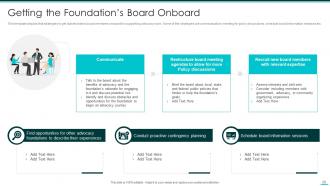
Slide 28: This slide depicts that strategies to get stakeholders/ board members onboard for supporting advocacy work.
Slide 29: This slide depicts title for three topics that are to be covered next in the template.
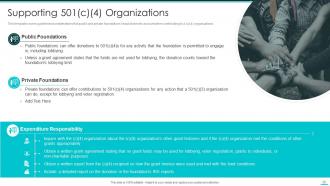
Slide 30: This slide covers guidelines/considerations that public and private foundations should take into account when contributing to a (c)(4) organizations.
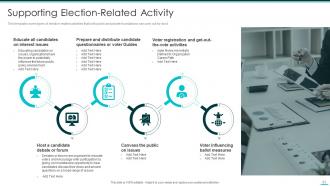
Slide 31: This slide covers types of election-related activities that both public and private foundations can carry out for fund.
Slide 32: This slide covers best practices for public and private foundations to support advocacy.
Slide 33: This is the icons slide.
Slide 34: This slide presents title for additional slides.
Slide 35: This slide shows about your company, target audience and its client's values.
Slide 36: This slide presents your company's vision, mission and goals.
Slide 37: This slide displays Venn.
Slide 38: This slide displays puzzle.
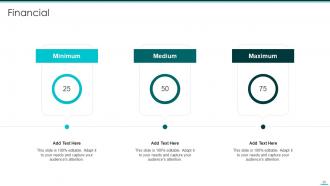
Slide 39: This slide showcases financials.
Slide 40: This slide presents targets of the company.
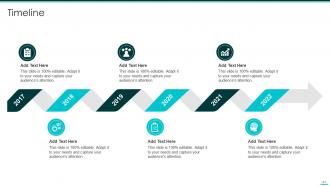
Slide 41: This slide exhibits yearly timeline.
Slide 42: This is thank you slide & contains contact details of company like office address, phone no., etc.
Philanthropy Advocacy Playbook Powerpoint Presentation Slides with all 47 slides:
Use our Philanthropy Advocacy Playbook Powerpoint Presentation Slides to effectively help you save your valuable time. They are readymade to fit into any presentation structure.



















FAQs for Philanthropy Advocacy Playbook
A successful philanthropy advocacy presentation includes compelling storytelling with beneficiary impact data, clear funding requests with specific allocation breakdowns, measurable outcomes and success metrics, stakeholder testimonials, and transparent organizational financials. These elements work together by building emotional connection, demonstrating accountability, and establishing trust, with many nonprofits finding that combining personal narratives with concrete data significantly enhances donor engagement and funding commitments.
Storytelling effectively promotes philanthropic initiatives by creating emotional connections, demonstrating tangible impact, and personalizing broader social issues through individual narratives. Nonprofits leverage compelling donor stories, beneficiary testimonials, and community transformation examples to build trust and inspire action, with many organizations finding that authentic storytelling increases donor engagement and long-term commitment significantly.
Social media serves as a powerful amplification tool for philanthropy advocacy, enabling organizations to expand reach, engage diverse audiences, mobilize supporters, and share compelling impact stories in real-time. Through strategic content campaigns, nonprofits streamline donor acquisition, enhance community building, and accelerate fundraising efforts, with many charitable organizations finding that digital platforms ultimately deliver broader visibility and deeper stakeholder engagement.
Nonprofit organizations can measure advocacy impact through donation tracking, policy change documentation, media coverage analysis, stakeholder engagement metrics, and legislative outcome monitoring. These measurement approaches enable organizations to demonstrate tangible results by connecting advocacy activities to increased funding, enhanced public awareness, and stronger community partnerships, ultimately delivering greater philanthropic support and sustainable organizational growth.
Effective volunteer engagement strategies include creating clear role definitions, providing comprehensive training programs, establishing mentorship systems, utilizing digital platforms for coordination, and recognizing contributions through awards ceremonies. These approaches streamline volunteer onboarding while building sustained commitment, with many nonprofit organizations finding that structured engagement ultimately delivers higher retention rates, expanded advocacy reach, and stronger community impact across diverse philanthropic initiatives.
Presenters can tailor their philanthropy advocacy messages by adapting language, data focus, and emotional appeals to match each stakeholder group's priorities, values, and decision-making criteria. Corporate donors respond to ROI metrics and brand alignment, while individual philanthropists connect with personal stories and community impact, and foundation boards prioritize measurable outcomes and strategic goals, ultimately enabling advocates to build stronger partnerships and secure greater support across diverse funding landscapes.
Visually compelling philanthropy slides incorporate impactful storytelling through beneficiary photos, clear data visualizations showing donation impact, consistent branding with warm color palettes, and minimal text with powerful headlines. These design elements enhance donor engagement by creating emotional connections, demonstrating transparency through compelling infographics, and maintaining professional credibility, ultimately driving increased participation and funding commitments across charitable organizations.
Philanthropy advocacy influences public policy through strategic lobbying, research dissemination, coalition building, grassroots mobilization, and direct stakeholder engagement with policymakers. These approaches enable organizations to shape legislation, secure government funding, and drive regulatory changes by presenting compelling data, building cross-sector alliances, and demonstrating community impact, ultimately delivering enhanced resources and systemic solutions for social challenges.
Organizations build partnerships with businesses through strategic alignment of values and mutual benefits, shared campaign development, and collaborative resource pooling. Through corporate social responsibility initiatives, nonprofits and companies create joint advocacy efforts in sectors like environmental sustainability and education reform, ultimately delivering expanded audience reach, enhanced credibility, and amplified social impact while strengthening both organizations' community engagement.
Sustaining donor engagement through advocacy requires personalized communication, regular impact updates, exclusive behind-the-scenes access, peer-to-peer fundraising opportunities, and meaningful volunteer involvement. These strategies enhance donor connection by demonstrating tangible outcomes, creating community experiences, and providing ongoing touchpoints, with many nonprofits finding that advocacy-focused donors show significantly higher retention rates and lifetime giving value.
Data and research strengthen philanthropy presentations by providing compelling impact metrics, donor behavior insights, success case studies, and comparative analysis across sectors and regions. Through evidence-based storytelling, organizations demonstrate measurable outcomes, validate strategic approaches, and build credibility with stakeholders, ultimately enabling more persuasive funding requests and partnership proposals that resonate with data-driven decision makers.
Common philanthropic advocacy pitfalls include lack of clear messaging, insufficient stakeholder research, unrealistic goal-setting, poor donor stewardship, and inadequate impact measurement. Organizations often struggle with these challenges, but those implementing strategic communication frameworks, comprehensive donor mapping, and transparent reporting systems find significantly improved fundraising outcomes, enhanced community trust, and stronger long-term partnerships that ultimately deliver sustainable social impact.
Advocacy presentations adapt to virtual platforms by incorporating interactive polling, breakout rooms for small-group discussions, multimedia storytelling elements, and strategic use of chat features for real-time engagement. Organizations like United Way and Amnesty International enhance virtual advocacy through compelling visual narratives, personalized follow-up sequences, and hybrid formats that combine live presentations with recorded testimonials, ultimately delivering broader reach and more measurable audience engagement than traditional in-person events.
Community voices serve as powerful authenticity drivers in philanthropy advocacy presentations, providing firsthand testimonials, personal impact stories, lived experiences, and grassroots perspectives that data alone cannot convey. These voices transform abstract concepts into compelling narratives, with many nonprofit organizations finding that beneficiary testimonials, volunteer insights, and community leader endorsements significantly enhance donor engagement and trust, ultimately delivering stronger emotional connections and increased funding commitments.
Visual storytelling enhances philanthropic messages by creating immediate emotional connections, simplifying complex social issues, and making abstract causes tangible through compelling imagery and data visualization. Through infographics, impact videos, and before-and-after visuals, nonprofits can demonstrate real outcomes while engaging donors' emotions, ultimately driving higher engagement rates and increased giving across healthcare, education, and humanitarian sectors.
-
It is my first time working with them and that too on a friend's recommendation. I would say, I am not expecting such a worldly service at this low price.
-
The information is visually stunning and easy to understand, making it perfect for any business person. So I would highly recommend you purchase this PPT design now!