


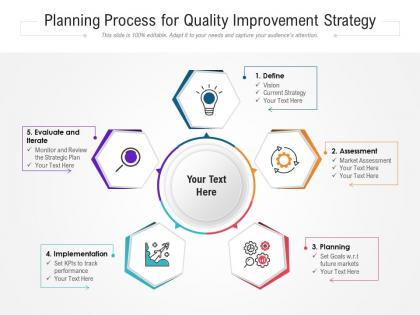
Planning process for quality improvement strategy




Try Before you Buy Download Free Sample Product
 Impress Your
 Audience
 100%
100% Editable
 Save Hours
 of Time


Our Planning Process For Quality Improvement Strategy are explicit and effective. They combine clarity and concise expression.
People who downloaded this PowerPoint presentation also viewed the following :
Planning process for quality improvement strategy with all 2 slides:
Give your audience a fulfilling experience. They will find our Planning Process For Quality Improvement Strategy elevating.
FAQs for Planning process for
So first, figure out exactly what's broken - don't just say "everything sucks." Set goals you can actually measure, then dig into why things went wrong in the first place. Break it down into specific steps with deadlines, and honestly, make someone own each part or it'll just sit there forever. I'd start with maybe two big things that'll make the biggest difference rather than tackling your whole list at once. Oh, and build in some way to check if it's working - you might need to change course halfway through. Keep your goals realistic too, based on actual data instead of just hoping for the best.
Start by collecting baseline data on what you're currently doing - boring but necessary. Then use analytics tools to spot trends and bottlenecks in your processes. The visualization part honestly makes everything way clearer; charts just hit different than spreadsheets. Don't get sucked into tracking vanity metrics though. Focus on KPIs that actually move the needle for your goals. Set up dashboards for real-time monitoring, and if you can swing it, use predictive analytics to catch issues before they blow up. Most crucial part? Turn those insights into concrete action items your team can actually execute.
Honestly, you've gotta get everyone on board from day one or you're screwed. Map out who's actually affected by the problem first - frontline workers, bosses with budgets, customers dealing with the mess. Each group sees things totally differently, and you'll miss huge blind spots working alone. Here's the thing though: people will fight changes they didn't help create. But if they're part of building the solution? They'll champion it. I learned this the hard way on a project last year. Bring them into planning conversations early, not after you've already decided everything. Their support literally determines if this thing succeeds or fails.
Before you start anything, figure out your baseline numbers - defect rates, customer happiness scores, how long processes take. Pick 2-3 metrics that actually matter to what you're trying to fix. I've watched teams go crazy trying to measure everything and it's a nightmare. Track those same numbers as you roll things out. But don't just rely on data - talk to your team and customers too. Sometimes the spreadsheet looks great but people are still frustrated. Set up regular check-ins so you can pivot if something's not working. Keep it simple at first.
Honestly, the biggest pain points are usually people hating change and leadership not backing you up. Staff gets super comfortable with their routines - which I get, but ugh. Then you've got unclear goals, crappy data, and everyone fighting over the same resources. Budget constraints suck too. Oh, and trying to fix everything at once? Recipe for disaster. My take: grab some quick wins first to get people excited, then make sure the higher-ups actually support what you're doing before you go big.
Try making a simple 2x2 grid - impact vs how doable each project actually is. Plot everything based on potential benefit and whether you can realistically pull it off right now. Obviously hit the high impact, high feasibility stuff first. The high impact but tough-to-execute projects? Maybe park those until you've got more resources or time. Honestly, I'd ditch most low impact things unless they're super quick wins that get people excited. Having your whole team weigh in on where projects land makes these prioritization conversations so much easier. Trust me, the visual really helps.
Honestly, start with PDSA cycles - you can literally kick one off today with whatever's driving your team crazy. They're low-risk and quick wins. For bigger picture stuff, root cause analysis is your friend (think fishbone diagrams or just doing the 5 Whys). Process mapping sounds boring but holy crap, it shows you waste you never knew was there. Run charts are perfect for tracking progress over time - way better than just hoping things improved. Oh, and if you're dealing with major initiatives, Lean Six Sigma methodologies work well, though they're probably overkill for most day-to-day problems.
Think of continuous feedback loops as your safety net for quality improvement - they stop you from wandering into the weeds. Set up regular check-ins to see what's actually working vs. what's a total disaster. Kind of like having GPS that keeps recalculating when you take a wrong turn. The trick is making feedback happen weekly, not waiting for those monthly reports that everyone ignores anyway. Real-time data lets you pivot fast when something's clearly not working. Honestly, I'd just pick 2-3 metrics you can track consistently rather than trying to measure everything.
Dude, leadership makes or breaks your whole QI thing. They control the money, set priorities, and create that culture where people either feel safe to speak up or just keep their heads down. I've watched so many good plans die because executives talked a big game initially but then disappeared when things got tough. Your team needs to see leaders actually removing roadblocks and celebrating wins. Otherwise people just go through the motions. Leaders also decide which numbers matter and how you'll measure success. Bottom line - you need real buy-in that lasts beyond the fancy launch presentation.
Honestly, tech makes quality improvement so much easier. Real-time dashboards show you what's happening right now instead of waiting around for reports. Project management tools are a game-changer - seriously, how did people coordinate anything before Slack and Asana? You can track everything automatically and actually see if your changes are working. The analytics help you measure impact way better than guessing. Oh, and digital workflows keep everyone doing things the same way across departments. My advice? Just pick one tool that fixes your biggest headache first - whether that's collecting data or keeping your team on the same page.
Start with outcome stuff - defect rates, customer satisfaction, process times. The things that actually show if you're winning or not. Leading indicators are clutch too, like training completion or audit scores that hint at future performance. Oh and cycle times, resource usage - basically the mechanics behind your results. Honestly? Most teams go overboard and drown in metrics. I'd pick 3-5 that your stakeholders genuinely care about first. You can always add more once those are solid, but there's something to be said for keeping it simple initially.
Honestly, you've gotta get leadership on board first - if they're not actually doing it themselves, forget about everyone else buying in. Train people properly too because expecting them to fix quality issues without knowing how is just setting them up to fail. Make it everyone's job, not just something you dump on the QA team. When stuff actually improves, celebrate those wins and tell everyone about it. Regular team check-ins work way better than only talking about quality when everything's on fire. Oh and create spaces where teams can actually share what's working - sounds obvious but most places skip this step entirely.
Look, you gotta make this stuff stick in your day-to-day work, not treat it like some fancy side project. Train everyone properly first - can't skip that step. Update your procedures and check in regularly so things don't slip back to the old ways. Management support is huge here. Without it, I swear everything just falls apart after a few months. Figure out which changes are most likely to backslide and focus there first. Set up ways for people to give feedback and actually celebrate when things go well. Oh, and short wins help keep people motivated way more than you'd think.
Honestly, cross-functional teams are a game changer for catching quality issues. Different departments see totally different problems - like customer service knows what actually breaks, ops sees where processes fail, IT spots the tech gaps. When you're stuck in your own bubble, you miss so much. The cool part is everyone brings their own problem-solving style, so you get way more creative solutions. Plus implementation goes smoother because people helped build it, not just got it dumped on them. I learned this the hard way on a project last year. Next time you're tackling quality stuff, grab folks from 3-4 different teams. You'll be surprised.
Honestly, small tweaks always win over huge changes. Pick one thing and nail it first. Get your actual workers involved from the start - they know what really happens day-to-day way better than management does. Set clear goals you can actually measure, then schedule regular check-ins because stuff will go wrong (it just does). The teams that crushed it? They wrote everything down like crazy and made a big deal about tiny wins to keep people motivated. Oh, and don't skip those review meetings - you'll need them to fix things quickly when they inevitably get weird.
No Reviews