

Plant Disease Detection Workflow Machine Learning Applications Ppt Example ML SS





Try Before you Buy Download Free Sample Product
 Impress Your
 Audience
 100%
100% Editable
 Save Hours
 of Time


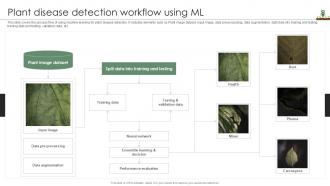
This slide covers the process flow of using machine learning for plant disease detection. It includes elements such as Plant image dataset, input image, data pre processing, data augmentation, Split data into training and testing, training data and testing, validation data, etc.
People who downloaded this PowerPoint presentation also viewed the following :
Plant Disease Detection Workflow Machine Learning Applications Ppt Example ML SS with all 9 slides:
Use our Plant Disease Detection Workflow Machine Learning Applications Ppt Example ML SS to effectively help you save your valuable time. They are readymade to fit into any presentation structure.








FAQs for Plant Disease Detection Workflow Machine Learning Applications Ppt
Honestly, it's pretty easy once you get the hang of it. Look for yellowing leaves, brown spots, or plants wilting when the soil's still moist. Fungal stuff usually looks fuzzy or creates those weird circular patches - totally gross but you'll know it when you see it. Bacterial diseases make these dark, water-soaked areas that spread fast. Stunted growth is another dead giveaway. The key is checking weekly before things get out of hand. I always take photos on my phone so I can compare if something looks off later. Catch it early and you'll save yourself a ton of headaches.
So basically, drones and satellites can spot sick plants way before you'd notice anything wrong just looking at them. Plants reflect light differently when they're stressed or diseased - something about chlorophyll and water content changes at the cellular level. Pretty wild, right? You set up regular flights over your fields and the tech learns what "normal" looks like for your crops. Then it flags weird patterns, usually weeks before you'd see brown spots or whatever. Honestly, it's like having x-ray vision for your fields. Just gotta establish those baseline readings first so it knows what to watch for.
Okay so basically healthy soil = healthy plants that don't get sick as much. Think of it like this - when your soil drains well and has the right pH, plants get strong immune systems naturally. But crappy soil with too much water or missing nutrients? Your plants become total wimps against disease. Honestly, I learned this the hard way after losing half my tomatoes one year. Compacted soil is the worst since roots can't spread out properly. Get a soil test done (like once a year) and work on adding organic stuff to it. Trust me, you'll deal with way fewer plant problems down the road.
Honestly, the tech stuff blows traditional methods out of the water for accuracy - we're talking 90-95% vs maybe 60-80% even with experienced people. AI can catch diseases super early too, way before you'd spot anything yourself. That said, nothing beats actually knowing your fields. I'd probably use both if I were you - let the apps and sensors do the heavy lifting for detection, then use your own judgment for what to actually do about it. Traditional scouting isn't dead, just... different now I guess.
Real-time PCR is probably your best bet to start with - gives you solid quantitative results for most plant pathogens. ELISA's still super common too, especially for viruses since it's cheap and pretty straightforward. You'll also see multiplex PCR a lot for detecting specific DNA/RNA. LAMP is getting popular because it's way faster than regular PCR, which is nice when you're in a rush. DNA barcoding and next-gen sequencing are cool if you need to identify mystery pathogens, but honestly they might be overkill depending on what you're working with. I'd stick with real-time PCR for now.
Definitely! Traditional methods hit maybe 70-80% accuracy, but deep learning models can push that over 90%. The computer vision tech has gotten crazy good - you just need tons of plant images to train it properly. Honestly though, don't try to replace experts completely. Best approach is mixing AI with human knowledge. Oh and if you're gonna try this, start small with like one or two diseases first. Way easier than jumping into everything at once and probably getting overwhelmed.
Yeah so climate change is basically screwing with plant diseases big time. Warmer temps mean pathogens stick around longer and spread to places they never could before. Your plants get stressed from heat and drought, so their defenses are weaker against fungi, bacteria, all that nasty stuff. Milder winters don't kill off diseases like they used to either. The timing's all messed up now - you might see outbreaks way earlier or later than normal. Honestly, it's pretty frustrating trying to predict anything anymore. I'd say check your crops more often and maybe adjust when you treat based on what the weather's actually doing locally, not just what used to happen.
Dude, the data on early disease detection is actually pretty solid. Kenyan coffee farmers using mobile apps cut their losses by 30-40% when they caught rust early. Dutch growers found late blight 2-3 weeks sooner with AI cameras and got 15% better yields. Iowa corn farmers had similar luck with drones - though honestly, I think they just wanted an excuse to fly those things around. Point is, catching problems before they spread gives you time to fix them. I'd start with whatever tech you can afford and upgrade later if it's working.
So basically, the microbes in your soil are like your plant's immune system. Good ones like mycorrhizal fungi will literally fight off the bad guys and steal their food sources. They even make their own antimicrobial stuff - pretty cool right? But if your soil gets stressed or out of whack, plants become sitting ducks for disease. I always think of it like gut health for plants (weird comparison but it works lol). You want diverse soil biology, so add compost and don't go crazy with fungicides since they'll nuke everything.
Honestly, it depends what matters most to you - speed or being super precise. PCR in a lab is crazy accurate but takes forever. Field tests are way more convenient if you're working on-site, just not as reliable. Budget's obviously a factor too. Time sensitivity is probably the biggest thing though - some diseases move so fast you can't wait around for lab results. Also think about whether your team knows how to run the more technical stuff, and if you're hunting for something specific or just doing general screening. I'd figure out your biggest limitation first, then pick from there.
Honestly, the real-time data is a game changer - you'll catch issues way before you'd see them normally. Drones with those fancy multispectral cameras pick up stress and nutrient problems by reading how light bounces off your crops. Pretty cool tech. Ground sensors track soil moisture and pH 24/7, plus satellite imagery covers your bigger picture monitoring. Set up alerts when readings go wonky and you can jump on problems fast. Way better than waiting until half your field looks like crap, you know? Treat the specific spots instead of playing catch-up later.
Honestly, those plant disease detection tools are game changers for pest control. You can spot problems way before they get out of hand instead of just spraying everything and hoping for the best. The AI stuff is getting crazy good - like it'll catch diseases I'd totally miss. So you end up using way less chemicals, which is better for your wallet and the environment. Plus you're actually targeting the real issues instead of going nuclear on everything. I'd start checking your plants regularly with some of those digital monitoring tools - even my neighbor swears by them now. Catch things early and you won't have to deal with major infestations later.
So basically you track when and where diseases hit your plants, then look for patterns. Weather data is huge here - you'll start seeing which conditions trigger outbreaks. I keep a simple spreadsheet with disease spots, weather, and what treatments I used. After like two seasons you'll have enough data to actually predict problems before they spread everywhere. The cool part is catching those early warning signs that you'd totally miss otherwise. Honestly, even basic tracking reveals disease cycles you never noticed. Plus you can see if your treatments are actually working or if you're just wasting money on stuff that doesn't help.
Honestly, the big ethical stuff you'll run into is mostly environmental impact, food safety, and how it affects farmers. Cross-pollination with wild plants could create superweeds or mess with biodiversity - that's probably the scariest part. Health effects get debated a lot but the science is pretty solid on safety. What really bugs me though is how GM tech makes farmers more dependent on big seed companies. Small farms get left behind while industrial ones dominate even more. Definitely check your school's ethics rules first and maybe get some stakeholder input before diving into GM research.
Honestly, lab testing blows visual diagnosis out of the water - we're talking 60-70% accuracy just looking at symptoms versus 90%+ with actual tests. Different diseases look crazy similar, and I can't tell you how many times I've seen people get it totally wrong from photos alone. Environmental stress throws another wrench in things since it mimics disease symptoms. But don't totally write off visual assessment - it's still useful for getting a general idea and figuring out which tests you actually need. My advice? Use what you can see to narrow things down, then get proper lab work before you make any big treatment calls.
-
The customer care of SlideTeam is very responsive. I was having a payment issue and they fixed it for me in no time.
-
The templates you provide are great! They have saved me tons of time and made my presentations come alive. Thank you for this awesome product. Keep up the good work!