


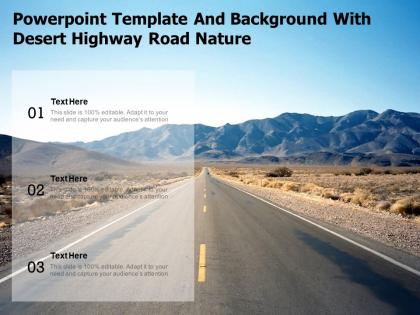
Powerpoint template and background with desert highway road nature




Try Before you Buy Download Free Sample Product
 Impress Your
 Audience
 100%
100% Editable
 Save Hours
 of Time


Utilize the following PowerPoint image slide titled Powerpoint Template And Background With Desert Highway Road Nature. This PowerPoint template is entirely editable and is available in both, standard and widescreen sizes. A wide range of topics can be targetted which include Image slides, Road using this PPT background. The other elements of PPT can also be modified if required.
People who downloaded this PowerPoint presentation also viewed the following :
Powerpoint template and background with desert highway road nature with all 2 slides:
Use our Powerpoint Template And Background With Desert Highway Road Nature to effectively help you save your valuable time. They are readymade to fit into any presentation structure.


FAQs for Powerpoint template and background with desert
Desert highways feature specialized asphalt compounds resistant to extreme temperature fluctuations, enhanced drainage systems for flash flood management, sand-drift barriers, reflective lane markings for visibility, and strategically spaced rest areas with emergency services. These engineering solutions address harsh environmental challenges through heat-resistant materials, advanced weather monitoring systems, and robust infrastructure design, ultimately delivering safer travel experiences and reduced maintenance costs for transportation authorities managing routes across arid landscapes.
**INPUT**: How do environmental factors such as temperature and moisture affect the maintenance of desert highways? **OUTPUT**: Environmental factors significantly impact desert highway maintenance through thermal expansion, surface cracking, sand accumulation, and moisture-related deterioration of asphalt materials. These conditions require specialized approaches including heat-resistant materials, enhanced drainage systems, and frequent surface treatments, with many transportation departments finding that proactive maintenance schedules ultimately reduce long-term costs and ensure safer travel experiences.
Desert highway safety challenges include extreme heat affecting vehicle performance, limited visibility from sandstorms and mirages, long distances between service stations, wildlife crossings, and driver fatigue from monotonous terrain. These conditions create operational risks for transportation companies and logistics providers, with many fleet operators finding that enhanced vehicle monitoring, driver training programs, and strategic route planning significantly reduce incidents while improving delivery reliability and operational efficiency.
Desert highways significantly impact local ecosystems through habitat fragmentation, wildlife movement barriers, altered water drainage patterns, and increased vehicle-wildlife collisions. These infrastructure developments present both challenges and opportunities, with many transportation authorities finding that strategic wildlife corridors, underpasses, and adaptive road design can minimize ecological disruption while maintaining essential connectivity for regional economic development.
Best practices for desert highway construction include proper soil stabilization, advanced drainage systems, heat-resistant asphalt materials, strategic vegetation placement, and comprehensive dust control measures. These engineering approaches enhance road durability by minimizing thermal expansion damage, preventing sand infiltration, and reducing maintenance costs, with many transportation authorities finding that strategic material selection ultimately delivers longer-lasting infrastructure and improved safety standards.
Transportation authorities manage desert highway traffic through intelligent transportation systems, dynamic message signs, automated traffic monitoring, strategic rest area placement, and real-time incident response protocols. These integrated approaches enable authorities to redirect traffic during peak periods, provide advance warning of congestion or hazards, and coordinate emergency services across vast distances, ultimately delivering smoother traffic flow and enhanced safety for long-distance travelers.
Desert highways serve as critical economic lifelines by connecting remote areas to major markets, enabling trade routes, facilitating resource extraction, and attracting tourism investments. These transportation corridors transform isolated regions by reducing logistics costs, enabling faster goods movement, and creating employment opportunities in construction, maintenance, and services, ultimately delivering improved access to healthcare, education, and commercial opportunities.
Desert highway preparation requires strategic fuel management with full tanks and emergency reserves, abundant water supplies exceeding daily needs, and non-perishable food provisions for extended delays. Smart travelers increasingly carry backup navigation systems, emergency communication devices, and vehicle maintenance supplies, with many finding that over-preparation ultimately delivers peace of mind and enhanced safety margins.
**INPUT**: What innovations in road technology are being implemented to improve desert highway safety? **OUTPUT**: Desert highway safety innovations include smart pavement sensors, solar-powered LED reflectors, automated sand-clearing systems, thermal-resistant asphalt compounds, and GPS-enabled emergency beacons. These technologies enhance driver visibility and road durability by monitoring surface conditions, providing continuous lighting, and enabling faster emergency response, with transportation authorities finding that strategic combinations ultimately deliver reduced accidents and improved traveler confidence.
Sandstorms dramatically reduce visibility to near-zero levels, create hazardous driving conditions through sand accumulation on roadways, and can damage vehicle engines and electronics through fine particle infiltration. Transportation authorities increasingly implement early warning systems, automated road closure protocols, and enhanced weather monitoring stations, enabling logistics companies and travelers to optimize route planning, minimize delays, and maintain operational safety in challenging desert environments.
Scenic desert highway routes include Route 66 through Arizona's Painted Desert, California's Joshua Tree National Park corridor, Utah's Scenic Byway 12, Nevada's Valley of Fire road, and New Mexico's Turquoise Trail. These routes showcase iconic landmarks like Monument Valley, Death Valley's salt flats, and ancient petroglyphs, while offering travelers breathtaking vistas and unique geological formations that deliver unforgettable experiences across America's diverse desert landscapes.
Desert highways significantly boost tourism by providing accessible routes to remote natural wonders, cultural sites, and recreational destinations. These scenic corridors often feature national parks, ancient petroglyphs, historic mining towns, scenic overlooks, and unique geological formations, with many regions finding that well-maintained desert routes create sustainable tourism economies while preserving cultural heritage.
Desert highway emergency strategies include GPS tracking systems, mobile communication towers, helicopter rescue units, strategically positioned service stations, and partnerships with local emergency responders. These comprehensive approaches streamline response times by enabling real-time location tracking, maintaining communication coverage, and providing rapid medical evacuation, with many transportation authorities finding that integrated emergency networks ultimately deliver faster rescue operations and enhanced traveler safety across remote desert corridors.
Cultural and historical aspects significantly influence desert highway design through route selection honoring traditional trade paths, incorporation of archaeological site protections, and architectural elements reflecting regional heritage. Many transportation authorities integrate local materials, traditional wayfinding methods, and historical corridor preservation into modern infrastructure projects, ultimately delivering culturally sensitive transportation networks that respect indigenous knowledge while enabling efficient regional connectivity.
Climate change implications on desert highway infrastructure include increased thermal expansion, accelerated asphalt degradation, frequent extreme weather events, higher maintenance costs, and structural vulnerabilities from temperature fluctuations. These challenges present opportunities for innovative materials, adaptive engineering solutions, and resilient design approaches, with transportation agencies increasingly investing in climate-resistant technologies and sustainable construction methods, ultimately delivering more durable infrastructure and enhanced long-term operational efficiency.
-
Visually stunning presentation, love the content.
-
Innovative and Colorful designs.
-
Excellent work done on template design and graphics.
-
Really like the color and design of the presentation.
-
The Designed Graphic are very professional and classic.