


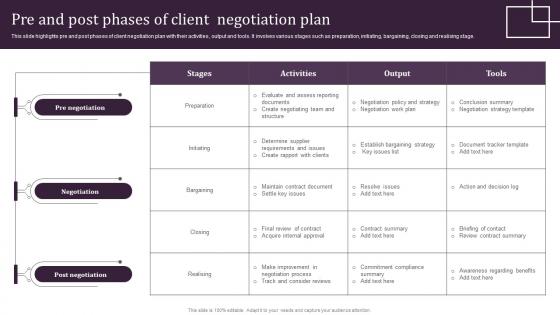
Pre And Post Phases Of Client Negotiation Plan




Try Before you Buy Download Free Sample Product
 Impress Your
 Audience
 100%
100% Editable
 Save Hours
 of Time


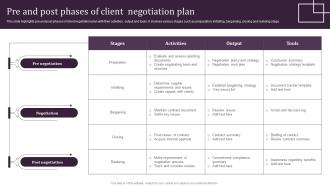
This slide highlights pre and post phases of client negotiation plan with their activities, output and tools. It involves various stages such as preparation, initiating, bargaining, closing and realising stage.
People who downloaded this PowerPoint presentation also viewed the following :
Pre And Post Phases Of Client Negotiation Plan with all 9 slides:
Use our Pre And Post Phases Of Client Negotiation Plan to effectively help you save your valuable time. They are readymade to fit into any presentation structure.








FAQs for Pre And Post Phases Of
Key components of an effective client negotiation plan include thorough preparation and research, clear objective setting, stakeholder identification, negotiation strategy development, and contingency planning. These elements work together by establishing strong foundations, defining success metrics, and anticipating client responses, with many organizations finding that structured approaches ultimately deliver better outcomes, stronger client relationships, and more favorable agreements across various business sectors.
Understanding the client's needs enhances negotiation by enabling personalized proposals, identifying mutual value opportunities, and building trust through targeted solutions. This approach allows negotiators to address specific pain points, present relevant benefits, and create win-win scenarios, with many organizations finding that needs-based strategies significantly improve closure rates and long-term client satisfaction.
Preparation serves as the foundation for successful client negotiations by enabling thorough research of client needs, competitive analysis, clear objective setting, and strategic approach development. This comprehensive groundwork allows negotiators to anticipate objections, present compelling value propositions, and adapt to unexpected scenarios, ultimately delivering stronger agreements and enhanced client relationships.
Identifying potential objections involves thorough client research, analyzing past negotiation patterns, conducting stakeholder interviews, and reviewing similar industry deals. By examining budget constraints, timeline pressures, and decision-making hierarchies, negotiators can anticipate concerns around pricing, implementation, and ROI, ultimately preparing strategic responses that address client priorities while maintaining deal momentum.
Building rapport before negotiations involves active listening to understand client priorities, researching their business challenges and industry context, finding common ground through shared experiences or mutual connections, and demonstrating genuine interest in their success. Through informal conversations, strategic meetings, and consistent follow-up communications, professionals can establish trust and credibility, while showcasing expertise and understanding of client needs, ultimately creating a collaborative foundation that enhances negotiation outcomes and long-term partnerships.
Visual aids like presentation templates enhance negotiation outcomes by organizing complex information clearly, maintaining professional credibility, and keeping discussions focused on key value propositions. These tools streamline communication between parties, reduce misunderstandings through structured data presentation, and enable negotiators to demonstrate ROI calculations visually, ultimately delivering more persuasive proposals and faster client decision-making.
Effective conflict management techniques include active listening, reframing disputes as mutual problems, finding common ground, using strategic pauses, and separating people from issues. These approaches streamline negotiations by reducing emotional tension, maintaining professional relationships, and focusing discussions on shared objectives, with many organizations finding that structured conflict resolution ultimately delivers faster agreements and stronger long-term partnerships.
Having a clear understanding of your own objectives is fundamental to successful negotiation, as it establishes your priorities, non-negotiables, and acceptable compromise points before discussions begin. This preparation enables negotiators to maintain focus during complex conversations, make strategic concessions while protecting core interests, and recognize win-win opportunities, with many professional services firms and sales organizations finding that objective clarity significantly improves deal outcomes and client satisfaction.
Active listening leverages strategic questioning, paraphrasing client concerns, and identifying underlying needs to uncover valuable negotiation insights. Through careful attention to verbal cues and emotional context, negotiators can discover budget constraints, decision-making timelines, and competitive pressures, ultimately enabling more targeted proposals and stronger client relationships that deliver mutually beneficial outcomes.
Common pitfalls include inadequate preparation, making excessive concessions early, failing to understand client priorities, neglecting win-win solutions, and poor communication of value propositions. These mistakes often result from rushing negotiations without research, with many organizations finding that structured preparation, active listening, and strategic patience ultimately deliver stronger partnerships and more sustainable agreements.
Cultural differences significantly impact international negotiations through varying communication styles, decision-making processes, relationship-building expectations, time orientations, and hierarchy structures. While Western clients often favor direct communication and quick decisions, many Asian and Middle Eastern cultures prioritize relationship development and consensus-building, with organizations increasingly finding that culturally-adapted approaches deliver stronger partnerships and successful outcomes.
**INPUT**: What metrics or indicators should be tracked to measure negotiation success? **OUTPUT**: Key negotiation success metrics include deal closure rates, time-to-agreement, contract value achieved versus targets, client satisfaction scores, and relationship retention rates. These indicators enable organizations to streamline future negotiations by identifying successful tactics, optimizing resource allocation, and enhancing long-term partnerships, with many companies finding that tracking these metrics ultimately delivers improved profitability and stronger client relationships. [Word count: 60 words]
Closing techniques can be tailored by matching your approach to client decision-making styles, communication preferences, risk tolerance, and purchasing motivations through careful observation and adaptive strategies. Analytical clients respond to data-driven presentations and detailed ROI calculations, while relationship-focused clients prefer collaborative discussions and testimonials, with successful sales professionals finding that personality-based closing ultimately delivers higher conversion rates and stronger client satisfaction.
Post-negotiation strategies include regular follow-ups, transparent progress reporting, proactive issue resolution, celebrating mutual wins, and maintaining open communication channels. These approaches enhance client trust by demonstrating commitment, accountability, and partnership focus, with many organizations finding that consistent post-deal engagement strengthens relationships, reduces future negotiation friction, and ultimately delivers enhanced client retention.
Technology streamlines negotiations through video conferencing platforms, collaborative document editing, data analytics for market insights, and digital contract management systems. These tools enhance preparation by providing real-time market data and competitor analysis, while enabling seamless communication and faster decision-making, ultimately delivering more informed strategies and reduced negotiation cycles for competitive advantage.
-
Love how there are no boring templates here! The design is fresh and creative, just the way I like it. Can't wait to edit and use them for my extended projects!
-
I was never satisfied with my own presentation design but SlideTeam has solved that problem for me. Thank you SlideTeam!