


Predictive Maintenance Equipment Condition Monitoring Automation In Manufacturing IT




Try Before you Buy Download Free Sample Product
 Impress Your
 Audience
 100%
100% Editable
 Save Hours
 of Time


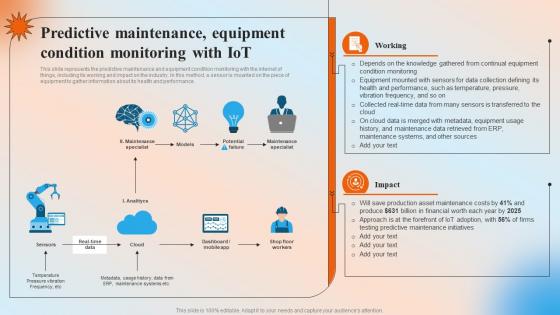
This slide represents the predictive maintenance and equipment condition monitoring with the internet of things, including its working and impact on the industry. In this method, a sensor is mounted on the piece of equipment to gather information about its health and performance.
People who downloaded this PowerPoint presentation also viewed the following :
Predictive Maintenance Equipment Condition Monitoring Automation In Manufacturing IT with all 6 slides:
Use our Predictive Maintenance Equipment Condition Monitoring Automation In Manufacturing IT to effectively help you save your valuable time. They are readymade to fit into any presentation structure.





FAQs for Predictive Maintenance Equipment Condition Monitoring Automation
Key components of a predictive maintenance strategy include condition monitoring sensors, data analytics platforms, machine learning algorithms, maintenance scheduling systems, and asset performance databases. These technologies work together by collecting real-time equipment data, identifying failure patterns, and optimizing maintenance timing, with manufacturing and energy companies finding significantly reduced downtime and maintenance costs.
Predictive maintenance uses real-time data analytics and sensors to forecast equipment failures before they occur, while traditional approaches rely on scheduled intervals or reactive repairs after breakdowns happen. Through IoT sensors and machine learning algorithms, manufacturers and utilities can reduce downtime by up to 50%, optimize resource allocation, and significantly lower maintenance costs compared to conventional methods.
**INPUT**: What technologies are commonly used in predictive maintenance solutions? **OUTPUT**: Predictive maintenance solutions commonly use IoT sensors, machine learning algorithms, vibration analysis, thermal imaging, and cloud computing platforms. These technologies streamline equipment monitoring by detecting anomalies early, reducing unplanned downtime, and optimizing maintenance schedules, with many manufacturing and energy companies finding that this strategic combination delivers significant cost savings and enhanced operational efficiency.
Data analytics serves as the foundation of predictive maintenance by transforming raw sensor data into actionable insights through pattern recognition, anomaly detection, and failure prediction algorithms. Through advanced analytics, manufacturers and facility managers can identify equipment degradation weeks before failures occur, optimize maintenance schedules, and reduce unplanned downtime by up to 50%, ultimately delivering significant cost savings and operational efficiency.
Machine learning algorithms improve predictive maintenance by analyzing sensor data patterns, predicting equipment failures before they occur, and optimizing maintenance schedules based on actual usage conditions. These technologies enable manufacturers, airlines, and energy companies to reduce unplanned downtime by up to 50%, minimize maintenance costs, and extend asset lifecycles, ultimately delivering significant operational efficiency and competitive advantage.
Manufacturing, energy and utilities, transportation, healthcare, and oil and gas industries most commonly benefit from predictive maintenance practices. These sectors leverage IoT sensors, machine learning algorithms, and data analytics to monitor equipment health, reduce unplanned downtime, and optimize maintenance schedules, with many organizations finding that predictive approaches deliver significant cost savings and operational efficiency improvements.
Predictive maintenance monitoring typically utilizes vibration sensors, temperature sensors, acoustic sensors, oil analysis sensors, and current signature sensors. These technologies enable organizations to detect equipment anomalies early by monitoring mechanical wear, thermal patterns, and electrical irregularities, with manufacturing facilities and power plants finding that strategic sensor combinations deliver significant cost reductions and operational efficiency.
Organizations determine the right predictive maintenance KPIs by aligning metrics with operational goals, asset criticality, and failure patterns, focusing on indicators like equipment downtime, maintenance costs, and mean time between failures. Through strategic analysis of historical data and business priorities, manufacturers, energy companies, and transportation firms identify KPIs that ultimately deliver improved asset reliability, reduced operational costs, and enhanced competitive advantage.
Companies face challenges including high initial technology costs, data quality and integration issues, skills gaps in analytics expertise, resistance to change from traditional maintenance teams, and complex algorithm development. While these obstacles can seem daunting, many manufacturing and energy organizations find that strategic phased implementation, employee training, and partnering with technology providers ultimately delivers significant cost savings and operational efficiency gains.
Predictive maintenance significantly extends equipment lifespan and enhances reliability by identifying potential failures before they occur, optimizing maintenance schedules, and reducing unexpected breakdowns. Through advanced sensors and analytics, manufacturers, power plants, and transportation companies achieve 20-30% longer equipment life, minimize costly downtime, and maintain consistent operational performance, ultimately delivering substantial cost savings and competitive advantage.
Companies should establish clear data collection protocols, invest in quality sensors and IoT infrastructure, define specific maintenance thresholds, train technical teams on analytics tools, and integrate predictive insights with existing maintenance workflows. These practices enable organizations to transition from reactive approaches to proactive maintenance strategies, with manufacturing and energy sectors finding that systematic implementation reduces equipment downtime significantly while optimizing resource allocation.
Predictive maintenance typically delivers cost savings of 8-12% on maintenance expenses, 70-75% reduction in breakdowns, and 25-30% decrease in maintenance time across manufacturing, energy, and transportation sectors. These improvements translate to millions in avoided downtime costs, optimized inventory management, and extended asset lifecycles, with many organizations finding that strategic implementation ultimately provides 5-10x return on investment.
IoT technologies enhance predictive maintenance by enabling real-time data collection from sensors, wireless connectivity for remote monitoring, and continuous equipment health tracking. Through IoT networks, manufacturers and facilities managers can detect anomalies earlier, schedule maintenance more precisely, and reduce unexpected downtime, ultimately delivering significant cost savings and operational efficiency improvements.
Predictive maintenance contributes to sustainability by reducing energy consumption, minimizing waste from premature part replacements, extending equipment lifecycles, and optimizing resource allocation across manufacturing operations. Through IoT sensors and AI analytics, manufacturers like automotive and chemical companies achieve significant reductions in carbon emissions, material waste, and operational costs, while ultimately enhancing both environmental performance and competitive advantage.
Predictive maintenance enhances industrial safety by identifying potential equipment failures before they occur, reducing unexpected breakdowns, minimizing worker exposure to hazardous conditions, and enabling proactive repairs during planned downtime. Manufacturing plants, oil refineries, and chemical facilities increasingly leverage these technologies to prevent catastrophic failures, reduce workplace accidents, and ensure regulatory compliance, ultimately delivering safer operations and enhanced worker protection.
-
Thank you for offering such helpful pre-designed templates. They are really beneficial to me in my job.
-
What a stunning collection of customizable templates! Really a time-saver..