


Primary Logo Design Proposal Powerpoint Presentation Slides




Try Before you Buy Download Free Sample Product
 Impress Your
 Audience
 100%
100% Editable
 Save Hours
 of Time


Designing a logo that identifies with your brand and provides recognition to your company's core values and the foundation is not an easy task. It requires skilled and well-qualified graphic designers to put in all their efforts and generate a premium visual identity for an organization. Clients look for cost-effective and experienced professional designing services for their companies. SlideTeam presents Primary Logo Design Proposal PowerPoint Presentation Slides; it explicitly publicizes your technical services in an attractive yet informative manner. Include a cover letter describing your key deliverables like a unique logo, custom typeface, distinctive color scheme, and tagline through this attention-grabbing PPT template. Elaborate on the project context and objectives to gain the trust of your audience by utilizing this trademark PPT slide. Display your sample design works with this PPT presentation in a well-organized fashion to garner the attention of your audience. Highlight the operational plan of action that you follow to develop a unique brand symbol for the client's company with our business identity PPT theme. This hallmark PPT visual assists you in showcasing the importance of your professional graphic design services for brand awareness, development, concept presentation, revisions, and delivery. Assign a proper time frame for each task in this timeline template of our company symbol PPT proposal. Give a detailed account of all the additional services you offer like brochure designs, photography, animation, and poster designs by taking the aid of this branding PPT graphic. Build a positive rapport with your clients and investors with this PowerPoint slide and create a visually-appealing proposal of your expert designing services. Use this brand development PowerPoint layout to break-down the cost changing factors. Download this content-ready PowerPoint presentation and convey your company's mission, vision, and goals; clearly and concisely.
People who downloaded this PowerPoint presentation also viewed the following :
Content of this Powerpoint Presentation
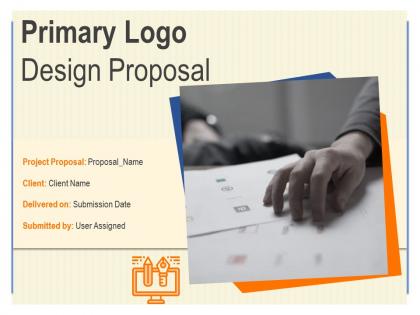
Slide 1: This slide introduces Primary Logo Design Proposal. State Client name, Submission date, User assigned.
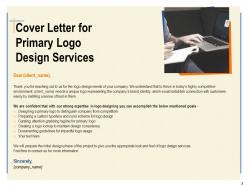
Slide 2: This slide displays Cover Letter for Primary Logo Design Services
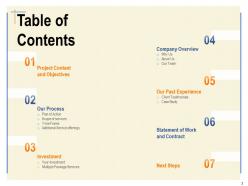
Slide 3: This slide depicts Table of Contents of the presentation.
Slide 4: This slide depicts Table of Content with- Project Context & Objectives
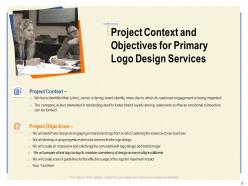
Slide 5: This slide depicts Project Context and Objectives for Primary Logo Design Services
Slide 6: This slide displays Table of Contents.
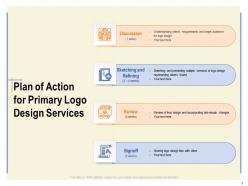
Slide 7: This slide displays Plan of Action for Primary Logo Design Services
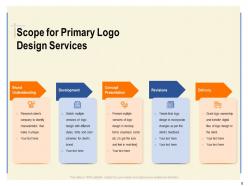
Slide 8: This slide shows Scope for Primary Logo Design Services
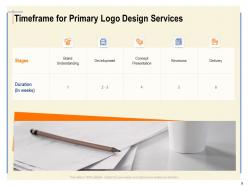
Slide 9: This slide shows Timeframe for Primary Logo Design Services.
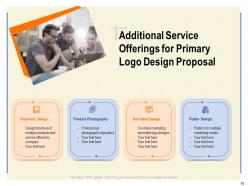
Slide 10: This slide showcases Additional Service Offerings for Primary Logo Design Proposal
Slide 11: This slide shows Table of Contents.
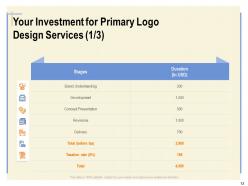
Slide 12: This slide depicts Investment details Primary for Logo Design Services.
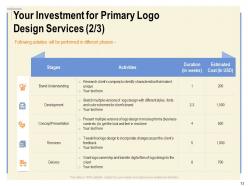
Slide 13: This slide depicts Investment details.
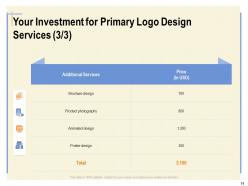
Slide 14: This slide depicts Investment details for Primary Logo Design Services.
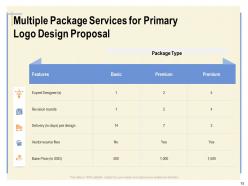
Slide 15: This slide showcases Multiple Package Services for Logo Design.
Slide 16: This slide showcases Table of Contents.
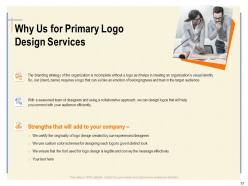
Slide 17: This slide shows reasons for choosing us for Primary Logo Design Services
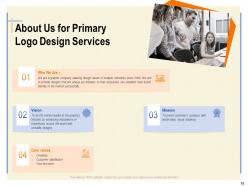
Slide 18: This is About Us slide to showcase Company specifications.
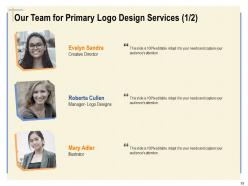
Slide 19: This is Our Team slide with Names and Designations.
Slide 20: This is also Our Team slide with Names and Designations.
Slide 21: This slide displays Table of Contents.
Slide 22: This slide shows Client Testimonials for Primary Logo Design Services.
Slide 23: This slide displays Client Testimonials.
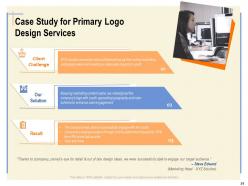
Slide 24: This slide presents Primary Logo Design Services.
Slide 25: This slide displays Table of Contents.
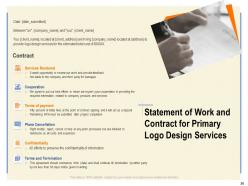
Slide 26: This slide shows Statement of Work and Contract for Primary Logo Design Services
Slide 27: This slide shows Table of Contents with- Next Steps
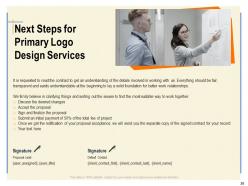
Slide 28: This slide shows Next Steps for Logo Design Services.
Slide 29: This is Contact Us slide with Email Address, Address and Contact number.
Slide 30: This is Icons Slide for Primary Logo Design Proposal.
Slide 31: This slide is titled as Additional Slides for moving forward.
Slide 32: This is About Us slide to showcase Company specifications.
Slide 33: This is Our Mission slide with Vision, Mission and Goal.
Slide 34: This is 30 60 90 Days Plan slide.
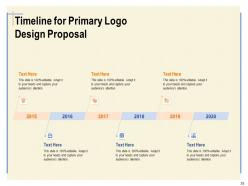
Slide 35: This slide shows Timeline for Logo Design Proposal
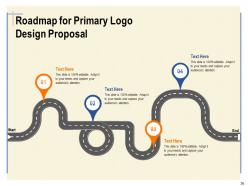
Slide 36: This slide shows Roadmap for Logo Design Proposal
Primary Logo Design Proposal Powerpoint Presentation Slides with all 36 slides:
Use our Primary Logo Design Proposal Powerpoint Presentation Slides to effectively help you save your valuable time. They are readymade to fit into any presentation structure.







FAQs for Primary Logo Design Proposal
Memorable primary logos incorporate simplicity, versatility, relevance to brand identity, distinctive visual elements, and scalable design across multiple platforms. These elements work together by ensuring instant recognition, maintaining clarity at any size, and creating emotional connections with target audiences, with many successful brands finding that strategic simplicity ultimately delivers stronger market presence and competitive differentiation.
Color psychology significantly influences brand perception by evoking specific emotions, conveying brand personality, and creating subconscious associations with quality and trustworthiness. Through strategic color selection, companies enhance brand recognition, communicate their values more effectively, and differentiate themselves in competitive markets, with many organizations finding that consistent color usage across their primary logo increases brand recall by up to 80%.
Typography serves as the visual voice of a brand, influencing readability, memorability, and emotional connection while conveying personality traits like trustworthiness, innovation, or approachability. Strategic font choices enhance brand recognition across digital and print platforms, with companies like Coca-Cola and Google demonstrating how distinctive typography creates competitive advantage, ultimately delivering consistent brand experiences and stronger market positioning.
Designers should approach logo scalability by creating vector-based designs that maintain clarity across sizes, testing readability at minimum dimensions, and developing simplified variations for complex applications. Through systematic testing across digital platforms, print materials, and branded merchandise, designers ensure logos remain recognizable and impactful, while establishing clear usage guidelines that preserve brand integrity across all mediums, ultimately delivering consistent brand recognition.
Common pitfalls include unclear brand positioning, overcomplicated designs, insufficient market research, poor scalability planning, and inadequate client communication throughout the process. These challenges can undermine proposal effectiveness by creating confusion about brand identity, limiting versatility across platforms, and misaligning with target audience expectations, ultimately affecting client satisfaction and competitive positioning.
A primary logo reflects a brand's mission and values through strategic color psychology, meaningful symbolism, carefully chosen typography, and visual metaphors that communicate core principles. These design elements work together to create immediate emotional connections with audiences, with companies like Nike's swoosh representing movement and achievement, or Apple's bitten apple symbolizing knowledge and innovation, ultimately delivering authentic brand recognition and competitive differentiation.
**INPUT**: What techniques can be used to ensure a primary logo is versatile and timeless? **OUTPUT**: Timeless logo design techniques include simple geometric forms, limited color palettes, scalable typography, balanced proportions, and avoiding trend-dependent elements. These approaches streamline brand recognition by ensuring clarity across digital platforms, print materials, and packaging applications, with many organizations finding that minimal, adaptable designs ultimately deliver stronger brand consistency and reduced redesign costs over time. **Word count: 58 words**
Cultural context significantly influences primary logo design through color symbolism, typography preferences, visual metaphors, and cultural associations that resonate with target audiences. For instance, while red signifies prosperity in Asian markets, it may represent danger in Western contexts, and financial institutions often adapt geometric shapes versus organic forms based on regional trust-building preferences, ultimately ensuring brand acceptance and market penetration.
Research and competitor analysis are crucial for creating distinctive, strategically positioned primary logos that avoid market confusion, identify differentiation opportunities, and ensure brand uniqueness. Through comprehensive market research, designers can analyze competitor visual strategies, understand industry conventions, and discover untapped positioning spaces, ultimately delivering logos that enhance brand recognition, establish competitive advantage, and resonate authentically with target audiences.
Client feedback integration involves establishing clear communication channels, setting expectations upfront, presenting design rationale alongside concepts, and creating structured revision rounds with specific parameters. Smart designers filter feedback through brand strategy objectives, educate clients on design principles during presentations, and propose alternative solutions that address concerns while maintaining visual integrity, ultimately delivering logos that satisfy client needs and preserve professional design standards.
Professional logo design software includes Adobe Illustrator, CorelDRAW, Sketch, Figma, and Canva Pro, each offering vector-based capabilities essential for scalable brand assets. These platforms streamline the design process by enabling precise typography control, color management, and infinite scalability, with many agencies finding that vector-based tools ultimately deliver versatile logos suitable for everything from business cards to billboards.
Mockups and presentations enhance logo proposals by showcasing real-world applications, demonstrating versatility across different mediums, and helping clients visualize the brand's potential impact. Through strategic presentation formats, designers can illustrate how logos perform on business cards, websites, signage, and packaging, while comprehensive mockups enable stakeholders to assess scalability and effectiveness, ultimately delivering stronger client confidence and faster approval processes.
Recent primary logo design trends include minimalist geometric shapes, responsive logos adaptable across platforms, bold typography with custom letterforms, gradient overlays, and sustainable color palettes reflecting environmental consciousness. These approaches streamline brand recognition by enhancing digital versatility, improving scalability across touchpoints, and connecting with increasingly conscious consumers, ultimately delivering stronger brand recall and competitive differentiation.
Balance and alignment fundamentally shape a primary logo's visual harmony by creating stability, directing viewer attention, and establishing professional credibility through proper weight distribution and element positioning. These principles enable brands to communicate trustworthiness and sophistication, with many organizations finding that well-balanced, aligned logos enhance brand recognition, streamline marketing consistency, and ultimately deliver stronger customer confidence across all touchpoints.
Effective communication strategies include comprehensive design briefs, visual mockups, competitor analysis, brand alignment documentation, and stakeholder presentations. These approaches streamline approval processes by demonstrating strategic thinking, showcasing practical applications across touchpoints, and connecting design choices to business objectives, with many organizations finding that structured rationale presentations minimize revisions while enhancing client confidence.
-
Unique and attractive product design.
-
Nice and innovative design.
-
Very unique and reliable designs.