


Principles Of Innovation Strategy For Business Model




Try Before you Buy Download Free Sample Product
 Impress Your
 Audience
 100%
100% Editable
 Save Hours
 of Time


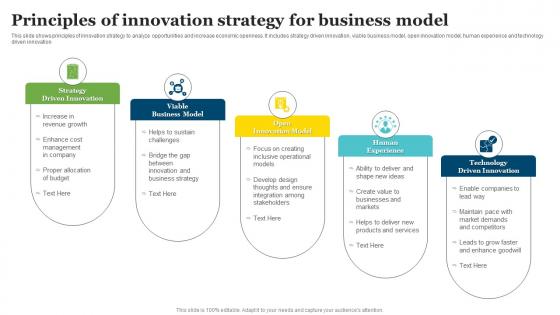
This slide shows principles of innovation strategy to analyze opportunities and increase economic openness. It includes strategy driven innovation, viable business model, open innovation model, human experience and technology driven innovation
People who downloaded this PowerPoint presentation also viewed the following :
Principles Of Innovation Strategy For Business Model with all 6 slides:
Use our Principles Of Innovation Strategy For Business Model to effectively help you save your valuable time. They are readymade to fit into any presentation structure.





FAQs for Principles Of Innovation Strategy
Key components of an effective innovation strategy include clear vision alignment, systematic ideation processes, resource allocation frameworks, risk management protocols, and performance measurement systems. These elements work together by fostering creative thinking, streamlining development workflows, and ensuring strategic focus, with many organizations finding that this comprehensive approach ultimately delivers sustained competitive advantage and accelerated market responsiveness.
Organizations balance risk and innovation by implementing staged experimentation, diversifying innovation portfolios across low and high-risk initiatives, and establishing clear governance frameworks with defined risk thresholds. Through pilot programs and iterative testing, companies in sectors like financial services and healthcare can minimize exposure while exploring breakthrough opportunities, ultimately delivering competitive advantage and sustainable growth in increasingly dynamic markets.
Market research provides crucial insights into customer needs, competitive landscapes, emerging trends, and market gaps that directly inform innovation priorities and resource allocation decisions. Through comprehensive market analysis, organizations can identify unmet demands, validate product concepts, and assess market readiness, ultimately reducing innovation risks while enhancing the likelihood of successful product launches and sustainable competitive advantage.
Companies foster innovation culture by encouraging experimentation, providing dedicated time for creative projects, establishing cross-functional collaboration spaces, implementing idea-sharing platforms, and recognizing innovative contributions. Through these approaches, organizations like 3M and Google enable employees to pursue passion projects, share insights across departments, and take calculated risks, ultimately delivering breakthrough products and enhanced competitive advantage.
Innovation strategy success metrics include revenue from new products, time-to-market acceleration, R&D return on investment, customer adoption rates, and patent portfolio growth. These measurements enable organizations to track both financial outcomes and operational efficiency, with many companies finding that combining leading indicators like idea pipeline strength with lagging indicators such as market share gains ultimately delivers comprehensive insights into innovation performance and competitive positioning.
Digital transformation trends significantly influence innovation strategies by driving organizations toward cloud-first approaches, data-driven decision making, and customer-centric solutions. These trends enable companies to accelerate product development cycles, enhance operational efficiency, and create seamless digital experiences, with many finding that strategic technology adoption delivers competitive advantages and sustainable growth in increasingly dynamic markets.
Startups can innovate through lean methodologies, strategic partnerships, open-source technologies, customer co-creation, and agile development cycles. These approaches enable resource-strapped companies to accelerate product development, reduce costs, and validate market fit, with many successful startups finding that strategic collaboration and iterative testing ultimately deliver competitive advantages without substantial capital investment.
Collaboration with external stakeholders enhances innovation by bringing diverse perspectives, specialized expertise, and complementary resources that internal teams might lack. Through strategic partnerships with suppliers, customers, universities, and startups, organizations accelerate product development, reduce research costs, and access emerging technologies, ultimately delivering breakthrough solutions and competitive advantage in increasingly complex markets.
Common innovation strategy pitfalls include lack of clear vision, insufficient resource allocation, resistance to change, poor risk management, and inadequate market research. These challenges can significantly hinder progress, with many organizations finding that successful innovation requires strategic leadership commitment, cross-functional collaboration, and systematic processes that balance creative exploration with practical implementation, ultimately delivering sustainable competitive advantage.
Organizations can prioritize innovation projects by establishing clear strategic alignment criteria, assessing market potential and technical feasibility, evaluating resource requirements, and analyzing competitive advantage opportunities. Many companies use scoring frameworks that balance short-term revenue impact with long-term strategic value, while considering risk tolerance and implementation timelines, ultimately enabling focused resource allocation and maximizing innovation portfolio returns.
Leadership style significantly impacts innovation by shaping organizational culture, risk tolerance, and creative freedom through transformational approaches, collaborative decision-making, and psychological safety. Leaders who encourage experimentation, embrace calculated failures, and provide resources for exploration create environments where teams generate breakthrough solutions, with many organizations finding that supportive leadership accelerates innovation cycles and competitive advantage.
Geographic market differences significantly affect innovation strategies through varying regulatory environments, cultural preferences, economic conditions, and infrastructure capabilities, requiring companies to adapt their approaches accordingly. Organizations increasingly localize their innovation efforts, with technology companies customizing features for different regions, pharmaceutical firms navigating diverse approval processes, and consumer brands tailoring products to regional tastes, ultimately delivering competitive advantage through market-specific solutions.
Organizations should monitor artificial intelligence and machine learning, Internet of Things integration, blockchain applications, augmented and virtual reality, and edge computing technologies. These emerging technologies streamline operations by automating processes, enhancing customer experiences, and enabling data-driven decision making, with many companies finding that early adoption delivers significant competitive advantages in increasingly digital markets.
Companies leverage customer feedback in innovation through surveys, focus groups, social media monitoring, beta testing programs, and direct customer interviews. These insights enable organizations to identify unmet needs, refine product features, and reduce development risks, with many businesses finding that customer-driven innovation delivers faster market adoption and stronger competitive advantage.
Successful innovation strategies include Apple's design-first approach, Amazon's customer-centric innovation, Tesla's vertical integration, and Netflix's data-driven content creation. These companies revolutionize their sectors by combining market research with bold experimentation, rapid prototyping, and strategic partnerships, ultimately delivering enhanced customer experiences and sustainable competitive advantages.
-
I’ve been your client for a few years now. Couldn’t be more than happy after using your templates. Thank you!
-
The PPTs are extremely simple to modify. Thank you for providing the slides that are ready to be used. They assist me in saving a lot of time.