


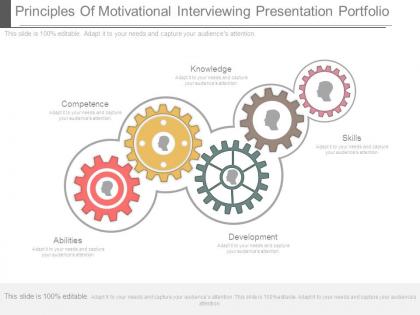
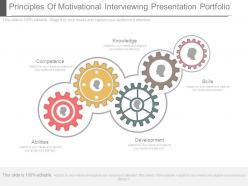
Principles of motivational interviewing presentation portfolio




Try Before you Buy Download Free Sample Product
 Impress Your
 Audience
 100%
100% Editable
 Save Hours
 of Time


Click away on our Principles Of Motivational Interviewing Presentation Portfolio site. Be prepared for a fascinating experience.
People who downloaded this PowerPoint presentation also viewed the following :
Principles of motivational interviewing presentation portfolio with all 7 slides:
Demonstrate a 'can do' attitude with our Principles Of Motivational Interviewing Presentation Portfolio. They will believe you are a go-getter.



FAQs for Principles of motivational
Motivational interviewing's core principles include expressing empathy, developing discrepancy between current behavior and goals, rolling with resistance, supporting self-efficacy, and fostering collaborative partnerships. These principles enhance behavioral change by creating non-confrontational dialogue, building intrinsic motivation, and empowering individuals to identify their own solutions, with many healthcare organizations and corporate wellness programs finding that this approach delivers higher engagement rates and sustained outcomes.
Motivational interviewing differs from traditional counseling by emphasizing client autonomy, collaborative goal-setting, and eliciting intrinsic motivation rather than providing direct advice or confrontational approaches. This client-centered method enhances engagement through reflective listening, open-ended questioning, and affirming client strengths, with many healthcare organizations and corporate wellness programs finding that it delivers higher participation rates and sustainable behavioral change outcomes.
Motivational interviewing proves most effective in healthcare settings for behavior change, addiction treatment programs, mental health counseling, and workplace coaching environments. Healthcare providers, therapists, and organizational leaders find that this approach enhances patient compliance, reduces resistance to treatment, and improves engagement outcomes, while simultaneously building stronger therapeutic relationships and ultimately delivering more sustainable behavioral transformations.
Empathy serves as the foundational element in motivational interviewing, enabling practitioners to understand clients' perspectives, validate their experiences, and create psychological safety for honest dialogue. Through empathetic listening and reflection, counselors in healthcare, addiction treatment, and corporate coaching build trust and rapport, while reducing resistance and defensiveness, ultimately facilitating clients' intrinsic motivation for positive behavioral change.
**INPUT**: How can motivational interviewing be adapted for diverse populations? **OUTPUT**: Motivational interviewing adapts for diverse populations through cultural competency training, language-appropriate materials, community-specific examples, and culturally relevant change frameworks that honor different values and communication styles. Healthcare systems, educational institutions, and social services increasingly customize these approaches by incorporating traditional practices, faith-based perspectives, and family-centered decision-making processes, ultimately enhancing engagement and achieving more sustainable behavioral changes across multicultural communities. [Word count: 60]
Practitioners can evoke change talk through open-ended questions like "What concerns you about your current situation?", reflective listening that amplifies client motivations, exploring discrepancies between current behaviors and personal values, and using scaling questions to assess readiness levels. These techniques work by creating psychological space for clients to voice their own arguments for change, with many therapists and counselors finding that client-generated motivations prove more sustainable than externally imposed directives, ultimately enhancing treatment engagement and long-term behavioral outcomes.
Motivational interviewing enhances substance use disorder treatment by building patient motivation through empathetic listening, exploring ambivalence about change, and strengthening commitment to recovery goals. Healthcare providers in rehabilitation centers, outpatient clinics, and hospitals use these collaborative techniques to reduce resistance, increase treatment engagement, and improve long-term sobriety outcomes.
Common challenges include maintaining patient-centered communication, avoiding the "righting reflex" to give direct advice, developing effective reflective listening skills, and managing resistance without confrontation. Healthcare providers, counselors, and social workers often find that transitioning from traditional directive approaches requires significant practice and ongoing supervision, while balancing empathy with professional boundaries ultimately delivers stronger therapeutic relationships and improved patient engagement outcomes.
Follow-up sessions enhance motivational interviewing effectiveness by reinforcing behavioral changes, addressing emerging challenges, and maintaining client momentum through ongoing support and accountability. These sessions enable healthcare providers, counselors, and coaches to track progress, adjust strategies based on real-world outcomes, and sustain motivation over time, ultimately delivering higher success rates and lasting behavioral transformation.
Essential skills for mastering motivational interviewing include active listening, empathetic responding, strategic questioning, reflective summarizing, and collaborative goal-setting. These communication techniques enhance client engagement by building trust, exploring motivations, and resolving ambivalence, with healthcare providers, counselors, and organizational coaches finding that this approach ultimately delivers stronger behavioral outcomes and sustainable change.
Motivational interviewing integrates seamlessly into existing therapeutic frameworks by enhancing client engagement, strengthening therapeutic alliance, and amplifying treatment outcomes across cognitive-behavioral, psychodynamic, and solution-focused approaches. Many therapists find that incorporating MI's reflective listening and change-talk elicitation techniques creates more collaborative sessions, reduces client resistance, and ultimately accelerates progress toward therapeutic goals.
Extensive research demonstrates motivational interviewing's effectiveness across healthcare, addiction treatment, mental health, and wellness programs, with meta-analyses showing significant behavioral change outcomes. Studies from medical institutions, substance abuse centers, and corporate wellness initiatives consistently find that MI techniques enhance patient compliance, reduce resistance to treatment, and accelerate behavior modification, ultimately delivering improved health outcomes and cost-effective interventions.
Motivational interviewing addresses ambivalence by exploring clients' conflicting feelings without judgment, helping them articulate both sides of their internal struggle through reflective listening and open-ended questions. This approach enables clients to voice their own motivations for change while working through resistance, ultimately allowing them to resolve contradictory emotions and move toward sustainable behavioral modifications with greater self-awareness and commitment.
**INPUT**: What tools and resources are available for practitioners to improve their motivational interviewing skills? **OUTPUT**: Motivational interviewing skill development tools include specialized training programs, certification courses, role-playing simulations, peer supervision groups, and evidence-based assessment frameworks. These resources enhance practitioner effectiveness by strengthening active listening techniques, refining reflective responses, and building change-focused conversations, with healthcare organizations, counseling centers, and social services finding that structured skill-building ultimately delivers improved client engagement and better therapeutic outcomes.
Motivational interviewing fosters client autonomy by encouraging self-directed decision-making, exploring personal values and motivations, and avoiding prescriptive advice that undermines independence. This collaborative approach builds resilience through enhanced self-efficacy, improved coping strategies, and strengthened intrinsic motivation, with many healthcare organizations and counseling services finding that clients demonstrate significantly better long-term outcomes and sustained behavioral changes.
-
Awesome presentation, really professional and easy to edit.
-
Use of different colors is good. It's simple and attractive.