


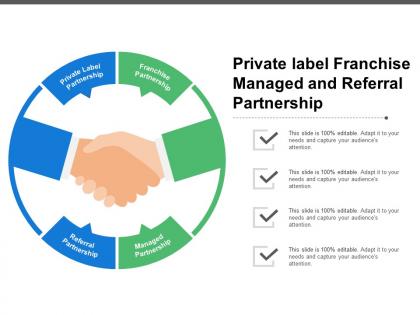
Private label franchise managed and referral partnership




Try Before you Buy Download Free Sample Product
 Impress Your
 Audience
 100%
100% Editable
 Save Hours
 of Time


Convey your thoughts with complete clarity. Our Private Label Franchise Managed And Referral Partnership avoid all confusion.
People who downloaded this PowerPoint presentation also viewed the following :
Private label franchise managed and referral partnership with all 5 slides:
Our Private Label Franchise Managed And Referral Partnership ensure you do not founder. They eliminate any chance of error.



FAQs for Private label franchise managed
A successful private label franchise partnership is defined by strong brand alignment, clear operational standards, comprehensive training programs, robust marketing support, and transparent financial structures. These partnerships thrive when franchisors provide consistent quality control and ongoing business development support, while franchisees maintain brand integrity and customer service excellence, ultimately delivering scalable growth and mutual profitability across diverse markets.
Brands can effectively assess potential franchise partners by evaluating their market presence, operational capabilities, financial stability, brand alignment, and customer base demographics. Through comprehensive due diligence including financial audits, market analysis, and alignment assessments, companies can identify partners who deliver complementary strengths, shared values, and proven execution capabilities, ultimately ensuring successful private label partnerships that enhance market reach and operational efficiency.
Private label franchise partnerships offer established brand recognition, proven business models, comprehensive training programs, ongoing operational support, and reduced startup risks. These strategic arrangements enable entrepreneurs to leverage successful systems while maintaining local market flexibility, with many franchisees finding that combining brand strength with operational guidance delivers faster market entry, higher customer trust, and ultimately greater profitability than independent ventures.
Brand reputation significantly impacts private label franchise relationships by influencing customer trust, partner selection criteria, and market positioning strategies. Strong brand reputations enable franchisors to attract premium partners, command higher licensing fees, and expand more rapidly across diverse markets, while weaker reputations may limit partnership opportunities, ultimately affecting scalability and competitive advantage in increasingly crowded retail environments.
Private label franchise partnerships can employ quality control strategies including supplier audits, standardized manufacturing protocols, regular product testing, clear quality specifications, and comprehensive monitoring systems. These approaches streamline consistency by establishing rigorous vendor requirements, implementing batch tracking procedures, and conducting frequent inspections, with many retail franchises finding that strategic quality partnerships ultimately deliver enhanced brand reputation and customer satisfaction across locations.
Market research is crucial for private label franchise success, as it identifies target demographics, analyzes competitor positioning, validates product demand, and determines optimal pricing strategies. Through comprehensive market analysis, franchisors can minimize investment risks, enhance operational efficiency, and accelerate market penetration, with many retail and food service franchises finding that data-driven insights ultimately deliver stronger brand positioning and competitive advantage.
Customization enables private label franchise partners to tailor products, branding, and service offerings to their specific market needs, customer preferences, and operational requirements. This strategic flexibility allows franchisees to maintain brand consistency while adapting to local demographics, ultimately delivering enhanced customer experiences and competitive differentiation in their respective markets.
Private label franchises leverage digital marketing through targeted social media campaigns, search engine optimization, content marketing, email automation, and local SEO strategies. These approaches enable franchisees to build brand recognition, attract qualified leads, and drive customer acquisition while maintaining consistent messaging across locations, with many retail and service franchises finding that integrated digital strategies deliver faster market penetration and sustainable revenue growth.
Common challenges in private label franchise partnerships include brand control conflicts, quality standardization issues, pricing disagreements, territorial disputes, and communication breakdowns between partners. While these partnerships offer market expansion opportunities, many franchisors and private label partners find that establishing clear governance frameworks, standardized operational procedures, and regular performance reviews ultimately delivers stronger brand consistency and sustainable competitive advantage.
Private label franchises allow franchisees to operate under their own brand while using the franchisor's proven systems, products, and operational support, unlike traditional franchises that require using the franchisor's established brand identity. This model enables greater local market flexibility and brand customization, with many entrepreneurs finding that private labeling delivers enhanced community connection while maintaining operational efficiency and franchisor guidance.
Private label agreements require careful attention to intellectual property rights, product liability allocation, quality control standards, termination clauses, and regulatory compliance requirements. These legal frameworks help protect both parties while establishing clear boundaries for manufacturing responsibilities, brand usage rights, and dispute resolution processes, with many successful partnerships finding that comprehensive contracts ultimately streamline operations and minimize future conflicts.
Effective communication enhances private label franchise partnerships by establishing clear expectations, streamlining operational processes, and ensuring consistent brand standards across all locations. Through regular check-ins, transparent reporting systems, and collaborative feedback mechanisms, franchisors and franchisees build stronger relationships, resolve issues faster, and ultimately deliver improved customer experiences while maximizing profitability for both parties.
Private label franchise success metrics include revenue growth, profit margins, market penetration rates, brand consistency scores, and customer satisfaction levels. Through comprehensive tracking systems, brands can monitor franchisee performance, operational efficiency, and market expansion, while identifying optimization opportunities and ensuring quality standards, ultimately delivering sustainable growth and competitive advantage across their franchise network.
Private label franchises can expand their product lines effectively through market research analysis, strategic supplier partnerships, customer feedback integration, and phased rollout testing. These approaches streamline expansion by identifying demand gaps, leveraging existing distribution networks, and minimizing inventory risks, with many franchisees finding that gradual diversification ultimately delivers enhanced revenue streams and stronger competitive positioning.
Consumer perception significantly influences private label brand success through quality associations, price-value perceptions, and brand trust levels. Through strategic positioning and consistent product delivery, retailers like Target and Costco have transformed consumer attitudes, with many customers now preferring store brands over national alternatives, ultimately driving higher margins and customer loyalty.
-
Presentation Design is very nice, good work with the content as well.
-
Visually stunning presentation, love the content.