


Process scope powerpoint template





Try Before you Buy Download Free Sample Product
 Impress Your
 Audience
 100%
100% Editable
 Save Hours
 of Time


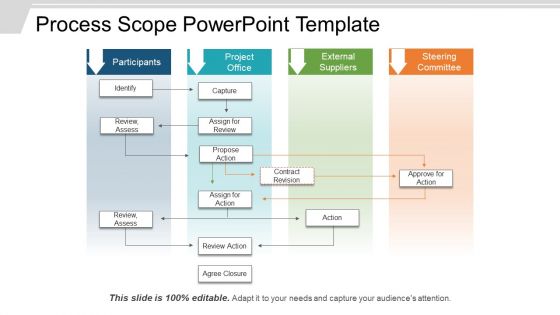
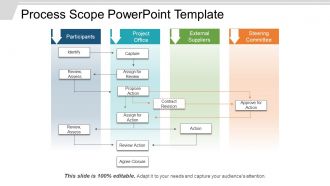
If you are looking for a comprehensive Process Scope PowerPoint presentation slide, then this is the one. Our team of talented designers has brainstormed all the aspects required for an effective process flowchart management PPT and thus, came up with this effective design. Analysis of the scope of process is the essence of process management. So, it becomes more important to have proper know – how of the process. The success of a project depends on the organization’s sync with the technicalities involved and as a project manager, it is you who must keep the team abreast with the requirements. This detailed process scope PPT template will help you elaborate upon the processes involved. You can easily outline the sequence of activities involved in converting the inputs into a valued output. Also, as you outline the process involved, you can broadly identify the category of people involved in the different processes. The varied categories have been given different colors to highlight them. The aesthetic design will make your presentation eye – catching. The details will become easier to spot with this impeccable graphic design. So, go ahead and download the template at the click of a button. Avoid any faux pas with our Process Scope Powerpoint Template. You will never commit any gaffes.
People who downloaded this PowerPoint presentation also viewed the following :
Process scope powerpoint template with all 5 slides:
Convince folks to act with full concentration with our Process Scope Powerpoint Template. Identify any haphazard approaches.


FAQs for Process
So process scope is just figuring out what you're actually managing vs what's someone else's problem. Draw those boundaries early! Which teams are you working with? What approvals do you need? Where does your authority end? Document all this stuff upfront because trust me, scope creep will bite you later. You don't want to be three weeks in wondering whose responsibility something is. I learned this the hard way on my last project - spent way too much time doing work that wasn't even mine. Getting clear on who owns what saves you from those messy situations where everyone's pointing fingers.
Dude, process scope is what keeps your project from turning into a total nightmare. You need clear boundaries on what processes you're tackling - otherwise you'll waste time on everything and accomplish nothing. I learned this the hard way on a project that went completely sideways. Define what's in and what's out right from the start. Document it somewhere everyone can see. When stakeholders inevitably ask for "just one tiny thing," you can point to those boundaries. It's honestly the only way to hit your deadlines and keep resources focused where they matter.
So basically you need to nail down your start and end points first. Then map out all the activities, who's involved, and what goes in/comes out at each step. Here's what always gets people though - you HAVE to spell out what's not included. I learned this the hard way on a project last year. Also document your resources, systems, tools, plus any quality standards you're stuck with. Short sentences work better than long ones for this stuff. Get everyone to actually agree on this list before you start, otherwise scope creep will destroy you later. Trust me on that one.
First thing - figure out where this thing actually starts and stops. Map the trigger event to the final deliverable. Get everyone in a room (Zoom works) and draw it out together, because I guarantee you all have different ideas about what's included. Be really explicit about what's in scope vs out of scope, even the obvious stuff. Those hand-offs between departments? Document them - that's where everything usually falls apart. Honestly, the whole exercise is pointless if people don't agree on the boundaries upfront, so get sign-off before you move on.
Honestly, scope creep is gonna be your worst enemy here. Stakeholders will keep throwing in "just one more thing" until your timeline's completely shot. Then you've got the nightmare of figuring out where one process actually ends and another starts - especially when teams overlap everywhere. Getting everyone to agree on what's included? Good luck with that one. Different stakeholders always want different things. Here's what saved me: write down your boundaries from day one, get people to actually sign off on them, and set up some kind of formal process for changes. Otherwise you'll be drowning in additions.
So project scope is basically *what* you're delivering - like the actual features or outcomes. Process scope? That's the *how* - all the steps, workflows, and methods you'll use to get there. Here's the thing though - you could have identical project goals but totally different approaches depending on your team or timeline. Maybe you're going agile vs waterfall, or working remote vs in-person. Same end result, completely different process. Honestly, I learned this the hard way on my last project. Map both out upfront and you'll dodge so many arguments later about who's doing what and when.
So I'd grab Lucidchart or just use a whiteboard to map everything out visually first. RACI matrices are clutch for figuring out who does what - seriously saves you from so much confusion later. SIPOC diagrams work great too for tracking the whole supplier-to-customer flow. Oh, and scope statements! Those are money for documenting what's included vs. what's absolutely not happening. My favorite though? Getting everyone together (doesn't matter if it's Zoom or in-person) to argue through all the blurry boundaries upfront. Way better than dealing with scope creep nightmares mid-project.
Dude, trust me on this - when your process scope is all over the place, everything falls apart. Teams start working on totally different assumptions about what they're supposed to be doing. Deadlines get blown because nobody really knows what's actually included. Your budget? Forget about it. I've seen this happen so many times and it's always a mess to untangle later. Stakeholders get pissed when the final product doesn't match what they had in mind. Honestly, just bite the bullet and hammer out those boundaries upfront, even though it's boring as hell.
Start by literally writing your process goals next to company objectives and see where they don't match up. Talk to stakeholders regularly - priorities change constantly and you'll miss it otherwise. Track metrics leadership actually cares about, not just the easy stuff. Do quarterly reviews asking "does this still make sense for our big picture?" Processes have this weird habit of sticking around way past their usefulness. Oh, and schedule those alignment conversations now before you're neck-deep in execution mode. Trust me on that one.
You gotta nail down your process scope first - think of it like setting boundaries around exactly what you're looking at for risks. Otherwise you'll end up with this unfocused mess that tries to analyze everything at once. I've seen people skip this step and regret it. Clear boundaries help you spot the risks that actually matter instead of getting distracted by random stuff that won't impact your process. Start by figuring out where your process begins and ends. Then map your inputs and outputs. Trust me, doing this upfront saves you tons of headache later when you're actually identifying risks.
Yeah, continuous improvement totally expands your process scope - usually in ways you didn't see coming. Your team finds inefficiencies and suddenly you're adding extra steps, more reviews, quality checks. It's honestly like opening Pandora's box sometimes. One fix creates three more opportunities! The scope creep isn't necessarily bad, just means your original boundaries shift and now you're juggling more complexity. I'd track these changes as they happen so you can adjust timelines and resources instead of getting blindsided later. Better to see it coming than scramble when deadlines hit.
Honestly, scope creep will kill your project if you're not careful about it upfront. Write down exactly what you're doing AND what you're NOT doing - trust me on this one. Share it with everyone, not just the main people. I've watched too many projects go sideways because someone assumed their random idea was part of the plan. Get people to actually agree to it in writing if you can. Draw diagrams when stuff gets complex. Then keep bringing it up in meetings - don't just send the document once and forget about it. Every time someone suggests something new, point back to those boundaries you set.
Honestly, you need to track stuff before and after each scope change hits. Timeline shifts, budget changes, how your resources get shuffled around - all that matters. Quality metrics too, like defect rates. I know, I know, sounds like a ton of work but trust me on this one. If you're doing agile, definitely watch your team velocity because scope creep absolutely destroys sprint performance. The key is getting baseline numbers early so you actually have something to compare against later. Just set up a basic tracking sheet that gets updated weekly. Nothing fancy - you want to catch trends before they bite you.
Look at Toyota's lean manufacturing - they nailed it by focusing on eliminating waste step by step, and honestly it changed everything for car companies. Amazon does the same thing with their delivery process, mapping out every single step from when you click "buy" to when it hits your door. Even McDonald's (love it or hate it) figured this out decades ago with their assembly line approach. None of these companies tried to fix everything at once though - that's the mistake most people make. Pick one process you actually control and get those boundaries crystal clear first. Once you've got that down, then you can think bigger.
Honestly, tech makes this so much easier. Start with something basic like Lucidchart or Visio to map out your processes - way better than those messy spreadsheets everyone loves to hate. Once you've got that down, workflow automation and project management tools help you see exactly where things hand off between teams. Real-time collaboration is clutch here since everyone can jump in and validate the scope together. The best part? Automated tracking catches scope creep before it spirals out of control. I'd probably stick with simple mapping first though - don't overcomplicate it right out the gate.
-
Excellent Designs.
-
Use of icon with content is very relateable, informative and appealing.