


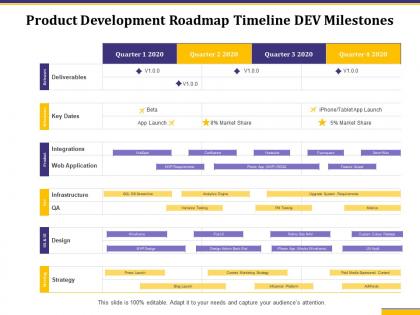
Product development roadmap timeline dev milestones ppt powerpoint topics




Try Before you Buy Download Free Sample Product
 Impress Your
 Audience
 100%
100% Editable
 Save Hours
 of Time


Our Product Development Roadmap Timeline Dev Milestones Ppt Powerpoint Topics are topically designed to provide an attractive backdrop to any subject. Use them to look like a presentation pro.
People who downloaded this PowerPoint presentation also viewed the following :
Product development roadmap timeline dev milestones ppt powerpoint topics with all 2 slides:
Use our Product Development Roadmap Timeline Dev Milestones Ppt Powerpoint Topics to effectively help you save your valuable time. They are readymade to fit into any presentation structure.
FAQs for Product development roadmap timeline dev milestones
The key stages of a product development roadmap include market research and ideation, concept development and validation, design and prototyping, testing and iteration, and launch preparation with go-to-market strategy. These stages enable organizations to systematically transform ideas into market-ready products while minimizing risks, optimizing resource allocation, and ensuring customer needs alignment, ultimately delivering competitive advantage and accelerated time-to-market.
Feature prioritization involves evaluating customer needs, business value, technical feasibility, resource requirements, and market timing to determine development sequence. Strategic frameworks like MoSCoW method, value-impact matrices, and customer feedback analysis help teams balance urgent fixes with long-term innovation, ultimately delivering maximum value while maintaining competitive positioning and sustainable growth trajectories.
**INPUT**: What tools and software are best suited for visualizing a product development roadmap? **OUTPUT**: Tools for visualizing product development roadmaps include Aha!, ProductPlan, Roadmunk, Monday.com, and Asana, each offering timeline views, milestone tracking, and stakeholder collaboration features. These platforms streamline cross-functional alignment by enabling real-time updates, resource allocation visibility, and progress monitoring, with many technology companies finding that visual roadmaps enhance team coordination and accelerate product delivery cycles. [Word count: 58 words]
Market research informs product development roadmaps by identifying customer needs, competitive gaps, market trends, and emerging opportunities through surveys, focus groups, and analytics. This data enables organizations to prioritize features strategically, validate concepts early, and allocate resources effectively, with many companies finding that research-driven roadmaps deliver higher success rates and stronger market positioning.
Cross-functional collaboration ensures product roadmaps integrate diverse perspectives from engineering, marketing, sales, customer success, and design teams, creating comprehensive strategies that balance technical feasibility with market demands. This collaborative approach enables organizations to identify potential bottlenecks early, align resource allocation across departments, and deliver products that meet both user needs and business objectives, ultimately accelerating time-to-market.
Product development roadmaps should typically be updated quarterly, with more frequent reviews during rapid market changes or major pivots. This cadence enables teams to incorporate customer feedback, competitive insights, and technological advances while maintaining strategic direction, with many organizations finding that regular updates enhance agility, improve resource allocation, and ultimately deliver more market-relevant products.
Key metrics include feature adoption rates, time-to-market for deliverables, customer satisfaction scores, revenue impact from new features, and development velocity. These measurements enable organizations to assess roadmap effectiveness by tracking user engagement, delivery efficiency, and business outcomes, with many product teams finding that combining leading indicators like sprint completion rates with lagging indicators like customer retention ultimately delivers comprehensive visibility into strategic execution and competitive positioning.
User feedback and testing significantly influence roadmap adjustments by revealing usability issues, feature gaps, performance bottlenecks, and shifting market demands. Through continuous testing cycles, product teams can prioritize high-impact features, eliminate low-value initiatives, and accelerate development timelines, with many organizations finding that feedback-driven roadmaps deliver stronger market fit and enhanced customer satisfaction.
Aligning stakeholders around a product development roadmap requires regular communication through structured meetings, transparent priority-setting frameworks, shared success metrics, and collaborative planning sessions that incorporate diverse perspectives. These strategies streamline decision-making by establishing clear expectations, reducing conflicting priorities, and ensuring consistent updates, with many organizations finding that quarterly alignment reviews and cross-functional workshops ultimately deliver stronger buy-in and faster execution.
Effective roadmap communication involves creating visual timelines, conducting regular milestone reviews, establishing clear feedback channels, and maintaining transparent progress updates across all project phases. Through strategic presentations and collaborative planning sessions, teams can align expectations, address concerns proactively, and ensure stakeholder buy-in, ultimately delivering enhanced project coordination and accelerated development cycles.
Common pitfalls include overcommitting to unrealistic timelines, lacking stakeholder alignment, ignoring market feedback, setting vague priorities, and failing to build in flexibility for iterations. These challenges often derail development cycles by creating resource conflicts, missed deadlines, and misaligned expectations, with many organizations finding that regular roadmap reviews and cross-functional collaboration ultimately deliver more strategic outcomes.
Balancing short-term goals with long-term vision requires strategic milestone planning, stakeholder alignment, and flexible prioritization frameworks that connect immediate deliverables to broader objectives. Organizations achieve this by implementing quarterly review cycles, maintaining clear success metrics, and ensuring each short-term initiative contributes to the overarching vision, ultimately delivering sustainable growth while meeting immediate market demands.
Product development forecasting methods include bottom-up estimation, historical data analysis, Monte Carlo simulation, agile story point estimation, and resource capacity planning. These approaches enable organizations to streamline project planning by identifying potential bottlenecks, optimizing resource allocation, and setting realistic milestones, with many development teams finding that combining multiple forecasting techniques ultimately delivers more accurate timelines and enhanced project success rates.
A product development roadmap remains crucial in Agile methodologies, providing strategic direction, stakeholder alignment, and long-term vision while maintaining flexibility for iterative development. It enables Agile teams to balance sprint-level execution with broader business objectives, communicate progress to stakeholders, and adapt priorities based on market feedback, ultimately delivering coherent product evolution rather than disconnected features.
Competitive analysis enhances product development roadmaps by identifying market gaps, revealing feature opportunities, and informing strategic positioning decisions that differentiate your offerings. Through systematic competitor evaluation, organizations can prioritize development resources more effectively, accelerate time-to-market for critical features, and ultimately deliver products that capture greater market share while avoiding costly missteps.
-
Informative presentations that are easily editable.
-
Very unique and reliable designs.