


Product Launch Goals Checklist With Status In Powerpoint And Google Slides




Try Before you Buy Download Free Sample Product
 Impress Your
 Audience
 100%
100% Editable
 Save Hours
 of Time


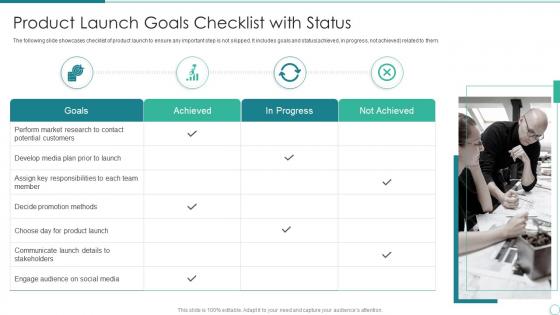
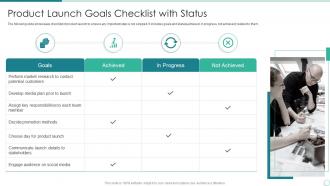
The following slide showcases checklist of product launch to ensure any important step is not skipped. It includes goals and status achieved, in progress, not achieved related to them.
People who downloaded this PowerPoint presentation also viewed the following :
Product Launch Goals Checklist With Status In Powerpoint And Google Slides with all 6 slides:
Use our Product Launch Goals Checklist With Status In Powerpoint And Google Slides to effectively help you save your valuable time. They are readymade to fit into any presentation structure.





FAQs for Product Launch Goals Checklist With Status In Powerpoint
A comprehensive product launch checklist should include market research and competitive analysis, target audience identification, pricing strategy, marketing campaign development, sales team training, and distribution channel preparation. These elements work together by ensuring strategic alignment, minimizing launch risks, and maximizing market penetration, with many organizations finding that thorough pre-launch preparation ultimately delivers faster adoption and competitive advantage.
A presentation template enhances product launch effectiveness by ensuring consistent messaging, professional visual design, and structured information flow across all stakeholder communications. Through standardized templates, teams streamline preparation time, maintain brand coherence, and deliver compelling narratives that resonate with investors, customers, and partners, ultimately accelerating market adoption and competitive positioning.
Market research forms the foundation of an effective product launch checklist by identifying target audiences, competitive landscapes, pricing strategies, optimal timing, and distribution channels. Through comprehensive market analysis, companies can prioritize critical launch activities, anticipate potential challenges, and allocate resources strategically, with many organizations finding that research-driven checklists significantly reduce launch risks while enhancing market penetration and customer adoption rates.
Visual storytelling in product launches combines compelling narratives with strategic design elements like customer journey maps, before-and-after scenarios, problem-solution frameworks, and data visualizations that demonstrate value propositions. These storytelling techniques enhance audience engagement by creating emotional connections, simplifying complex features into relatable benefits, and ultimately delivering memorable presentations that drive adoption and competitive differentiation.
Post-launch metrics include user adoption rates, customer acquisition costs, revenue growth, churn rates, and customer satisfaction scores. These performance indicators enable organizations to assess market penetration, operational efficiency, and user engagement, with many companies finding that tracking conversion funnels and feature usage delivers actionable insights for strategic optimization.
Marketing and sales teams collaborate effectively during product launches through shared goal setting, coordinated messaging development, and integrated campaign planning. By establishing joint training sessions, creating unified customer personas, and implementing shared tracking systems, these teams streamline communication and accelerate market penetration, with many organizations finding that this strategic alignment ultimately delivers faster revenue growth and stronger competitive positioning.
**INPUT**: What are the best practices for creating a timeline for product launch activities? **OUTPUT**: Best practices for product launch timelines include working backward from launch date, incorporating buffer periods, defining clear milestones, coordinating cross-functional dependencies, and establishing regular checkpoint reviews. These approaches streamline coordination by aligning marketing campaigns, production schedules, and stakeholder communications, with many organizations finding that structured timelines ultimately deliver smoother launches and greater market readiness. [Word count: 58 words]
Common pitfalls include insufficient market research, inadequate stakeholder communication, unrealistic timelines, poor risk assessment, and limited post-launch monitoring plans. These oversights often derail launches by creating misaligned expectations, resource constraints, and missed opportunities, with many organizations finding that comprehensive planning and clear accountability measures ultimately deliver smoother executions and stronger market reception.
Customer feedback should be integrated through pre-launch beta testing, focus groups, survey analysis, and iterative product refinement based on user insights. This strategic approach enables companies to address pain points, enhance features, and align messaging with customer expectations, with many organizations finding that feedback-driven launches deliver higher adoption rates, reduced support costs, and stronger market positioning.
Product launch tools include project management platforms like Asana or Monday.com, marketing automation software such as HubSpot, analytics dashboards, collaboration tools like Slack, and customer feedback systems. These technologies streamline launches by centralizing task coordination, automating campaign workflows, and tracking performance metrics, with many organizations finding that integrated tool stacks reduce launch timelines while enhancing cross-team collaboration.
**INPUT**: How can we ensure that our product launch targets the right audience? **OUTPUT**: Ensuring your product launch targets the right audience requires comprehensive market research, detailed buyer persona development, competitive analysis, and strategic segmentation based on demographics, behaviors, and needs. Through data-driven insights and customer feedback loops, organizations can refine their targeting strategies, optimize messaging across channels, and deliver personalized experiences that resonate, ultimately driving higher conversion rates and market penetration. [Word count: 60 words]
Essential components include competitor pricing strategies, feature comparisons, market positioning, target audience overlap, and distribution channels. This analysis enables organizations to identify market gaps, differentiate their offerings, and optimize pricing structures, with many companies finding that thorough competitive research ultimately delivers strategic positioning advantages and faster market penetration.
A presentation template establishes consistent messaging, visual standards, and key milestone frameworks that ensure marketing, sales, product development, and operations teams communicate unified information to stakeholders. By standardizing how launch progress, metrics, and deliverables are presented, teams maintain clarity on roles, timelines, and objectives, while enabling seamless collaboration and reducing miscommunication that often derails cross-functional initiatives.
A product launch messaging framework should include value propositions, target audience definitions, competitive differentiators, key benefits, pain point solutions, and consistent brand voice guidelines. These elements streamline communication across sales, marketing, and customer service teams by ensuring unified positioning, clearer customer engagement, and stronger market penetration, ultimately delivering enhanced brand recognition and accelerated adoption rates.
Social media amplifies product launches through strategic content planning, influencer partnerships, targeted advertising campaigns, community engagement, and real-time customer feedback collection. Successful companies leverage platform-specific strategies across LinkedIn, Instagram, and Twitter to build anticipation, demonstrate product value, and drive conversions, with many brands finding that authentic storytelling and user-generated content ultimately deliver higher engagement rates and stronger market penetration.
-
You know what? I'm so glad I opted for this PPT design. It has been a total game-changer for me and my presentations. Thank you!
-
Great quality product.