


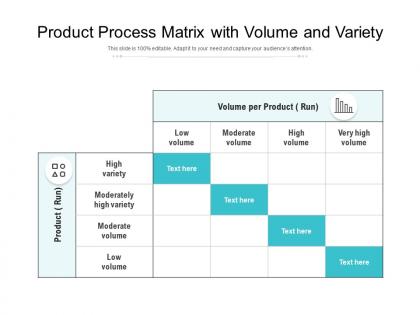
Product process matrix with volume and variety




Try Before you Buy Download Free Sample Product
 Impress Your
 Audience
 100%
100% Editable
 Save Hours
 of Time


Our Product Process Matrix With Volume And Variety are topically designed to provide an attractive backdrop to any subject. Use them to look like a presentation pro.
People who downloaded this PowerPoint presentation also viewed the following :
Product process matrix with volume and variety with all 2 slides:
Use our Product Process Matrix With Volume And Variety to effectively help you save your valuable time. They are readymade to fit into any presentation structure.
FAQs for Product process matrix with
The Product-Process Matrix's key dimensions are product variety (from standardized to customized) and process structure (from job shop to continuous flow). These dimensions interact inversely, with high-volume standardized products aligning with continuous processes, while low-volume customized products suit job shop operations, ultimately enabling organizations to optimize operational efficiency and competitive positioning.
Businesses determine optimal Product-Process Matrix positioning by analyzing production volume, product variety, customization requirements, cost structure, and competitive strategy. Companies must evaluate their market demands against operational capabilities, with low-volume manufacturers often finding job shop processes most effective, while high-volume producers typically benefit from assembly line approaches, ultimately delivering enhanced operational efficiency and strategic alignment.
Market demand changes, production volume requirements, cost pressures, technological advancements, and competitive positioning influence a company's decision to shift its position on the Product-Process Matrix. These strategic shifts enable organizations to optimize operational efficiency, reduce manufacturing costs, and enhance scalability, with many companies finding that aligning their process structure with product characteristics ultimately delivers improved profitability and market responsiveness.
The Product-Process Matrix helps align production processes with product design by matching product volume and variety characteristics with appropriate manufacturing processes, ensuring optimal resource allocation and operational efficiency. Through strategic positioning within the matrix, organizations can identify process improvements, minimize production costs, and enhance product quality, while avoiding misalignment that leads to inefficiencies, ultimately delivering competitive advantage and scalable manufacturing operations.
Volume and variety serve as the fundamental classification axes within the Product-Process Matrix, with volume representing production quantity levels and variety indicating the range of product customization or differentiation. These dimensions enable organizations to strategically position their operations, with high-volume, low-variety scenarios favoring continuous processes, while low-volume, high-variety products benefit from job shop approaches, ultimately delivering optimal resource allocation and competitive positioning.
The Product-Process Matrix proves particularly valuable in manufacturing-intensive industries like automotive, electronics, pharmaceuticals, food processing, and textiles, where production volume and product variety decisions significantly impact operational efficiency. These sectors leverage the matrix to optimize their manufacturing strategies, with automotive companies using it to balance customization demands against mass production benefits, ultimately enhancing competitive positioning and resource allocation.
Companies leverage the Product-Process Matrix by aligning production processes with product volume and variety characteristics, enabling strategic decisions about manufacturing approaches, resource allocation, and capacity planning. This strategic combination streamlines operations by matching process types to product requirements, reducing waste, and optimizing workflow designs, ultimately delivering enhanced operational efficiency and competitive advantage across manufacturing environments.
The Product-Process Matrix limitations include oversimplified categorization, static analysis that doesn't account for rapid market changes, limited consideration of external factors, and difficulty handling hybrid or customized products. While it provides strategic framework guidance, organizations increasingly find that complex manufacturing environments, evolving customer demands, and technological disruptions require more dynamic, multi-dimensional analysis tools for comprehensive decision-making.
The Product-Process Matrix aligns with lean manufacturing by identifying optimal process structures that minimize waste, enhance flow efficiency, and maximize value delivery across different production volumes. Through strategic process selection, manufacturers streamline operations, reduce inventory costs, and eliminate non-value-added activities, with many organizations finding that matrix-guided decisions ultimately deliver faster throughput and improved operational efficiency.
Firms in misaligned positions can adopt strategic realignment through process redesign, product portfolio adjustments, market repositioning, or hybrid manufacturing approaches. These strategies enable organizations to optimize operational efficiency while maintaining competitive advantage, with many companies finding that gradual transitions through intermediate positions, rather than dramatic shifts, deliver sustainable results and minimize operational disruption.
Emerging technologies enable companies to shift their positioning on the Product-Process Matrix by automating production processes, enhancing customization capabilities, and reducing traditional volume constraints. Through AI, robotics, and flexible manufacturing systems, organizations can achieve high-volume efficiency while maintaining product variety, with automotive and electronics manufacturers finding they can deliver both cost advantages and customized solutions simultaneously.
The Product-Process Matrix informs supply chain decisions by aligning process types with product characteristics, determining optimal supplier relationships, inventory strategies, and distribution networks. Through this strategic framework, organizations streamline procurement for job shops requiring flexible suppliers, while assembly lines benefit from standardized partnerships, ultimately delivering cost efficiency and operational alignment across manufacturing environments.
Globalization shifts companies within the Product-Process Matrix by expanding market access, enabling economies of scale, and intensifying competitive pressures that demand operational efficiency. Through global supply chains and distributed manufacturing, organizations can optimize their process positioning while serving diverse markets, with many multinational companies finding that strategic repositioning delivers cost advantages and enhanced market responsiveness.
Organizations should track metrics including production volume, unit costs, product variety levels, capacity utilization, and lead times to assess their Product-Process Matrix position effectively. These performance indicators enable companies to evaluate operational efficiency, resource allocation, and strategic alignment, with manufacturing firms finding that monitoring quality consistency, flexibility responsiveness, and throughput rates ultimately delivers competitive advantage and optimized positioning.
Startups can utilize the Product-Process Matrix by mapping their current product variety and production volume to identify optimal process strategies, then planning transitions as they scale from job shops to batch processes to line flows. This strategic approach enables efficient resource allocation, prevents costly misalignments between product complexity and manufacturing processes, and ultimately delivers streamlined operations that support sustainable growth.
No Reviews