


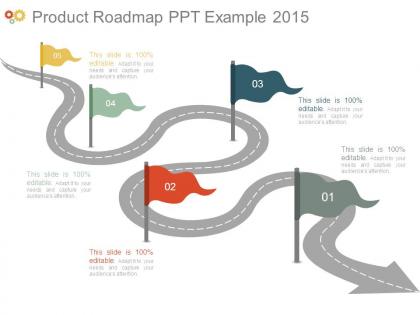
Product roadmap ppt example 2015





Try Before you Buy Download Free Sample Product
 Impress Your
 Audience
 100%
100% Editable
 Save Hours
 of Time


Give folks cause to join forces with our Product Roadmap Ppt Example 2015. Get them involved in achieving common goals.
People who downloaded this PowerPoint presentation also viewed the following :
Product roadmap ppt example 2015 with all 7 slides:
Our Product Roadmap Ppt Example 2015 assure you an excellent bargain. They create affordable brilliance.
FAQs for Product roadmap
A product roadmap serves as a strategic communication tool that aligns teams, stakeholders, and resources around a shared product vision, prioritizes feature development based on business objectives, and translates long-term goals into actionable timelines. This strategic framework enables organizations to coordinate cross-functional efforts, manage stakeholder expectations, and maintain competitive advantage through systematic product evolution, with many technology companies finding that clear roadmaps significantly reduce development inefficiencies.
Teams effectively prioritize roadmap features by evaluating customer impact, business value, technical feasibility, and strategic alignment with company objectives. Through frameworks like RICE scoring, user feedback analysis, and competitive assessment, product teams streamline decision-making while balancing short-term wins with long-term vision, ultimately delivering enhanced user experiences and sustained competitive advantage.
A comprehensive product roadmap presentation should include strategic objectives, timeline milestones, feature priorities, resource allocation requirements, and stakeholder impact assessments. These components work together by aligning cross-functional teams, communicating development phases clearly, and demonstrating business value, with many organizations finding that well-structured roadmaps accelerate decision-making and enhance strategic execution.
Product roadmaps should be reviewed monthly and updated quarterly to maintain alignment with evolving market conditions, customer feedback, and competitive dynamics. Many successful organizations implement agile roadmap processes that enable rapid pivots when market shifts occur, ultimately delivering more responsive products while maintaining strategic direction and stakeholder confidence in an increasingly competitive landscape.
Common product roadmap pitfalls include overcommitting to rigid timelines, lacking stakeholder alignment, focusing on features rather than outcomes, ignoring customer feedback, and creating overly detailed long-term plans. These mistakes often lead to missed deadlines, resource misallocation, and strategic drift, with many organizations finding that flexible, outcome-focused roadmaps deliver better product-market fit and stakeholder buy-in.
Customer feedback integrates into product roadmaps through systematic collection via surveys, user interviews, support tickets, analytics data, and beta testing programs. These insights enable product teams to prioritize features based on actual user needs, validate assumptions, and identify market gaps, with many technology companies finding that feedback-driven roadmaps deliver higher user satisfaction and stronger competitive positioning.
**INPUT**: What tools or software are most effective for visualizing product roadmaps? **OUTPUT**: Effective product roadmap visualization tools include Aha!, ProductPlan, Roadmunk, Monday.com, and Miro, each offering timeline views, stakeholder collaboration features, and integration capabilities. These platforms streamline roadmap creation by enabling real-time updates, cross-functional alignment, and strategic prioritization, with many product teams finding that visual roadmaps enhance communication and accelerate decision-making processes.
Aligning cross-functional teams around a shared product roadmap requires regular communication through structured meetings, transparent priority frameworks, and collaborative planning sessions that involve all stakeholders. By establishing clear success metrics, shared documentation platforms, and consistent feedback loops, organizations can ensure engineering, marketing, sales, and support teams work cohesively toward common objectives, ultimately delivering faster product iterations and improved customer experiences.
Market research provides critical insights into customer needs, competitive landscapes, market trends, and emerging opportunities that directly inform product roadmap priorities and strategic direction. Through comprehensive market analysis, companies can identify high-impact features, validate development investments, and align product evolution with actual market demands, ultimately ensuring their roadmap delivers competitive advantage and sustainable growth.
Agile methodologies transform product roadmaps by emphasizing iterative development, continuous customer feedback integration, and flexible priority adjustments based on market changes. Through sprint-based planning and regular retrospectives, teams can pivot strategies quickly, incorporate user insights seamlessly, and deliver incremental value consistently, ultimately enabling faster time-to-market and more responsive product evolution.
Strategic roadmaps focus on long-term vision, market positioning, and high-level business objectives spanning multiple years, while tactical roadmaps detail specific features, timelines, and implementation steps for shorter periods. Strategic roadmaps guide overall direction and resource allocation across organizations, whereas tactical roadmaps enable development teams to execute specific deliverables, ultimately ensuring alignment between vision and execution.
Metrics and KPIs track product roadmap success by measuring feature adoption rates, customer satisfaction scores, revenue impact, time-to-market improvements, and user engagement levels. Through strategic tracking, organizations monitor development velocity, market penetration, and customer retention, while identifying optimization opportunities, ultimately delivering enhanced competitive advantage and measurable business growth across their product portfolio.
Effective roadmap communication techniques include visual storytelling through interactive dashboards, regular stakeholder briefings with tailored messaging, progress tracking systems, and milestone-based updates. These approaches enhance transparency and alignment by presenting complex timelines clearly, addressing specific audience concerns, and maintaining consistent dialogue, with many organizations finding that combining visual elements with structured feedback sessions ultimately delivers stronger stakeholder buy-in and project momentum.
Balancing short-term wins with long-term goals requires strategic prioritization through incremental milestones, stakeholder alignment, and resource allocation that delivers immediate value while building toward future objectives. Successful product teams achieve this by implementing phased releases, maintaining clear communication across departments, and regularly reassessing priorities, with many organizations finding that quick wins generate momentum and stakeholder buy-in for larger strategic initiatives.
User personas guide product roadmap direction by providing data-driven insights into customer needs, pain points, priorities, and behavioral patterns, ensuring development efforts align with actual user requirements. Through persona analysis, product teams prioritize features, allocate resources strategically, and make informed decisions about functionality, with many organizations finding that persona-driven roadmaps deliver more targeted solutions and higher user adoption rates.
-
Great designs, really helpful.
-
Excellent design and quick turnaround.