


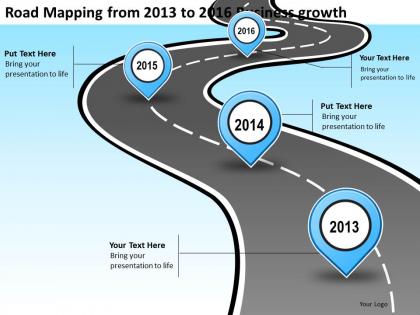
Product roadmap timeline road mapping from 2013 to 2016 business growth powerpoint templates slides




Try Before you Buy Download Free Sample Product
 Impress Your
 Audience
 100%
100% Editable
 Save Hours
 of Time


Fast track your career with our product roadmap timeline Road Mapping from 2013 to 2016 Business growth powerpoint templates slides. Give your thoughts the impetus they deserve.
People who downloaded this PowerPoint presentation also viewed the following :
Product roadmap timeline road mapping from 2013 to 2016 business growth powerpoint templates slides with all 5 slides:
Do not let the excitement abate. Our product roadmap timeline Road Mapping from 2013 to 2016 Business growth powerpoint templates slides will keep the mood up.


FAQs for Product roadmap timeline road mapping from 2013 to 2016 business growth
A product roadmap timeline should include strategic objectives, major feature releases, development milestones, resource allocation periods, and stakeholder review checkpoints. These components work together by aligning cross-functional teams, establishing clear delivery expectations, and enabling strategic pivots based on market feedback, with many organizations finding that comprehensive timelines enhance product success rates and stakeholder confidence.
Product roadmap prioritization involves evaluating features based on customer value, business impact, technical feasibility, and resource requirements, while considering market timing and strategic alignment. Organizations typically use frameworks like value versus effort matrices, customer feedback data, and competitive analysis to rank initiatives, with many product teams finding that regular stakeholder input and iterative reassessment ensures roadmaps deliver maximum competitive advantage.
Best practices for setting realistic product roadmap timelines include conducting thorough scope analysis, incorporating buffer time for unexpected challenges, involving cross-functional teams in estimation, using historical project data, and regularly reviewing capacity constraints. These approaches streamline planning by balancing ambitious goals with practical limitations, enabling teams to deliver consistent value while maintaining stakeholder confidence and ultimately achieving sustainable product development momentum.
Effectively communicating roadmap changes requires transparent, proactive outreach through regular stakeholder meetings, detailed update reports, and clear reasoning behind modifications. By providing context around market shifts, resource constraints, or customer feedback driving changes, teams maintain trust and alignment, with many organizations finding that consistent communication channels and visual roadmap tools ultimately enhance stakeholder buy-in and strategic collaboration.
Tools that enhance product roadmap timeline visualization include Aha!, ProductPlan, Roadmunk, Jira Portfolio, and Microsoft Project, each offering different levels of customization and stakeholder collaboration features. These platforms streamline roadmap communication by enabling real-time updates, cross-functional alignment, and dynamic timeline adjustments, with many product teams finding that visual clarity ultimately accelerates decision-making and stakeholder buy-in across organizations.
Product roadmaps should be revisited quarterly for strategic alignment and updated monthly for tactical adjustments, though high-growth startups and rapidly evolving sectors may require more frequent reviews. This balanced approach enables organizations to maintain long-term vision while adapting to market changes, customer feedback, and competitive pressures, ultimately delivering more relevant products and stronger market positioning.
User feedback serves as a critical driver in product roadmap prioritization, timeline adjustments, and feature development decisions, helping teams validate assumptions, identify pain points, and align development efforts with actual user needs. Through continuous feedback loops, product teams can accelerate high-impact features, delay lower-priority items, and pivot timelines based on real-world usage data, ultimately delivering more user-centric products and competitive market positioning.
Agile methodologies transform product roadmaps from rigid, date-driven documents into flexible, outcome-focused frameworks that prioritize iterative delivery, continuous feedback loops, and adaptive planning cycles. This approach enables teams to respond quickly to market changes, customer insights, and technical discoveries, with many organizations finding that quarterly sprints and regular retrospectives ultimately deliver more relevant products and faster time-to-market advantages.
Product roadmap success metrics include feature delivery rate, time-to-market accuracy, stakeholder satisfaction scores, revenue impact from launched features, and customer adoption rates. These measurements enable organizations to evaluate planning effectiveness, resource allocation efficiency, and strategic alignment, with many product teams finding that tracking both leading indicators like velocity and lagging indicators like business outcomes ultimately delivers better roadmap optimization and competitive positioning.
Balancing short-term goals with long-term strategy requires prioritizing immediate revenue-generating features while allocating resources toward strategic initiatives that deliver future competitive advantage. Through quarterly milestone planning and strategic resource allocation, organizations streamline development cycles, enhance customer satisfaction, and maintain market positioning, with many product teams finding that this dual approach ultimately delivers sustainable growth and operational efficiency.
Common pitfalls include overcommitting to specific dates, underestimating development complexity, ignoring stakeholder dependencies, failing to build in buffer time, and creating overly detailed long-term plans. These mistakes often result from pressure for certainty rather than strategic flexibility, with many successful organizations finding that quarterly milestones with monthly reviews deliver better outcomes than rigid annual schedules.
Cross-functional teams contribute to comprehensive product roadmaps by integrating diverse expertise, identifying technical constraints early, aligning customer insights with business objectives, and ensuring feasible timelines across departments. This collaborative approach enables organizations to anticipate market challenges, streamline development processes, and deliver solutions that balance user needs with operational capabilities, ultimately creating more realistic roadmaps and faster product iterations.
Strategic roadmaps focus on long-term vision, market positioning, and competitive differentiation over 12-24 months, while tactical roadmaps detail specific features, sprints, and deliverables within quarterly cycles. Strategic roadmaps guide investment decisions and stakeholder alignment, whereas tactical roadmaps enable development teams to execute daily priorities, ultimately delivering both strategic market advantage and operational efficiency.
Industry-specific context significantly affects product roadmap timelines by determining regulatory compliance requirements, development cycles, and market dynamics unique to each sector. Healthcare and financial services require extensive testing and approval phases, while retail and technology industries enable faster iteration cycles, with many organizations finding that aligning timeline expectations with industry standards ultimately delivers more realistic milestones and stakeholder confidence.
**INPUT**: What methods can be used to visualize a product roadmap timeline for different audiences? **OUTPUT**: Product roadmap visualization methods include Gantt charts, timeline views, kanban boards, milestone maps, and feature-based matrices tailored to specific stakeholder needs. These approaches enable product teams to communicate strategic priorities through executive summaries for leadership, detailed sprint views for development teams, and customer-focused benefit timelines for sales organizations, ultimately delivering alignment and transparency across departments while streamlining decision-making processes. **Word count: 58 words**
-
The content is very helpful from business point of view.
-
Best way of representation of the topic.