


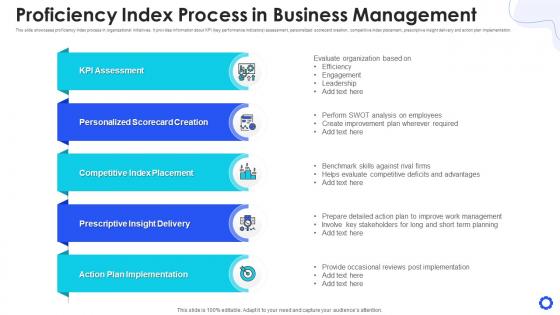
Proficiency index process in business management




Try Before you Buy Download Free Sample Product
 Impress Your
 Audience
 100%
100% Editable
 Save Hours
 of Time


Our Proficiency Index Process In Business Management are topically designed to provide an attractive backdrop to any subject. Use them to look like a presentation pro.
People who downloaded this PowerPoint presentation also viewed the following :
Proficiency index process in business management with all 6 slides:
Use our Proficiency Index Process In Business Management to effectively help you save your valuable time. They are readymade to fit into any presentation structure.





FAQs for Proficiency index process
The Proficiency Index is a standardized measurement tool that evaluates skill levels, performance capabilities, or competency benchmarks across individuals, teams, or organizations through weighted scoring systems. It's calculated by combining multiple assessment criteria, performance metrics, and comparative data points, with many organizations finding that this comprehensive approach enables strategic talent development, identifies skill gaps more effectively, and ultimately delivers enhanced workforce optimization and competitive advantage in increasingly complex business environments.
Organizations can effectively utilize the Proficiency Index by establishing clear skill benchmarks, conducting regular assessments across departments, mapping competencies to specific roles, and identifying targeted training opportunities. Through systematic evaluation processes, companies streamline talent development, enhance workforce capabilities, and optimize resource allocation, with many finding that structured proficiency tracking ultimately delivers improved performance outcomes and competitive advantage.
The Proficiency Index impacts talent development by identifying skill gaps, measuring learning progress, guiding targeted training investments, and enabling personalized development pathways. Through data-driven insights, organizations can streamline resource allocation, enhance employee capabilities more strategically, and accelerate career progression, with many companies finding that systematic proficiency measurement ultimately delivers stronger performance outcomes and competitive advantage.
The Proficiency Index identifies skill gaps by systematically measuring current competencies against required performance standards, benchmarking individual and team capabilities, and highlighting specific areas needing development. Through comprehensive assessment frameworks, organizations can prioritize training investments, streamline resource allocation, and enhance workforce effectiveness, with many companies finding that data-driven skill mapping ultimately delivers improved productivity and competitive advantage.
The Proficiency Index serves as a quantitative benchmark in performance appraisals, measuring employee competency levels across technical skills, soft skills, role-specific abilities, and professional development milestones. This standardized assessment tool enables managers to identify skill gaps, track improvement over time, and make data-driven decisions about promotions, training investments, and career development paths, ultimately delivering more objective evaluations and strategic workforce planning.
The Proficiency Index varies significantly across industries based on complexity requirements, regulatory standards, technology adoption rates, and skill demands. While sectors like financial services and healthcare typically show higher proficiency requirements due to compliance needs, manufacturing and retail often emphasize operational efficiency metrics, with organizations increasingly finding that industry-specific benchmarks deliver more accurate workforce assessments and strategic talent development.
Yes, the Proficiency Index can be integrated with existing learning management systems through APIs, data synchronization protocols, and compatible assessment frameworks. This integration enables organizations to streamline training evaluation, automate skill tracking, and enhance reporting capabilities, with many educational institutions and corporate training departments finding that seamless LMS integration delivers comprehensive analytics and improved learning outcomes.
Best practices for implementing a Proficiency Index include establishing clear skill frameworks, conducting regular assessments, aligning metrics with business objectives, ensuring transparent communication, and integrating results with development programs. These approaches streamline talent management by identifying skill gaps, accelerating targeted training, and enhancing workforce planning, with many organizations finding that strategic proficiency tracking ultimately delivers improved performance and competitive advantage.
The Proficiency Index streamlines recruitment by providing standardized skill assessments, automated candidate scoring, competency gap analysis, and role-specific benchmarking across different positions. Through data-driven evaluation tools, organizations accelerate hiring timelines, reduce interviewer bias, and improve candidate-role matching accuracy, while enabling HR teams to focus resources on top-tier prospects and ultimately deliver faster, more strategic talent acquisition.
When analyzing Proficiency Index data, consider completion rates, accuracy scores, time-to-proficiency benchmarks, skill gap identification, and performance consistency across different competencies. These metrics enable organizations to streamline training programs, enhance resource allocation, and deliver targeted development initiatives, with many companies finding that comprehensive proficiency analysis ultimately drives competitive advantage through optimized workforce capabilities.
Cultural differences significantly influence Proficiency Index interpretation through varying educational systems, workplace expectations, assessment familiarity, and performance standards across regions. While multinational corporations increasingly recognize these variations when evaluating talent, they adapt scoring frameworks, provide cultural context training, and implement region-specific benchmarks, ultimately delivering more equitable assessments and better cross-cultural hiring decisions.
Common pitfalls include relying solely on quantitative metrics without considering qualitative factors, inconsistent evaluation criteria across departments, and failing to account for role-specific requirements or individual development trajectories. These assessment challenges can lead to skewed performance reviews, demotivated employees, and misaligned talent development strategies, with many organizations finding that balanced evaluation frameworks ultimately deliver more accurate insights and better employee engagement outcomes.
The Proficiency Index adapts to remote and hybrid environments through digital assessment platforms, virtual skill tracking systems, and cloud-based performance analytics that monitor productivity across locations. These technologies enable managers to evaluate employee competencies through online simulations, remote project assessments, and collaborative digital workflows, ultimately delivering consistent performance measurement and targeted development opportunities regardless of work location.
Tools that enhance Proficiency Index tracking include learning management systems, competency assessment platforms, performance analytics software, skill mapping tools, and integrated HR dashboards. These technologies streamline evaluation by automating assessments, providing real-time progress monitoring, and generating comprehensive reports, with many organizations finding that strategic combinations deliver enhanced workforce development insights and accelerated skill advancement across departments.
Organizations ensure Proficiency Index relevance by regularly updating assessment criteria, incorporating emerging skills requirements, and aligning metrics with evolving industry standards and technological changes. Through continuous stakeholder feedback, periodic benchmark reviews, and integration of real-time performance data, companies can adapt their proficiency measurements to reflect current market demands, ultimately maintaining competitive advantage and ensuring workforce development remains strategically aligned with business objectives.
-
Content of slide is easy to understand and edit.
-
Colors used are bright and distinctive.