

Program management kpi dashboard showing task status and budget health




Try Before you Buy Download Free Sample Product
 Impress Your
 Audience
 100%
100% Editable
 Save Hours
 of Time


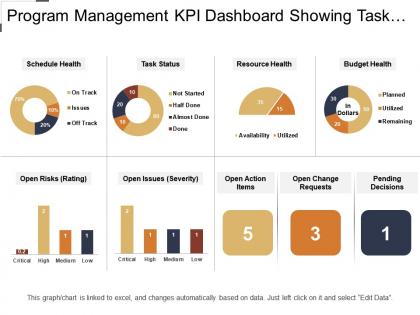
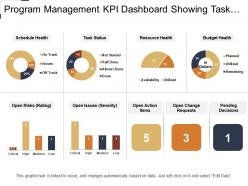
The Program Management KPI Dashboard PowerPoint slide provides the view of situational awareness of what the information means now as well as what it might mean in the future to the viewer. The Data Driven Task Status Dashboard Presentation template is a professional template designed by SlideTeam for Project Managers and Program Managers so that they can keep a check on the status of the project. Professional Program Management slide designed to present KPI’s i.e. key performance indicators in a professional manner. A user can populate the pie chart or line chart values editing the excel table which associated with this data driven chart PPT template. You can discuss different proportions of Schedule Health, Task Status, Resource Health, and Budget Health with the help of Pie Chart, whereas a user can illustrate Open Risk (Rating), and Open Issues (Severity) by using Line Chart. A user can discuss Open Action Items, Open Change Request, and Pending Decision in single value. A Task Status And Budget Health presentation slide divided into four sections. The PPT template designed including the pie chart, line chart, semi-circle figure, and square boxes. Get your thoughts considered before all else with our Program Management Kpi Dashboard Showing Task Status And Budget Health. They bring them to the forefront.
People who downloaded this PowerPoint presentation also viewed the following :
Program management kpi dashboard showing task status and budget health with all 6 slides:
Derive due credit with our Program Management Kpi Dashboard Showing Task Status And Budget Health. Your effort is bound to draw appreciation.


FAQs for Program management kpi dashboard showing task status
Traditional KPIs focus on individual project metrics like budget, timeline, and scope, while program management KPIs emphasize strategic alignment, cross-project dependencies, resource optimization, and portfolio-level outcomes. Program-specific KPIs track benefit realization, stakeholder engagement across multiple initiatives, and organizational capability development, with many enterprises finding that these strategic metrics deliver greater competitive advantage and long-term value creation.
Aligning KPIs with organizational goals enhances program success by ensuring strategic focus, optimizing resource allocation, and creating measurable pathways to business objectives. This alignment enables organizations to track progress effectively, identify performance gaps early, and make data-driven adjustments, with many companies finding that well-aligned metrics deliver improved project outcomes and stronger competitive positioning.
Effective stakeholder satisfaction metrics include regular feedback surveys, Net Promoter Scores, communication frequency assessments, milestone approval rates, and issue resolution timeframes. These measurements enable program managers to gauge engagement levels, identify concerns early, and adjust strategies accordingly, with many organizations finding that consistent stakeholder pulse checks ultimately deliver stronger program outcomes and enhanced collaborative relationships.
Risk management KPIs contribute to overall program performance by providing early warning systems, enabling proactive decision-making, and minimizing potential disruptions before they escalate. These metrics streamline resource allocation, enhance stakeholder confidence, and reduce unexpected costs, with many organizations finding that effective risk monitoring ultimately delivers improved project timelines and higher success rates.
Resource allocation KPIs enable program managers to track utilization rates, budget adherence, skill distribution, capacity planning, and cost-per-deliverable across project portfolios. These metrics streamline decision-making by identifying underutilized resources, preventing bottlenecks, and optimizing team assignments, with many organizations finding that strategic resource reallocation delivers 20-30% efficiency improvements and accelerated delivery timelines.
Program management impact on business ROI can be quantified through metrics like cost reduction percentages, time-to-market acceleration, resource utilization improvements, and revenue generation from delivered initiatives. Many organizations track portfolio value realization, operational efficiency gains, and strategic objective achievement rates, with financial services and manufacturing companies finding that structured program measurement delivers 15-25% better ROI visibility and strategic alignment.
Program management KPIs for multi-project programs include portfolio completion rate, cross-project resource utilization, cumulative budget variance, milestone achievement percentage, and inter-project dependency resolution time. These metrics enable program managers to monitor overall portfolio health, identify bottlenecks across interconnected projects, and optimize resource allocation, with many organizations finding that integrated dashboards tracking these KPIs deliver enhanced visibility and faster decision-making capabilities.
Measuring deliverable quality involves establishing clear acceptance criteria, conducting regular quality audits, tracking defect rates, implementing peer review processes, and monitoring customer satisfaction scores. Through systematic quality gates and stakeholder feedback loops, organizations streamline validation processes, reduce rework costs, and enhance client relationships, with many finding that structured quality frameworks ultimately deliver higher success rates and competitive advantage.
Essential tools for visualizing program management KPIs include interactive dashboards, Gantt charts, burndown charts, heat maps, and real-time scorecards. These visualization techniques streamline performance tracking by consolidating complex data, enabling instant trend identification, and facilitating stakeholder communication, with many organizations finding that visual KPI management ultimately delivers faster decision-making and enhanced program transparency.
KPIs enable predictive insights by tracking trend patterns, resource utilization rates, milestone deviations, stakeholder engagement levels, and budget variance trajectories over time. Through advanced analytics and historical data comparison, program managers can identify potential bottlenecks, resource constraints, and timeline risks early, ultimately enabling proactive mitigation strategies and maintaining competitive project delivery schedules.
Change management KPIs improve program adaptability by measuring resistance levels, adoption rates, communication effectiveness, and stakeholder engagement throughout transitions. These metrics enable program managers to identify bottlenecks early, adjust training approaches, and accelerate implementation timelines, with many organizations finding that tracking change velocity and user feedback ultimately delivers smoother transitions and higher success rates.
Balancing quantitative and qualitative KPIs requires integrating measurable metrics like budget variance and timeline adherence with subjective assessments including stakeholder satisfaction, team morale, and strategic alignment. Through regular dashboards combining hard data with feedback surveys, organizations can evaluate both numerical performance and program health, ultimately delivering comprehensive insights that drive better decision-making and sustainable program success.
Program management benchmarks include schedule adherence, budget variance, resource utilization, stakeholder satisfaction, and strategic alignment metrics. While manufacturing sectors typically focus on operational efficiency and cost reduction, healthcare organizations emphasize compliance and quality outcomes, with many institutions finding that sector-specific benchmarks combined with universal performance indicators deliver the most meaningful comparative insights and competitive advantage.
Program lifecycle KPIs assist continuous improvement by tracking performance patterns across project phases, identifying bottlenecks in resource allocation, and measuring delivery consistency against strategic objectives. These metrics enable organizations to refine methodologies, optimize team productivity, and enhance stakeholder satisfaction, with many companies finding that systematic KPI analysis reduces project overruns while accelerating future program delivery timelines.
**INPUT**: Which specific KPIs are crucial for measuring team collaboration and productivity within programs? **OUTPUT**: Crucial KPIs include cross-functional task completion rates, communication frequency metrics, shared milestone achievement percentages, resource utilization efficiency, and inter-team dependency resolution times. These collaboration indicators streamline program oversight by identifying bottlenecks, enhancing resource allocation, and accelerating deliverable timelines, with many organizations finding that tracking these metrics delivers improved team alignment and measurable productivity gains. **Word count: 58**
-
Wonderful templates design to use in business meetings.
-
Very well designed and informative templates.