


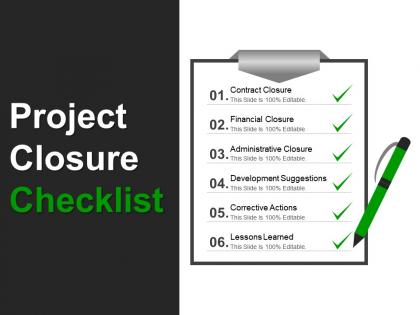
Project closure checklist powerpoint templates




Try Before you Buy Download Free Sample Product
 Impress Your
 Audience
 100%
100% Editable
 Save Hours
 of Time


Generate a buzz with our Project Closure Checklist Powerpoint Templates. They are good at creating curiosity.
People who downloaded this PowerPoint presentation also viewed the following :
Project closure checklist powerpoint templates with all 5 slides:
Attain ambitions with our Project Closure Checklist Powerpoint Templates. Develop the drive to arrive at your goals.




FAQs for Project closure
Key components include project deliverables verification, stakeholder sign-off documentation, resource release procedures, lessons learned documentation, and final budget reconciliation. These elements streamline the closure process by ensuring complete deliverable validation, facilitating smooth resource transitions, and capturing valuable insights, with many organizations finding that comprehensive checklists significantly reduce post-project issues while enhancing future project efficiency.
A project closure checklist improves team accountability by establishing clear documentation requirements, defined responsibility assignments, and standardized evaluation processes for each team member's deliverables. Through structured review protocols, teams complete knowledge transfers, conduct performance assessments, and document lessons learned more thoroughly, with many organizations finding that formal closure processes enhance future project execution and professional development outcomes.
Common pitfalls include inadequate documentation, skipping stakeholder sign-offs, incomplete financial reconciliation, poor resource transition planning, and insufficient lessons learned capture. These oversights can create future compliance issues, budget discrepancies, and knowledge gaps, with many organizations finding that thorough closure processes ultimately enhance project credibility and organizational learning capabilities.
Stakeholder feedback serves as a critical evaluation component in project closure checklists, assessing deliverable quality, process effectiveness, communication adequacy, and overall satisfaction levels. Through structured surveys, interviews, and retrospective sessions, organizations capture valuable insights for future improvements, identify lessons learned, and ensure all expectations were met, ultimately enhancing project management capabilities and stakeholder relationships.
Documentation serves as the project's institutional memory, capturing lessons learned, final deliverables, performance metrics, stakeholder feedback, and technical specifications for future reference. This comprehensive record enables organizations to replicate successes, avoid previous pitfalls, and accelerate future project timelines, while ensuring knowledge transfer remains intact even when team members transition to new roles.
A project closure checklist facilitates knowledge transfer by systematically documenting lessons learned, best practices, technical specifications, stakeholder feedback, and process improvements throughout project completion. This structured approach ensures critical insights are captured and accessible, enabling future project teams to leverage previous experiences, avoid recurring pitfalls, and accelerate implementation timelines, ultimately delivering enhanced organizational efficiency and competitive advantage.
Assessing project deliverables during closure involves conducting quality reviews, verifying acceptance criteria compliance, obtaining stakeholder sign-offs, documenting any deviations, and confirming deliverable handover protocols. These validation steps streamline future project transitions by establishing clear completion standards, ensuring client satisfaction, and creating accountability frameworks, with many organizations finding that thorough deliverable assessment reduces post-closure issues significantly.
Team members can effectively communicate lessons learned through structured debriefing sessions, comprehensive documentation templates, cross-functional retrospectives, and formal knowledge transfer meetings. These approaches enable organizations to capture critical insights, operational challenges, and strategic recommendations systematically, with many project teams finding that structured communication ultimately enhances future project success and organizational learning capacity.
Best practices for ensuring stakeholder satisfaction at project closure include conducting comprehensive final reviews, delivering complete documentation, facilitating knowledge transfer sessions, obtaining formal sign-offs, and scheduling post-project evaluations. These approaches streamline the transition process by confirming deliverable acceptance, addressing outstanding concerns, and capturing lessons learned, ultimately delivering clear project outcomes and maintaining strong stakeholder relationships for future collaborations.
A project closure checklist facilitates handover by ensuring comprehensive documentation transfer, stakeholder communication protocols, training completion verification, and operational readiness assessments are systematically addressed. This structured approach streamlines transitions for organizations across industries, with many finding that detailed checklists reduce post-handover support requests, minimize operational disruptions, and ultimately deliver smoother service continuity and enhanced team accountability.
**INPUT**: What metrics should be evaluated during the project closure phase? **OUTPUT**: Project closure metrics include budget variance, schedule adherence, scope completion, quality deliverables, stakeholder satisfaction, and resource utilization rates. These evaluation criteria enable organizations to measure project success, identify process improvements, and capture lessons learned, with many companies finding that systematic closure assessments ultimately enhance future project performance and strategic decision-making across their portfolio. [Word count: 56 words]
Emotional intelligence enhances project closure by recognizing team emotions, facilitating open feedback conversations, and managing stakeholder reactions to project endings with empathy and understanding. Through active listening, acknowledging contributions, and addressing concerns about transitions or team changes, project managers create positive closure experiences that strengthen relationships and improve future collaboration opportunities.
Celebration techniques include team recognition ceremonies, success story documentation, stakeholder appreciation events, lessons learned showcases, and achievement milestone reviews. These approaches enhance team morale, strengthen stakeholder relationships, and build organizational knowledge, with many companies finding that structured celebrations improve team retention, foster collaboration culture, and create valuable case studies for future project success.
A project closure checklist supports audits and evaluations by systematically documenting deliverables, timelines, budget variances, resource utilization, and lessons learned throughout the project lifecycle. This comprehensive documentation enables auditors to verify compliance, assess performance against initial objectives, and identify process improvements, while evaluation teams can analyze project success metrics, stakeholder satisfaction, and strategic outcomes, ultimately delivering transparency and accountability for future project planning.
Post-project closure follow-up actions include periodic performance reviews, stakeholder satisfaction surveys, lessons learned documentation, ongoing support protocols, and success metrics monitoring. These activities ensure sustained project benefits by identifying improvement opportunities, maintaining stakeholder relationships, and capturing valuable insights for future initiatives, ultimately delivering continued value and organizational learning.
-
Attractive design and informative presentation.
-
Topic best represented with attractive design.