


Project evaluation checklist business process modeling techniques




Try Before you Buy Download Free Sample Product
 Impress Your
 Audience
 100%
100% Editable
 Save Hours
 of Time


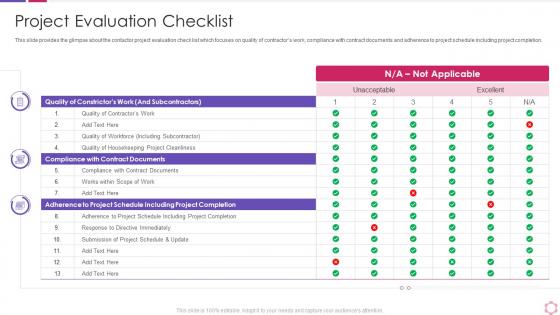
This slide provides the glimpse about the contactor project evaluation check list which focuses on quality of contractors work, compliance with contract documents and adherence to project schedule including project completion.
People who downloaded this PowerPoint presentation also viewed the following :
Project evaluation checklist business process modeling techniques with all 6 slides:
Use our Project Evaluation Checklist Business Process Modeling Techniques to effectively help you save your valuable time. They are readymade to fit into any presentation structure.





FAQs for Project evaluation checklist business
Key project objectives typically include delivering specific outcomes within defined timelines, budgets, and quality parameters, while addressing stakeholder requirements and measurable success criteria. These objectives align with strategic goals by supporting organizational priorities like market expansion, operational efficiency, or competitive advantage, with many companies finding that well-aligned projects deliver higher ROI and sustainable growth.
Project success measurement typically includes performance metrics like budget adherence, timeline completion, quality standards, stakeholder satisfaction scores, and ROI calculations. Through comprehensive tracking systems, organizations monitor cost variance, delivery milestones, user adoption rates, and business impact indicators, with many finding that balanced scorecards combining financial and operational metrics deliver clearer project accountability and strategic alignment.
Project evaluation stakeholders typically include project sponsors, team members, end users, customers, regulatory bodies, and senior management, each bringing distinct perspectives and success criteria. Effective evaluation processes address these diverse needs through structured feedback sessions, tailored reporting formats, and comprehensive metrics that balance operational efficiency with strategic outcomes, ultimately ensuring stakeholder alignment and project value delivery.
Data collection methods for project evaluation include surveys, interviews, focus groups, performance metrics analysis, and observational studies. These approaches enable organizations to capture quantitative outcomes, qualitative feedback, and behavioral changes, with many institutions finding that combining multiple methods delivers comprehensive insights and supports evidence-based decision-making for future initiatives.
Project budget and resource evaluation involves analyzing cost variance, resource utilization rates, return on investment metrics, and milestone achievement against allocated funds. Through comprehensive tracking systems, organizations monitor spending patterns, identify cost overruns, and assess resource productivity, with many finding that regular evaluation cycles enable strategic reallocation and ultimately deliver improved project outcomes.
Project risks include scope creep, resource constraints, timeline delays, stakeholder misalignment, and technical challenges. These risks are monitored through regular milestone assessments, budget tracking, stakeholder feedback loops, and performance metrics, with mitigation strategies involving contingency planning, resource reallocation, and proactive communication protocols, ultimately ensuring project success and organizational resilience.
Project timeline assessment involves comparing planned versus actual milestone dates, analyzing critical path deviations, tracking task completion rates, and evaluating resource allocation efficiency throughout project phases. Through project management software and regular status reports, organizations can identify bottlenecks, measure schedule adherence percentages, and document delay causes, ultimately enabling better deadline management and improved project delivery predictability.
Project deliverable quality criteria include functionality assessment, adherence to requirements, performance benchmarks, user acceptance standards, and compliance verification. These evaluation frameworks streamline quality assurance by establishing clear metrics, reducing revision cycles, and ensuring stakeholder alignment, with many organizations finding that structured assessment criteria ultimately deliver faster project completion and enhanced client satisfaction.
Feedback gathering typically involves structured surveys, one-on-one interviews, focus groups, and collaborative review sessions with both internal teams and external stakeholders. This input is incorporated through systematic analysis, prioritization matrices, and iterative refinement processes, with many organizations finding that combining quantitative metrics with qualitative insights ultimately delivers more comprehensive project evaluations and enhanced future planning capabilities.
Lessons learned include identifying evaluation methodology gaps, documenting stakeholder communication breakdowns, recording resource allocation missteps, capturing timeline estimation errors, and noting risk assessment oversights. These insights enable organizations to refine their project evaluation frameworks, enhance predictive accuracy, and streamline decision-making processes, with many finding that systematic documentation reduces future project failures by improving strategic planning capabilities.
Scope changes are managed through formal change control processes that assess impact on timeline, budget, resources, and deliverables before approval. Effective evaluation involves stakeholder consultation, risk analysis, and documentation of decisions, with many organizations finding that structured change management ultimately preserves project success while enabling necessary adaptations and strategic pivots.
Best practices for presenting evaluation findings include creating executive summaries with key insights, using visual dashboards and infographics, organizing recommendations by priority and timeline, and structuring presentations around business outcomes rather than raw data. These approaches streamline stakeholder decision-making by translating complex evaluation results into clear action items, with many organizations finding that visual storytelling and prioritized recommendations accelerate project approvals and resource allocation.
Sustainability assessment involves monitoring long-term impact through performance metrics, stakeholder feedback, resource utilization tracking, and outcome durability analysis. Organizations typically conduct quarterly reviews, annual impact studies, and beneficiary surveys to evaluate whether project benefits persist, while measuring cost-effectiveness, adoption rates, and environmental or social improvements, ultimately ensuring strategic investments deliver lasting competitive advantage.
Project evaluation tools include project management platforms, data analytics software, survey and feedback systems, financial tracking applications, and reporting dashboards. These technologies streamline evaluation by automating data collection, enabling real-time performance monitoring, and generating comprehensive analytical reports, with many organizations finding that integrated software solutions deliver faster insights, enhanced accuracy, and more strategic decision-making capabilities.
The evaluation process incorporates continuous improvement by establishing regular milestone reviews, real-time performance monitoring, stakeholder feedback loops, and adaptive planning cycles. These mechanisms enable project teams to identify inefficiencies, adjust resource allocation, and refine methodologies throughout project execution, with many organizations finding that this iterative approach ultimately delivers enhanced outcomes and competitive advantage.
-
Unique and attractive product design.
-
Best way of representation of the topic.