


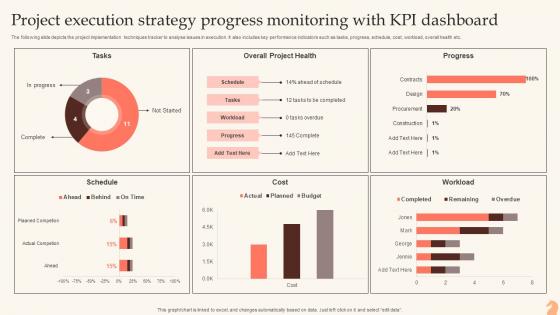
Project Execution Strategy Progress Monitoring With KPI Dashboard




Try Before you Buy Download Free Sample Product
 Impress Your
 Audience
 100%
100% Editable
 Save Hours
 of Time


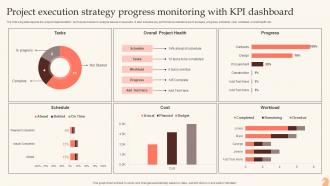
The following slide depicts the project implementation techniques tracker to analyse issues in execution. It also includes key performance indicators such as tasks, progress, schedule, cost, workload, overall health etc.
People who downloaded this PowerPoint presentation also viewed the following :
Project Execution Strategy Progress Monitoring With KPI Dashboard with all 7 slides:
Use our Project Execution Strategy Progress Monitoring With KPI Dashboard to effectively help you save your valuable time. They are readymade to fit into any presentation structure.





FAQs for Project Execution Strategy Progress Monitoring
Key components of an effective project execution strategy include clear scope definition, resource allocation planning, risk management frameworks, communication protocols, and milestone tracking systems. These elements work together by streamlining project workflows, enhancing team coordination, and minimizing operational delays, with many organizations finding that strategic integration ultimately delivers faster project completion and improved stakeholder satisfaction.
Project managers align execution strategy with project goals by establishing clear milestone frameworks, implementing regular progress assessments, and maintaining consistent stakeholder communication throughout project lifecycles. Through strategic resource allocation and adaptive planning methodologies, organizations streamline project delivery, enhance team coordination, and minimize scope deviations, ultimately delivering measurable outcomes and competitive advantage.
Stakeholder engagement during project execution ensures alignment, secures necessary resources, facilitates timely decision-making, and maintains project momentum through regular communication and feedback loops. Active engagement enables project managers to address concerns proactively, manage scope changes effectively, and leverage stakeholder expertise, ultimately delivering successful outcomes while maintaining strong relationships for future initiatives.
Risk management integrates into project execution strategy through continuous risk assessment, proactive mitigation planning, stakeholder communication protocols, and adaptive response mechanisms. These approaches enable organizations to identify potential disruptions early, allocate resources strategically, and maintain project momentum, with many companies finding that embedded risk frameworks ultimately deliver improved project success rates and reduced costly delays.
Common project execution challenges include scope creep, resource constraints, communication breakdowns, timeline delays, and stakeholder misalignment. These obstacles can be mitigated through robust change management processes, strategic resource allocation, regular stakeholder communication, and adaptive project monitoring systems, ultimately delivering enhanced operational efficiency and competitive advantage.
Effective communication influences project execution strategy by ensuring clear objectives, coordinating team efforts, and maintaining stakeholder alignment throughout project lifecycles. Through regular updates, structured feedback channels, and transparent reporting systems, organizations streamline decision-making processes, minimize costly delays, and enhance resource allocation, with many finding that robust communication frameworks ultimately deliver faster project completion and higher success rates.
Methodologies to enhance project execution include Agile for iterative development, Waterfall for sequential planning, Scrum for team collaboration, Lean for waste reduction, and Kanban for workflow visualization. These approaches streamline project delivery by improving team coordination, accelerating decision-making, and enhancing resource allocation, with many organizations finding that strategic methodology selection ultimately delivers faster time-to-market and improved stakeholder satisfaction.
Resource allocation and management significantly impact project execution by determining timeline adherence, budget control, and quality outcomes through strategic distribution of human capital, financial resources, and technological assets. Effective resource management enables organizations to minimize bottlenecks, optimize team productivity, and maintain project momentum, with many companies finding that proper allocation ultimately delivers faster completion times and enhanced competitive advantage.
Technology and tools streamline project execution through automated task management, real-time collaboration platforms, predictive analytics, resource optimization software, and integrated communication systems. These solutions enhance operational efficiency by reducing manual oversight, accelerating decision-making, and minimizing project delays, with many organizations finding that strategic technology integration ultimately delivers faster project completion and improved resource allocation.
Project execution metrics include schedule adherence, budget variance, quality indicators, stakeholder satisfaction scores, and resource utilization rates. These measurements enable organizations to track performance across timeline, financial, and operational dimensions, with many project managers finding that combining leading indicators like milestone completion with lagging indicators ultimately delivers greater visibility and strategic control over project outcomes.
Team collaboration significantly impacts project execution through enhanced communication, coordinated resource allocation, shared accountability, and collective problem-solving capabilities. Strong team dynamics enable faster decision-making, reduced conflicts, and streamlined workflows, with many organizations finding that collaborative teams deliver projects 25% faster while maintaining higher quality standards and stakeholder satisfaction.
Quality control strategies during project execution include regular milestone reviews, standardized testing protocols, stakeholder feedback loops, risk assessment checkpoints, and continuous performance monitoring. These approaches streamline project delivery by identifying issues early, maintaining consistent standards, and ensuring deliverables meet specifications, with many organizations finding that proactive quality management ultimately reduces costs while enhancing client satisfaction and competitive advantage.
Adaptability is crucial for project execution success, enabling teams to respond to changing requirements, unexpected challenges, and evolving stakeholder needs while maintaining project momentum. Through flexible methodologies and responsive planning, organizations streamline resource allocation, minimize delays, and enhance delivery outcomes, with many project managers finding that adaptive strategies ultimately deliver better results and stronger competitive advantage.
Best practices for monitoring and controlling project execution include regular progress tracking, stakeholder communication protocols, risk assessment frameworks, budget variance analysis, and milestone reviews. These practices enable project managers to identify deviations early, adjust resource allocation strategically, and maintain timeline adherence, with many organizations finding that consistent monitoring ultimately delivers improved project outcomes and enhanced stakeholder confidence.
Cultural differences influence project execution strategies through communication styles, decision-making processes, work hierarchies, time orientations, and risk tolerance levels. International projects require adapted approaches like flexible scheduling for different time zones, culturally sensitive stakeholder engagement, and localized team management practices, with many multinational organizations finding that culturally aware execution strategies significantly enhance project success rates and cross-border collaboration effectiveness.
-
Unique research projects to present in meeting.
-
Definitely recommend SlideTeam to all who need help with PowerPoint presentations. Their design team can create anything you need.