


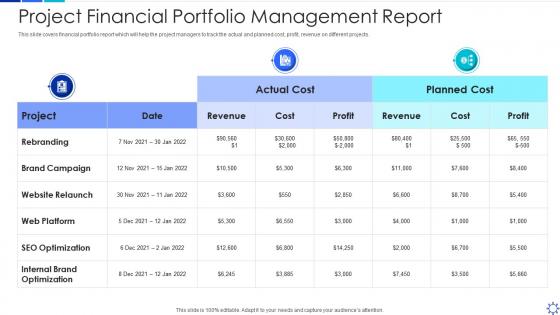
Project financial portfolio management report




Try Before you Buy Download Free Sample Product
 Impress Your
 Audience
 100%
100% Editable
 Save Hours
 of Time


Our Project Financial Portfolio Management Report are topically designed to provide an attractive backdrop to any subject. Use them to look like a presentation pro.
People who downloaded this PowerPoint presentation also viewed the following :
Project financial portfolio management report with all 6 slides:
Use our Project Financial Portfolio Management Report to effectively help you save your valuable time. They are readymade to fit into any presentation structure.





FAQs for Project financial
Project finance components include special purpose vehicles, non-recourse debt structures, cash flow-based lending, risk allocation mechanisms, and long-term contractual frameworks. Unlike traditional corporate financing, these structures isolate project risks from sponsor balance sheets, enable higher leverage ratios, and attract institutional investors through predictable cash flows, with infrastructure and energy sectors finding enhanced capital efficiency.
Risk assessment enhances project finance viability by identifying potential challenges, quantifying financial exposure, and developing mitigation strategies that reassure lenders and investors. Through comprehensive risk analysis, project sponsors can demonstrate operational resilience, optimize financing structures, and secure better terms, with many infrastructure and energy projects finding that thorough assessments ultimately accelerate funding approvals.
Financial models serve as the analytical backbone of project finance, evaluating cash flow projections, debt service coverage ratios, return calculations, risk scenarios, and financing structure optimization. These comprehensive models enable lenders, investors, and sponsors to assess project viability across industries like infrastructure, energy, and telecommunications, ultimately delivering transparent risk assessment and informed decision-making that accelerates deal closure.
Capital structure significantly impacts project financing by affecting borrowing costs, risk allocation, and investor returns through optimal debt-to-equity ratios. Different structures enable projects to minimize financing expenses, attract diverse investor types, and manage cash flow requirements, with infrastructure and energy sectors finding that strategic leverage combinations ultimately deliver enhanced project viability and competitive funding terms.
Commercial banks, investment banks, development finance institutions, export credit agencies, and institutional investors like pension funds typically engage in project finance. These institutions require detailed feasibility studies, robust cash flow projections, experienced sponsors with proven track records, and comprehensive risk mitigation through insurance and contractual structures, ultimately ensuring projects deliver predictable returns while minimizing exposure.
Public-private partnerships facilitate project finance by combining public sector backing with private capital, expertise, and operational efficiency, reducing financial burden on governments while accelerating infrastructure delivery. Through strategic risk-sharing arrangements, PPPs enable banks, pension funds, and institutional investors to fund large-scale projects like highways, hospitals, and airports, ultimately delivering faster implementation and enhanced service quality.
Common renewable energy financing structures include debt-equity combinations, green bonds, power purchase agreements, lease arrangements, and tax equity partnerships. These mechanisms streamline project development by reducing capital costs, mitigating risks, and leveraging government incentives, with many solar and wind developers finding that strategic financing combinations ultimately deliver lower electricity costs and enhanced investor returns.
Geopolitical factors significantly impact project financing through currency volatility, regulatory changes, political stability assessments, and cross-border investment restrictions. Financial institutions and investors increasingly incorporate geopolitical risk modeling into their decision-making processes, with many emerging market projects requiring enhanced due diligence, political risk insurance, and strategic partnerships with local entities to ensure viability and competitive returns.
Project financing tax implications include depreciation benefits, interest deductibility, tax credits for renewable projects, debt-to-equity optimization, and transfer pricing considerations. Through strategic structuring, organizations enhance cash flows by maximizing depreciation schedules, leveraging tax-efficient jurisdictions, and timing debt service payments, with many infrastructure developers finding that proper tax planning delivers significant cost reductions and improved project returns.
Project sponsors effectively communicate value by presenting comprehensive financial models, detailed risk assessments, clear market analysis, experienced management credentials, and robust operational plans. These materials demonstrate project viability through realistic revenue projections, mitigation strategies, and strategic positioning, with many sponsors finding that combining quantitative data with compelling stakeholder testimonials ultimately delivers investor confidence and competitive financing terms.
Greenfield projects face higher financing challenges due to untested market conditions, regulatory uncertainties, longer development timelines, and lack of operational history, while brownfield projects benefit from established infrastructure and proven cash flows. However, brownfield financing presents complexities around environmental liabilities, asset valuations, and legacy debt structures, with many financial institutions finding that greenfield ventures ultimately deliver higher returns despite requiring more comprehensive risk assessment.
Regulatory compliance significantly shapes project finance by establishing mandatory environmental standards, financial reporting requirements, and risk assessment protocols that projects must meet to secure funding. These frameworks enhance investor confidence and project transparency while requiring additional due diligence costs, with many infrastructure and energy projects finding that strong compliance records ultimately deliver lower financing costs and faster approvals.
Due diligence serves as the comprehensive risk assessment foundation in project finance, involving technical, financial, legal, environmental, and market evaluations to validate project viability. Through rigorous analysis, lenders and investors examine construction timelines, revenue projections, and regulatory compliance, while identifying potential risks early, ultimately enabling informed financing decisions and structured risk mitigation strategies.
Technology and innovation reduce project finance costs by automating due diligence processes, streamlining documentation workflows, and enabling real-time risk monitoring throughout project lifecycles. Through AI-powered analytics and blockchain platforms, financial institutions accelerate loan approvals, minimize administrative overhead, and enhance transparency in fund disbursements, ultimately delivering faster project execution and improved investor returns.
Emerging trends include green finance initiatives, digital infrastructure investments, public-private partnerships, supply chain resilience projects, and technology-enabled financing platforms. These developments enhance project viability by streamlining approval processes, reducing risk assessment timelines, and enabling more flexible capital structures, with many financial institutions finding that diversified portfolios ultimately deliver stronger returns in volatile markets.
-
Great product with highly impressive and engaging designs.
-
Really like the color and design of the presentation.