


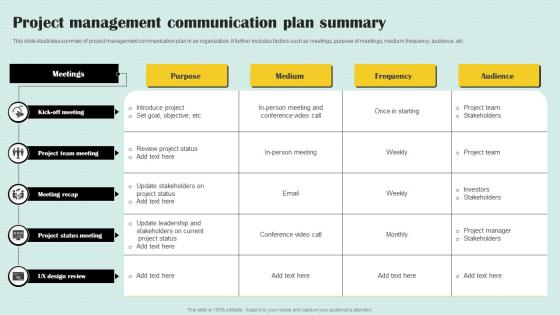
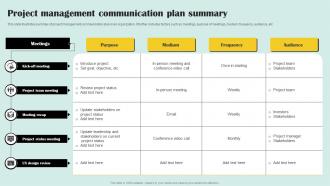
Project Management Communication Plan Summary




Try Before you Buy Download Free Sample Product
 Impress Your
 Audience
 100%
100% Editable
 Save Hours
 of Time


This slide illustrates summary of project management communication plan in an organization. It further includes factors such as meetings, purpose of meetings, medium, frequency, audience, etc.
People who downloaded this PowerPoint presentation also viewed the following :
Project Management Communication Plan Summary with all 6 slides:
Use our Project Management Communication Plan Summary to effectively help you save your valuable time. They are readymade to fit into any presentation structure.





FAQs for Project Management
Key components include stakeholder identification, communication objectives, message content guidelines, delivery methods, frequency schedules, and feedback mechanisms. These elements work together by ensuring relevant information reaches appropriate audiences through optimal channels, while establishing clear accountability and response protocols, ultimately enhancing project transparency and stakeholder engagement across organizations.
Stakeholder identification involves mapping internal team members, executives, clients, vendors, and end-users, then analyzing their decision-making authority, project impact, and information requirements. Through stakeholder analysis matrices and direct interviews, project managers can determine communication frequency, preferred channels, and content depth for each group, ultimately ensuring targeted messaging that enhances project transparency and stakeholder engagement.
Technology enhances project communication strategies by providing real-time collaboration platforms, automated status tracking, centralized document management, and integrated messaging systems. Through cloud-based tools and mobile applications, project teams streamline information sharing, reduce response times, and maintain transparency across distributed workforces, ultimately delivering improved coordination and faster project completion rates.
Ensuring clear, consistent communication requires establishing standardized protocols, regular check-ins, centralized documentation systems, defined stakeholder roles, and structured feedback loops from project initiation through closure. Through automated reporting tools and scheduled touchpoints, project managers streamline information flow, minimize misunderstandings, and maintain alignment across teams, ultimately delivering improved project outcomes and stakeholder satisfaction.
Effective virtual communication techniques include regular video conferences, structured messaging platforms, collaborative document sharing, asynchronous updates, and clear escalation protocols. These approaches streamline coordination by establishing consistent touchpoints, maintaining transparency across time zones, and ensuring accountability, with many distributed teams finding that combining synchronous and asynchronous methods ultimately delivers faster decision-making and stronger project outcomes.
Feedback mechanisms can be integrated through regular stakeholder surveys, structured review meetings, communication audits, and digital feedback platforms that capture input throughout project phases. These mechanisms enable project managers to identify communication gaps, adjust messaging strategies, and enhance stakeholder engagement, with many organizations finding that systematic feedback collection ultimately delivers improved project outcomes and stronger stakeholder relationships.
Project managers typically face challenges including stakeholder resistance, information overload, cultural barriers, technology limitations, and inconsistent messaging across teams. These obstacles can be overcome by establishing clear communication protocols, utilizing collaborative platforms like Slack or Microsoft Teams, conducting regular stakeholder feedback sessions, and implementing structured reporting frameworks, ultimately delivering improved project transparency and enhanced team coordination.
Communication frequency is crucial for project success, with factors including project complexity, stakeholder expectations, risk levels, team distribution, and project phase determining optimal timing. Strategic communication schedules balance information needs with productivity, with high-risk projects requiring daily updates while stable initiatives may need weekly reports, ultimately enhancing transparency and stakeholder confidence.
Visual aids enhance project communication by simplifying complex data, improving information retention, accommodating different learning styles, and reducing language barriers across diverse teams. Through charts, dashboards, and infographics, organizations streamline stakeholder understanding, accelerate decision-making processes, and minimize miscommunication risks, with many project managers finding that visual elements deliver faster approvals and enhanced team alignment.
Cultural differences impact project communication through varying communication styles, hierarchy expectations, decision-making approaches, and conflict resolution preferences, potentially creating misunderstandings and delays. Successful project managers mitigate these challenges by establishing clear communication protocols, providing cultural awareness training, using visual aids and standardized templates, and creating inclusive environments where team members feel comfortable expressing concerns, ultimately enhancing collaboration and project outcomes.
A communication matrix ensures systematic information flow by defining who receives what information, when, and through which channels, preventing miscommunication and project delays. This structured approach enhances team coordination, stakeholder engagement, and decision-making speed, with many project managers finding that clear communication protocols reduce conflicts by up to 40% while improving overall project success rates.
Measuring communication plan effectiveness involves tracking response rates, feedback quality, stakeholder engagement levels, meeting attendance, and information retention across team members. Through surveys, pulse checks, and milestone reviews, project managers can assess whether messages reach intended audiences, generate appropriate actions, and reduce miscommunication incidents, ultimately ensuring smoother project delivery and enhanced stakeholder satisfaction.
Formal channels ensure structured information flow through official reports, status meetings, and documented approvals, while informal channels facilitate quick problem-solving, relationship building, and knowledge sharing among team members. This strategic combination enhances project coordination, minimizes miscommunication risks, and accelerates decision-making, with many organizations finding that balanced communication approaches ultimately deliver improved stakeholder engagement and project outcomes.
Active listening improves stakeholder engagement by demonstrating respect, uncovering underlying concerns, and ensuring comprehensive understanding of diverse perspectives and requirements. Through focused attention, clarifying questions, and thoughtful responses, project managers build stronger relationships, reduce miscommunication, and foster collaborative decision-making, with many organizations finding that enhanced listening practices ultimately deliver higher stakeholder satisfaction and project success rates.
Crisis communication strategies include establishing immediate escalation protocols, creating centralized information hubs, implementing frequent stakeholder updates, designating crisis communication leads, and maintaining transparent messaging channels. These approaches streamline decision-making by reducing information silos, accelerating response times, and ensuring consistent messaging, with many project teams finding that proactive crisis communication frameworks ultimately deliver faster resolution and stronger stakeholder confidence.
-
Thanks to SlideTeam, we have an ideal template to present all the info we need to cover. Their slides give our numbers and projections a more clear and enchanting look.
-
One word for SlideTeam–Versatile!