


Project Management Schedule Executive Summary




Try Before you Buy Download Free Sample Product
 Impress Your
 Audience
 100%
100% Editable
 Save Hours
 of Time


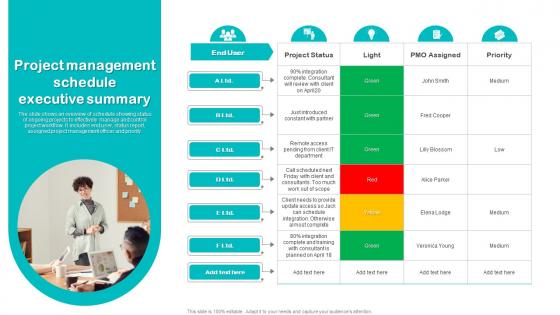
The slide shows an overview of schedule showing status of ongoing projects to effectively manage and control project workflow. It includes end user, status report, assigned project management officer and priority.
People who downloaded this PowerPoint presentation also viewed the following :
Project Management Schedule Executive Summary with all 6 slides:
Use our Project Management Schedule Executive Summary to effectively help you save your valuable time. They are readymade to fit into any presentation structure.





FAQs for Project Management
Key components of an effective project management schedule include task sequencing, resource allocation, milestone identification, dependency mapping, and timeline estimation. These elements work together by establishing clear project phases, optimizing team productivity, and enabling proactive risk management, with many organizations finding that well-structured schedules reduce delivery times while enhancing stakeholder communication and project success rates.
Gantt charts enable project managers to visualize project timelines by displaying tasks, dependencies, milestones, and resource allocation in a comprehensive timeline format. Through these visual tools, managers can track progress, identify bottlenecks, and adjust schedules dynamically, with many organizations finding that Gantt charts streamline communication and ultimately deliver improved project coordination and on-time completion rates.
Best practices for estimating task durations include using historical data from similar projects, breaking complex tasks into smaller components, consulting with subject matter experts, applying three-point estimation techniques, and building in buffer time for uncertainties. These approaches enhance accuracy by leveraging past experience, detailed analysis, and expert knowledge, with many project managers finding that combining multiple estimation methods ultimately delivers more realistic schedules and improved project outcomes.
Resource allocation significantly affects project management schedules by determining task duration, identifying critical path dependencies, and influencing milestone completion timelines. Poor allocation creates bottlenecks and delays, while strategic resource distribution enables teams to accelerate deliverables, minimize scheduling conflicts, and maintain project momentum, with many organizations finding that optimized allocation reduces overall project timelines by 20-30%.
Popular project management scheduling tools include Microsoft Project, Asana, Trello, Monday.com, Smartsheet, and Gantt chart platforms like TeamGantt. These software solutions streamline project planning by enabling task automation, resource allocation, and real-time collaboration, with many organizations finding that integrated scheduling platforms ultimately deliver improved team productivity and enhanced project visibility.
Project managers can handle scheduling conflicts by implementing flexible resource allocation, utilizing cross-training to create backup capabilities, establishing clear priority frameworks, and leveraging project management software for real-time visibility. Through proactive communication and strategic buffer planning, teams can navigate competing demands while maintaining project momentum, with many organizations finding that collaborative scheduling approaches and regular conflict resolution protocols ultimately enhance both team productivity and project delivery timelines.
The critical path method identifies the longest sequence of dependent tasks that determines minimum project duration, enabling managers to prioritize resources and focus on activities that directly impact completion timelines. This approach streamlines project scheduling by highlighting bottlenecks, optimizing resource allocation, and minimizing delays, with many organizations finding that it delivers faster project completion and enhanced operational efficiency.
Milestones impact project progress tracking by serving as critical checkpoints that measure completion against planned timelines, deliverables, and budget allocations. These strategic markers enable project managers to identify delays, reallocate resources, and communicate status to stakeholders, with many organizations finding that well-defined milestones ultimately enhance accountability and deliver more predictable project outcomes.
Schedule adjustment strategies include scope reallocation, resource redistribution, timeline compression through parallel activities, milestone rescheduling, and stakeholder expectation realignment. These approaches enable project managers to maintain delivery momentum while accommodating changes, with many organizations finding that proactive schedule flexibility, combined with clear communication protocols, ultimately delivers better project outcomes and stronger client relationships.
Agile methodologies transform project scheduling by replacing rigid timelines with iterative sprints, adaptive planning, and continuous stakeholder feedback. Through sprint-based development cycles, organizations enhance flexibility, accelerate delivery timelines, and minimize project risks, while maintaining quality standards, ultimately delivering faster time-to-market and improved customer satisfaction across dynamic business environments.
Key metrics for assessing schedule performance include schedule variance, schedule performance index, earned value, actual versus planned progress, and critical path analysis. These metrics enable project managers to identify delays, resource bottlenecks, and budget implications early, with many organizations finding that regular monitoring ultimately delivers faster project completion and enhanced stakeholder confidence.
Stakeholder communication integrates with project management schedules through scheduled status meetings, milestone reviews, progress reports, and decision checkpoints aligned with key project phases. This strategic coordination ensures stakeholders receive timely updates, can address concerns proactively, and make informed decisions, while project managers maintain transparency and secure necessary approvals, ultimately delivering smoother project execution.
Risk management serves as the foundation for realistic project scheduling by identifying potential delays, resource constraints, and scope changes that could derail timelines. Through proactive risk assessment and contingency planning, project managers build buffer time, secure backup resources, and develop alternative pathways, with many organizations finding that comprehensive risk integration reduces schedule overruns by 30-40%.
Lessons learned from past projects inform future scheduling by identifying recurring bottlenecks, resource allocation patterns, and realistic timeframe expectations through systematic documentation and analysis. Organizations leverage these insights to refine estimation techniques, anticipate potential delays, and implement preventive measures, with many project managers finding that historical data significantly enhances scheduling accuracy and reduces project overruns.
A project schedule focuses specifically on task timelines, dependencies, milestones, and resource allocation across defined phases, while a project plan encompasses broader elements including scope, budget, risk management, communication strategies, and quality standards. The schedule serves as the temporal framework within the comprehensive plan, with many organizations finding that integrating both documents streamlines project execution and enhances stakeholder alignment.
-
Attractive design and informative presentation.
-
Wow, never been this impressed with any online service provider. Really appreciate the customer support all along from the navigation to purchasing the right products.