

Project Prince2 Work Package Timeline




Try Before you Buy Download Free Sample Product
 Impress Your
 Audience
 100%
100% Editable
 Save Hours
 of Time


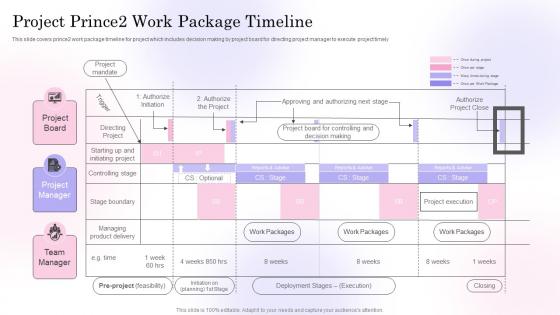
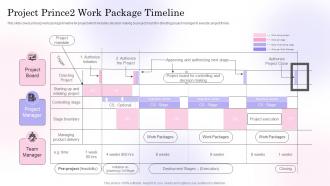
This slide covers prince2 work package timeline for project which includes decision making by project board for directing project manager to execute project timely
People who downloaded this PowerPoint presentation also viewed the following :
Project Prince2 Work Package Timeline with all 6 slides:
Use our Project Prince2 Work Package Timeline to effectively help you save your valuable time. They are readymade to fit into any presentation structure.





FAQs for Project Prince2
Key components of a PRINCE2 Work Package Timeline include work package description, deliverables and quality criteria, time and resource constraints, reporting arrangements, and tolerance levels. These elements streamline project execution by establishing clear boundaries, defining accountability structures, and enabling precise progress tracking, with many project managers finding that comprehensive timelines ultimately deliver enhanced control and successful outcomes.
The Work Package Timeline directly integrates with the Project Plan through Stage Plans and Team Plans, ensuring hierarchical alignment from project-level milestones down to detailed task schedules. This strategic alignment enables Project Managers to track progress against major deliverables while Team Managers coordinate daily activities, ultimately delivering seamless resource coordination and predictable project outcomes across all management layers.
Best practices for defining PRINCE2 Work Package start and end dates include aligning with Stage Plan milestones, incorporating realistic buffer time, considering resource availability, accounting for dependencies between work packages, and establishing clear tolerance levels. These practices enable Project Managers to create achievable timelines while maintaining control, with many organizations finding that well-defined temporal boundaries enhance team accountability, streamline progress monitoring, and ultimately deliver better project outcomes.
Project managers monitor Work Package Timeline progress through regular checkpoint reviews, milestone tracking, performance measurements against baseline schedules, and continuous stakeholder communication. These monitoring approaches enable early identification of delays, resource bottlenecks, and scope changes, with many organizations finding that systematic progress tracking ultimately delivers improved project predictability and enhanced stakeholder confidence.
Resource allocation plays a critical role in developing Work Package Timelines by determining task sequencing, identifying potential bottlenecks, and establishing realistic delivery schedules based on available personnel and materials. Through strategic resource planning, project managers can optimize team utilization, minimize conflicts between competing priorities, and ensure adequate skills coverage, ultimately delivering more accurate timelines and enhanced project efficiency across organizations.
Risk management significantly influences Work Package Timeline scheduling by requiring buffer time allocation, dependency sequencing adjustments, and resource contingency planning to mitigate identified threats. Through proactive risk assessment, project managers can prioritize critical path activities, implement parallel task structures where possible, and establish milestone checkpoints, ultimately delivering more reliable timelines while maintaining project quality and stakeholder confidence.
Milestones within the Work Package Timeline serve as critical checkpoints that mark significant achievements, deliverable completions, and decision points throughout project execution. These strategic markers enable project managers to track progress, assess quality gates, and maintain stakeholder alignment, while providing clear measurement points for schedule adherence, ultimately delivering enhanced project control and accountability across complex organizational initiatives.
Common pitfalls when creating Work Package Timelines include underestimating task durations, failing to account for dependencies between activities, insufficient resource allocation planning, and inadequate buffer time for unexpected delays. These issues often result from poor stakeholder communication and unrealistic deadline pressures, with many project managers finding that thorough upfront planning and regular timeline reviews significantly enhance project delivery success and team accountability.
Changes in project scope should be reflected through formal change control processes, timeline reassessment, and stakeholder communication to ensure Work Package alignments remain accurate. Teams typically update dependencies, resource allocations, and delivery milestones, while project managers coordinate with stage boundaries and tolerance levels, ultimately maintaining project integrity and enabling informed decision-making across all affected work streams.
**INPUT**: What tools or software are recommended for tracking the Work Package Timeline in PRINCE2? **OUTPUT**: Recommended tools for tracking PRINCE2 Work Package Timelines include Microsoft Project, Primavera P6, Smartsheet, Monday.com, and specialized PRINCE2 software like ProjectPlace. These platforms streamline work package monitoring by enabling milestone tracking, resource allocation visibility, and automated progress reporting, with many project organizations finding that integrated dashboards ultimately deliver enhanced timeline control and stakeholder transparency.
Stakeholders can be engaged effectively through regular consultation sessions, collaborative timeline reviews, transparent communication of dependencies and constraints, and structured feedback mechanisms. By involving key stakeholders in milestone definition, resource planning discussions, and risk assessment activities, project managers ensure buy-in while leveraging diverse expertise, ultimately delivering more realistic timelines and stronger project support.
Task duration estimation methods include analogous estimating using historical data, parametric estimating through mathematical models, three-point estimating with optimistic/pessimistic/realistic scenarios, bottom-up estimating from detailed work breakdowns, and expert judgment consultations. These techniques enhance project accuracy by incorporating multiple perspectives, quantitative analysis, and risk considerations, with many project managers finding that combining several methods delivers more reliable timelines and better resource allocation across complex deliverables.
Dependencies between tasks significantly impact Work Package Timeline by creating sequential constraints, resource bottlenecks, and potential delay cascades throughout the project schedule. When upstream deliverables are delayed, downstream activities automatically shift, with many project managers finding that critical path dependencies can extend timelines by 20-30%, ultimately requiring buffer time allocation and proactive dependency management to maintain delivery commitments.
Successful Work Package Timeline indicators include clear deliverable milestones, realistic resource allocation, defined quality criteria, regular checkpoint schedules, and measurable acceptance criteria aligned with project tolerances. These elements enable Project Managers to track progress effectively, identify risks early, and maintain stakeholder confidence, with many organizations finding that well-structured timelines enhance team accountability while delivering predictable outcomes and streamlined project governance.
Lessons learned from previous projects significantly enhance Work Package Timeline accuracy by identifying recurring bottlenecks, resource allocation patterns, realistic task durations, and dependency challenges from comparable deliverables. Organizations leverage these insights to refine estimation techniques, adjust buffer times, and improve stakeholder coordination, with many project teams finding that systematic lesson capture reduces timeline overruns by incorporating proven scheduling methodologies and risk mitigation strategies.
-
Loved the collection. Editing the presentation was seamless with their templates.
-
Superb! The innovative and inspiring template designs provide an edge to the presentation.