


Project Quality Assurance Strategy Evaluation Dashboard




Try Before you Buy Download Free Sample Product
 Impress Your
 Audience
 100%
100% Editable
 Save Hours
 of Time


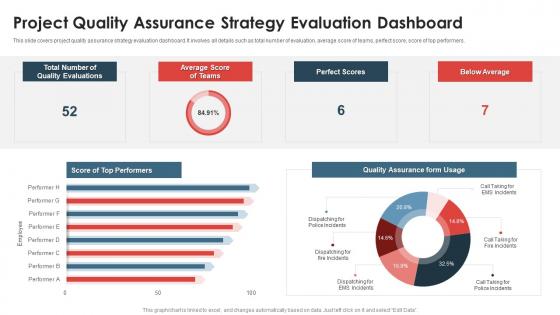
This slide covers project quality assurance strategy evaluation dashboard. It involves all details such as total number of evaluation, average score of teams, perfect score, score of top performers.
People who downloaded this PowerPoint presentation also viewed the following :
Project Quality Assurance Strategy Evaluation Dashboard with all 7 slides:
Use our Project Quality Assurance Strategy Evaluation Dashboard to effectively help you save your valuable time. They are readymade to fit into any presentation structure.






FAQs for Project Quality Assurance
Project Quality Assurance principles include prevention-focused planning, continuous monitoring, stakeholder involvement, process standardization, and risk-based testing methodologies. These approaches streamline project delivery by establishing clear quality benchmarks, implementing systematic review cycles, and maintaining consistent documentation standards, with many organizations finding that proactive QA reduces rework costs while enhancing client satisfaction and competitive positioning.
Project managers effectively integrate QA into project planning by establishing quality standards early, defining testing phases throughout development milestones, allocating dedicated QA resources, and creating continuous feedback loops between development and testing teams. This strategic approach enables organizations to identify issues before they escalate, streamline delivery timelines, and ultimately deliver higher-quality outcomes while reducing costly post-launch corrections.
Project Quality Assurance commonly employs testing frameworks like Selenium and JIRA, methodologies such as Six Sigma and Agile testing, statistical process control, and automated inspection systems. These approaches streamline quality monitoring by reducing defects, accelerating delivery timelines, and enhancing customer satisfaction, with many organizations finding that integrated QA frameworks ultimately deliver competitive advantage and operational efficiency.
Quality assurance focuses on preventing defects through process improvement, standardization, and systematic planning, while quality control involves detecting and correcting defects through testing, inspections, and reviews. QA establishes frameworks and methodologies upfront, whereas QC validates deliverables against requirements, with many organizations finding that combining both approaches ultimately delivers higher project success rates and reduced rework costs.
Stakeholder engagement ensures Project Quality Assurance aligns with business expectations, requirements, and success criteria through continuous feedback, validation, and collaborative oversight. Active stakeholder participation enables early issue identification, requirement clarification, and quality standard validation, with many organizations finding that engaged stakeholders significantly reduce rework costs and enhance project outcomes.
Teams measure QA effectiveness through defect detection rates, test coverage metrics, customer satisfaction scores, time-to-resolution tracking, and post-release defect analysis. These measurements enable organizations to identify process gaps, optimize resource allocation, and enhance product reliability, with many software development teams finding that comprehensive QA metrics ultimately deliver faster release cycles and improved customer experiences.
Common QA implementation challenges include inconsistent process adherence, inadequate resource allocation, resistance to change, lack of stakeholder buy-in, and insufficient training across project teams. These obstacles often emerge in fast-paced environments like software development and manufacturing, where teams struggle to balance quality requirements with tight deadlines, ultimately requiring strategic planning and cultural alignment to deliver successful outcomes.
Project Quality Assurance significantly enhances project delivery by establishing systematic standards, implementing continuous monitoring processes, and preventing defects before they escalate into costly issues. Through structured testing protocols and milestone reviews, organizations streamline timelines, reduce rework costs, and deliver superior outcomes, with many companies finding that robust QA frameworks ultimately increase client satisfaction and competitive advantage.
Continuous improvement in QA practices ensures organizations adapt to evolving technologies, methodologies, and market demands while maintaining high-quality standards. This iterative approach enables teams to identify process inefficiencies, reduce defect rates, and enhance testing methodologies, with many software development companies finding that regular QA refinements ultimately deliver faster release cycles and improved customer satisfaction.
Organizations foster quality culture by establishing clear quality standards, providing comprehensive training programs, implementing regular peer reviews, recognizing quality achievements, and empowering team members to identify improvement opportunities. Through these approaches, teams in sectors like software development, construction, and healthcare enhance accountability, reduce defects, and improve deliverable consistency, while creating environments where quality becomes everyone's responsibility, ultimately delivering higher client satisfaction and competitive advantage.
Key quality metrics include defect density, customer satisfaction scores, requirements traceability, test coverage percentages, and schedule variance rates. These metrics enable project managers to identify issues early, optimize resource allocation, and ensure deliverables meet specifications, with many organizations finding that systematic monitoring reduces rework costs by 30-40% while enhancing client relationships.
Risk management aligns with Project Quality Assurance by integrating quality metrics into risk assessment frameworks, establishing proactive monitoring systems, and creating feedback loops between quality checkpoints and risk mitigation strategies. Through systematic quality audits, organizations identify potential failures early, streamline corrective actions, and enhance project deliverables, ultimately delivering reduced costs and improved stakeholder confidence.
Essential training for QA professionals includes technical testing methodologies, automation tools, risk assessment frameworks, regulatory compliance standards, and communication skills. These competencies enable QA teams to streamline quality processes, enhance project deliverables, and minimize costly defects, with many organizations finding that well-trained QA professionals ultimately deliver faster project cycles and improved stakeholder confidence.
Feedback loops enhance Project Quality Assurance effectiveness by enabling continuous monitoring, rapid issue identification, and real-time course corrections throughout project lifecycles. Through systematic feedback mechanisms, organizations streamline quality processes, reduce defect rates, and accelerate delivery timelines, with many teams finding that iterative feedback ultimately delivers improved stakeholder satisfaction and competitive project outcomes.
**INPUT**: What are some best practices for documenting QA procedures and outcomes in projects? **OUTPUT**: Best practices include creating standardized templates, maintaining real-time documentation updates, establishing clear approval workflows, implementing version control systems, and ensuring comprehensive traceability matrices. These approaches streamline quality oversight by centralizing information, reducing miscommunication, and enabling consistent auditing across project phases, with many organizations finding that structured documentation ultimately delivers faster issue resolution and enhanced stakeholder confidence. **Word count: 59 words**
-
They helped us design the pamphlets for our church’s food drive! The people loved the design, and I’m happy to say it was successful. Thank you, SlideTeam!
-
I really liked their customized design services. I got my desired template made by their expert team. Thank You!