


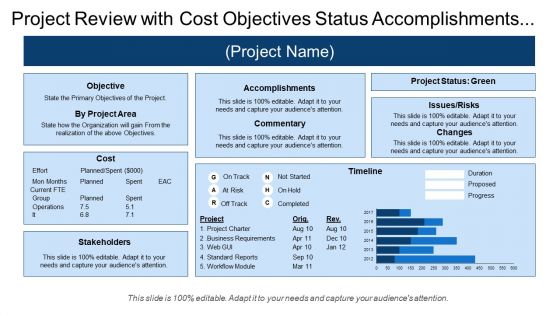
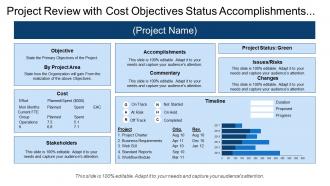
Project review with cost objectives status accomplishments changes




Try Before you Buy Download Free Sample Product
 Impress Your
 Audience
 100%
100% Editable
 Save Hours
 of Time


Interact with folks and enhance the event due to our Project Review With Cost Objectives Status Accomplishments Changes. It allows you to join in the festivities.
People who downloaded this PowerPoint presentation also viewed the following :
Project review with cost objectives status accomplishments changes with all 5 slides:
Our Project Review With Cost Objectives Status Accomplishments Changes enable better concentration. They ensure attention isn't diverted.

FAQs for Project review with cost objectives
Hit the basics first: what you planned vs what actually happened, plus your budget and timeline numbers - they always ask about those anyway. Talk through the biggest challenges and how you handled them. Honestly, people eat up the problem-solving stories more than the smooth sailing stuff. Don't forget metrics wherever you can swing it instead of vague "it went great" type language. Oh, and if you had any quick wins, definitely include those since everyone loves a success story. Wrap up with what's next so they're not left hanging.
Start with your biggest wins - numbers are your friend here. "Cut processing time by 40%" hits way harder than vague success stories. I'd bucket everything into timeline, budget, quality stuff since it's cleaner to follow. Connect achievements back to what you originally promised and show real impact on users or the business. Oh, and definitely shout out your team members who killed it. The process stuff matters too - what actually worked so you can repeat it next time. Honestly, most people skip that last part but it's gold for future projects.
Timeline and budget stuff is obvious, but honestly? Team velocity tells you way more about what's really going down than any fancy dashboard. Track scope creep too - that'll kill you fast. Quality metrics like defect rates or customer satisfaction are solid choices. Oh, and don't sleep on stakeholder engagement because I've seen perfect projects tank when people just... stop caring. Resource utilization is another good one. Start with maybe 3-4 metrics that actually matter for your project. You can always pile on more later if you need to dig deeper.
Honestly, start by comparing what you planned vs what actually went down - that's where you'll find the good stuff. Your original timeline and budget probably tell a brutal story when you stack them against reality. Get feedback from your team too since they catch the messy process stuff you miss from your manager perch. Here's the thing though - don't just hunt for failures. Sometimes your wins happened because people worked around broken systems, which is actually worse in the long run. Be real about what created extra work or slowed everyone down. Write it all down so you're not repeating the same mistakes next project.
Oh dude, stakeholder meetings can be brutal when people just stare blankly at you. Here's what's worked for me: send them a quick summary beforehand with actual agenda points so they're not walking in blind. During the meeting, throw in polls or ask people direct questions - honestly, anything to wake them up. I always share failures along with wins because people get way more honest when you're real with them. The thing is, executives want different info than your dev team, so adjust how you talk to each group. Oh and definitely follow up after with next steps or everything just... disappears into the void.
Honestly, visuals are a game changer for project reviews. People actually remember stuff when you show charts instead of just rattling off numbers. Budget variances? Timeline changes? Way easier to grasp with a quick graph. Screenshots beat talking about progress any day - like, actually show them what you built! Quick tip though: don't go overboard with random graphics everywhere. Pick maybe 2-3 visuals that actually matter to your main points. Trust me, stakeholders will thank you for not making them sit through another boring slide deck. Plus it keeps everyone from zoning out during longer presentations.
Honest feedback is where the magic happens in post-project reviews. Get everyone to share what actually went down - the good, bad, and ugly. Creating a blame-free zone is tough but so worth it. People clam up if they think they'll get roasted for admitting mistakes. Once folks start talking openly, you'll uncover crazy insights about your processes and team stuff you never noticed. I always end up learning more from the messy projects anyway. Ask follow-up questions when something sounds interesting and write down the good stuff so you don't forget it next time around.
Just do three buckets: wins, fails, and what's next. Lead with one sentence on whether you actually hit your goals. Then 3-5 bullets max per section - seriously, no one reads long retrospectives anyway. Skip the fluffy stuff like "we need better communication." What does that even mean? Give real examples instead. Each section should end with actual next steps you can take. Oh and time-box it to 30 minutes. You can always circle back later if something needs a deeper dive, but most issues don't really need that.
Oh man, biggest mistake? Jumping straight into the technical stuff without explaining why anyone should care. Your audience will zone out instantly. Don't try covering everything either - just hit the main wins. And please don't be that person who presents a bunch of problems without any solutions... like thanks for the anxiety, right? Make your slides visual instead of walls of text. Practice your timing too - I've seen so many good presentations crash because someone ran out of time for the important parts. Oh, and have your numbers ready for questions. People love poking holes in data.
Honestly, monthly reviews work for most stuff, but it really depends. Fast-moving or risky projects? Do them weekly. Longer-term things can probably get away with quarterly check-ins. I've watched teams completely burn out from too many reviews - it's almost worse than not communicating enough, if that makes sense. Start monthly and see how it feels. Your stakeholders will tell you pretty quickly if it's too much or not enough. Complex projects obviously need more attention. But seriously, if people start skipping meetings or looking dead inside, you've gone overboard.
Project reviews are honestly goldmines - they show you exactly what to avoid next time and what actually works. Update your templates based on real results, not what you thought would happen. We had one post-mortem that was so bad it completely changed how we communicate (for the better though). Document specific stuff, not generic "communicate better" nonsense. Short sentences work. Longer ones help you explain the nuances of what went wrong and why. Start some kind of shared database your team can check before new projects. Trust me, you'll reference it way more than you think.
Honestly, presentation software is a game changer for project reviews. You can throw all your progress, timelines, and key metrics onto visual dashboards instead of drowning in email threads. Stakeholders eat up those colorful charts way more than boring text blocks - I've seen people's eyes literally glaze over during text-heavy meetings. The collaborative stuff is pretty sweet too since team members can drop comments right on the slides. Oh, and some of these tools auto-update with your project data which saves tons of time. Just start with a basic template tracking your main KPIs and expand from there.
Get those notes down within 24 hours - trust me, everyone forgets stuff fast. Write down the actual decisions made, what went smoothly, and what was a disaster. Don't sugarcoat it like most people do, that just wastes time later. Make action items super clear with real owners and deadlines that aren't impossible. Oh, and explain WHY each task matters - context is everything. Keep it simple with bullets so people can scan quickly. Bottom line: someone who skipped the meeting should read your notes and know exactly what went down plus what's happening next.
Ok so basically you gotta totally switch up your approach based on who you're talking to. Executives? Hit them with the big picture stuff - budget impact, strategic wins, outcomes. They'll zone out if you get into technical weirdness. Your project team though - that's where you get into the weeds about what broke, what didn't, lessons learned, all that good stuff. Other department people mostly just want to know "how does this mess with my world?" I made this mistake once showing sprint charts to our CEO... awkward silence for days. Just think about what decisions they need to make with your info and go from there.
Dude, make a tight agenda beforehand with actual time slots for each thing. Seriously designate someone to be the time cop - I cannot stress this enough because I've sat through way too many of these that drag on forever. Use timers if you have to. When people go off on tangents (and they will), just say you'll circle back later. The whole point is making decisions and figuring out next steps, not rehashing every little detail. Oh and don't feel bad about cutting people off when time's up. Trust me, everyone secretly wants the meeting to end on schedule anyway.
-
Appreciate the research and its presentable format.
-
Amazing product with appealing content and design.