


Project task list on the basis of priority days ppt powerpoint presentation layouts gridlines




Try Before you Buy Download Free Sample Product
 Impress Your
 Audience
 100%
100% Editable
 Save Hours
 of Time


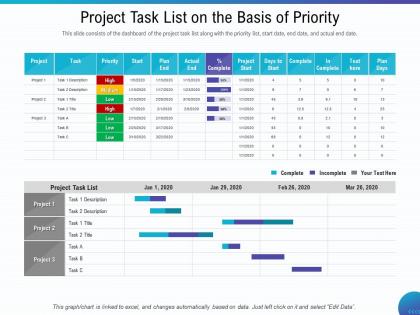
This slide consists of the dashboard of the project task list along with the priority list, start date, end date, and actual end date.
People who downloaded this PowerPoint presentation also viewed the following :
Project task list on the basis of priority days ppt powerpoint presentation layouts gridlines with all 2 slides:
Use our Project Task List On The Basis Of Priority Days Ppt Powerpoint Presentation Layouts Gridlines to effectively help you save your valuable time. They are readymade to fit into any presentation structure.
FAQs for Project task list on the basis of priority days ppt powerpoint
Look at impact first - what actually moves your project forward? Deadlines matter too, but honestly half the "urgent" stuff isn't really urgent. Quick wins are golden because they keep you feeling productive. Dependencies will bite you though - some tasks block your whole team, so those jump to the front of the line. I just make a simple 1-5 rating for each factor. Total up the scores and start with whatever's highest. Works way better than my old method of just panicking and doing whatever seemed loudest!
So there's this thing called the Eisenhower Matrix - basically you dump all your tasks into four boxes. Urgent AND important stuff? Do it now. Important but not urgent? Schedule it (this is actually where the good stuff lives). Urgent but not important? Hand it off to someone else. Neither urgent nor important? Just... don't. The trick is being honest about what's actually urgent - spoiler alert, most things aren't. I literally ask myself "what happens if I ignore this?" and half the time the answer is nothing. Start by brain-dumping everything, then sort ruthlessly. You'll end up dropping way more than you think.
Dude, you HAVE to get stakeholders involved in prioritizing stuff. They actually know what matters to users and the business. I wasted like 3 weeks once building something literally no one wanted - huge lesson learned there. Set up regular check-ins, not just a one-time thing at kickoff. They'll help you figure out if you should tackle technical debt or push new features. Plus they catch dependencies you'd totally miss otherwise. Things change constantly (obviously), so those quick touchpoints are clutch for staying on track.
Basically agile makes prioritization way more flexible than the old waterfront approach. You're not locked into decisions from day one - instead you're constantly reevaluating what actually matters to users. Sprint planning becomes this ongoing thing where the product owner leads but everyone jumps in with their thoughts on complexity and dependencies. Honestly, some of the best insights come from random team discussions. Techniques like story mapping or MoSCoW help, though sometimes we just do dot voting when we're feeling lazy. The beauty is those short cycles - when something shifts, you can actually respond instead of being stuck. Focus on your highest-value stories for the next sprint and build from there.
Try the Eisenhower Matrix - it's where you plot stuff by urgent vs important, super helpful for seeing what actually matters. There's also impact scoring where you rate tasks 1-10, or MoSCoW (must have, should have, etc). Honestly though, I'm obsessed with the effort vs impact thing - finding those low-effort, high-impact tasks is like finding money on the ground. Quick wins feel amazing. Ask yourself what would actually move things forward if you could only do one thing today. Just grab your task list and run it through whatever method feels right. The Eisenhower one's probably the easiest to start with.
Dude, project management software seriously changed my life for prioritizing stuff. The visual dashboards are clutch - you can see everything laid out and actually make sense of what needs doing first. Setting priority levels and deadlines becomes super straightforward, plus tracking task dependencies so you don't miss anything important. Filtering by urgency is probably my favorite feature, way better than my old system of random sticky notes (which was honestly chaos). When priorities shift - and they always do - you can adjust things in seconds. My advice? Set up clear priority categories first, then review weekly. Takes like 10 minutes but saves hours of stress.
Ugh, the worst thing you can do is make everything "urgent" - then nothing actually is. Don't bounce between priorities every five minutes either, it drives your team crazy. I learned this the hard way when I kept switching our sprint goals. Also watch out for task dependencies - can't do B if A isn't even started yet, right? People love pushing their pet projects as "critical" too. Here's what helps: write down what actually makes something high priority and don't budge when stakeholders come knocking. Oh, and be realistic about capacity or you'll burn everyone out.
MoSCoW basically forces everyone to stop saying "everything's urgent" and actually pick what matters. Must haves? That's the stuff that'll completely break your project. Should haves are important but honestly, you could probably launch without them if you had to. Could haves are for when you magically have extra time (which... let's be real, never happens). Won't haves get explicitly banned from this round - no exceptions. The best part is watching stakeholders try to justify why their random idea is actually "critical." Suddenly everyone gets way more honest about priorities. Try running your backlog through these buckets next meeting.
Okay so basically you need to look at two things for every task - how urgent it is and how important it is. Most people get these mixed up constantly. Important stuff actually moves your project forward. Urgent just means it has a tight deadline. Do the important AND urgent things first, obviously. Then tackle important but not urgent ones. Here's the thing though - don't get sucked into only doing urgent tasks because they feel so pressing. Half the time they don't even matter that much! I'd make a simple 2x2 grid and plot everything out. Sounds nerdy but it actually works really well.
Sprint reviews every 2-3 weeks work really well for catching priority shifts early. I'd use MoSCoW or scoring matrices to reassess - super helpful for keeping things organized. Weekly standups are good too, but honestly they drag on forever sometimes. When scope creep hits (and it always does), immediately re-rank everything by impact vs effort. Compare your current tasks against updated business goals monthly with stakeholders. Trust me, those check-ins save you from working on stuff that's already irrelevant. The whole point is staying flexible without losing focus on what actually moves the needle.
Oh totally, team dynamics mess with your delegation way more than you'd think. Like, I've seen managers assign stuff based on who gets along instead of who's actually good at it - which is kinda backwards but happens all the time. Trust plays a huge role too. You'll give the important projects to people you trust even if someone else might crush it better. And don't get me started on those loud personalities who basically hijack priorities just by being vocal. The trick is catching yourself doing this stuff and forcing yourself to step back. Ask yourself - am I picking this person because they're right for the job, or because it's easier?
Honestly, I just keep asking myself "what breaks if this gets pushed back?" - that question alone cuts through so much noise. Rank everything by what directly hits your main deadlines and deliverables. Your project timeline shows you the dependencies, so focus on anything that'll create a domino effect downstream. I do weekly check-ins with stakeholders since they love changing their minds about what's "urgent." Set up some basic scoring system for impact vs urgency. Sounds boring but it actually works. Also, don't forget those regular team touchpoints - they'll catch stuff you missed.
Get everyone together - video call works fine - and actually talk it through. First figure out what each person really needs and why, not just their surface requests. You'd be surprised how often people are basically wanting the same thing but explaining it totally differently! Look for stuff that helps multiple teams at once. Those are your easy wins right there. For the real conflicts where someone has to lose? That's when you need to pull in whoever gets paid to make those calls. Just write down what you decide so nobody can pretend later they heard something else.
Look, start simple with just tracking your task completion rates and deadline hits - you don't want to spend more time measuring than actually working lol. I'm obsessed with what I call "priority drift" - basically how often you abandon your "urgent" stuff for other "urgent" stuff. That one's super telling. Check if your big-picture projects are actually moving forward instead of just putting out fires constantly. Stakeholder happiness matters too, obviously. The real win? Less firefighting over time while your important work keeps progressing. Honestly though, pick like 2-3 metrics max or you'll just create another thing to procrastinate on.
Look back at your finished projects and see which tasks actually mattered vs what just felt urgent. I used to always go for the fun technical stuff first - terrible idea lol. Now I keep track of what caused real delays and what stakeholders genuinely cared about afterward. Dependencies are sneaky too, I'm always underestimating those. Keep some kind of lessons learned doc (doesn't have to be fancy) and check it before new projects start. You'll get way better at filtering out the noise from stuff that's actually important. Trust me, past you has solid advice for future you.
-
Great designs, really helpful.
-
Informative design.