


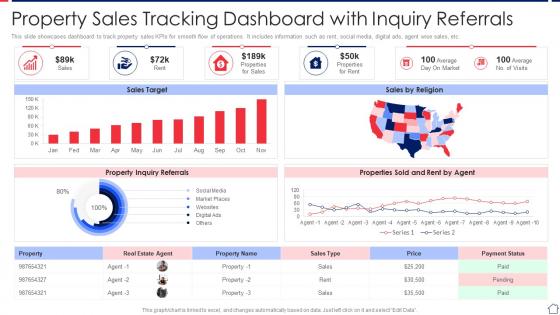
Property Sales Tracking Dashboard With Inquiry Referrals




Try Before you Buy Download Free Sample Product
 Impress Your
 Audience
 100%
100% Editable
 Save Hours
 of Time


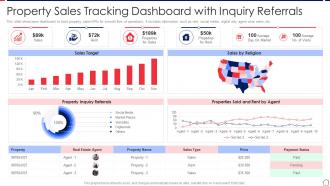
This slide showcases dashboard to track property sales KPIs for smooth flow of operations. It includes information such as rent, social media, digital ads, agent wise sales, etc.
People who downloaded this PowerPoint presentation also viewed the following :
Property Sales Tracking Dashboard With Inquiry Referrals with all 7 slides:
Use our Property Sales Tracking Dashboard With Inquiry Referrals to effectively help you save your valuable time. They are readymade to fit into any presentation structure.





FAQs for Property Sales Tracking Dashboard
A comprehensive property sales dashboard should include average sale price, days on market, inventory levels, conversion rates, lead sources, and sales volume by location. These metrics enable real estate agencies and property developers to streamline market analysis, optimize pricing strategies, and enhance client acquisition efforts, ultimately delivering faster transactions and improved competitive positioning.
Visualization techniques enhance property sales data understanding by transforming complex datasets into intuitive charts, heat maps, trend graphs, and interactive dashboards that reveal patterns instantly. These visual tools enable real estate professionals to identify market trends, pricing opportunities, and buyer preferences more effectively, while streamlining decision-making processes and ultimately delivering faster market insights and competitive advantage.
Real-time data transforms property sales dashboards by enabling immediate market responsiveness, accurate pricing decisions, and instant lead tracking capabilities. This immediacy allows real estate professionals to capitalize on market fluctuations, adjust strategies based on current inventory levels, and respond to client inquiries with up-to-date information, ultimately delivering competitive advantage and enhanced customer experiences.
Property sales dashboards can be tailored through role-based customization, personalized metrics selection, adjustable visualization formats, and flexible reporting frequencies to meet diverse stakeholder requirements. Real estate agents focus on lead conversion and pipeline tracking, while executives prioritize revenue trends and market analysis, with many organizations finding that customizable interface designs and automated alert systems ultimately deliver enhanced decision-making capabilities and improved operational efficiency.
Integrating CRM data into property sales dashboards delivers enhanced lead tracking, automated follow-up scheduling, comprehensive client history visualization, sales pipeline transparency, and performance analytics across teams. This strategic combination enables real estate professionals to streamline client interactions, accelerate deal closures, and optimize resource allocation, with many agencies finding that centralized data access ultimately increases conversion rates and delivers superior customer experiences.
Predictive analytics within property sales dashboards enables forecasting market trends, buyer behavior patterns, optimal pricing strategies, and lead conversion probabilities through machine learning algorithms and historical data analysis. Real estate agencies leverage these insights to anticipate demand fluctuations, identify high-value prospects, and optimize inventory management, ultimately delivering faster sales cycles and enhanced revenue performance.
**INPUT**: What tools or software are best suited for creating an effective property sales dashboard? **OUTPUT**: Effective property sales dashboards utilize Tableau, Power BI, Salesforce Analytics, Google Data Studio, and specialized real estate platforms like Chime, Follow Up Boss, or Realvolve. These tools streamline property tracking, lead management, and commission calculations while enabling real estate agencies to enhance client relationships, accelerate deal closures, and ultimately deliver competitive advantages in increasingly data-driven markets. **Word count: 58 words**
Market trends can be effectively represented through interactive charts showing price movements over time, comparative neighborhood analysis, inventory levels, days on market metrics, and seasonal patterns. These visualizations enable real estate professionals to identify emerging opportunities, adjust pricing strategies, and provide data-driven insights to clients, ultimately enhancing decision-making and competitive positioning.
Common pitfalls include information overload, poor visual hierarchy, irrelevant metrics, lack of real-time updates, and inadequate filtering options. These design flaws undermine dashboard effectiveness by creating confusion, slowing decision-making, and reducing user adoption, with many real estate teams finding that streamlined, intuitive dashboards ultimately deliver faster insights and improved sales performance.
User experience significantly impacts dashboard adoption by determining how easily agents can navigate features, access critical property data, and complete daily tasks without friction. Intuitive interfaces with clear visualizations enable faster lead tracking and client management, while poor UX creates resistance and low engagement, with many real estate teams finding that streamlined, mobile-responsive dashboards ultimately drive higher utilization rates and improved sales performance.
Geographic data visualizations in property sales reveal market trends, pricing patterns, regional demand fluctuations, neighborhood performance metrics, and investment opportunities across different locations. These visualizations enable real estate professionals to identify emerging markets, optimize pricing strategies, and guide investment decisions, with many agencies finding that location-based analytics ultimately deliver competitive advantages and enhanced portfolio performance.
A property sales dashboard aids in identifying buyer personas by analyzing demographic data, purchase patterns, price preferences, location choices, and timeline behaviors across different client segments. Through comprehensive data visualization, real estate professionals can distinguish patterns between first-time buyers, investors, and luxury clients, ultimately enabling targeted marketing strategies and personalized service approaches that significantly enhance conversion rates.
Real estate KPIs include average days on market, price per square foot, lead conversion rates, listing-to-sale ratios, and commission margins. These metrics enable agencies to streamline operations, optimize pricing strategies, and enhance client experiences, with many real estate firms finding that comprehensive dashboard monitoring ultimately delivers faster transactions and improved market positioning.
Historical data comparison in property sales dashboards involves overlay charts, trend lines, year-over-year metrics, and period-to-period variance analysis. These visualization techniques enable real estate professionals to identify market patterns, seasonal fluctuations, and performance trajectories, with many agencies finding that comparative dashboards streamline forecasting accuracy and strategic pricing decisions.
Customization options include filtering by property type, location, price range, agent performance, and time periods, alongside adjustable visualization formats and personalized metric displays. These features streamline decision-making by enabling real estate professionals to focus on relevant data segments, track individual performance metrics, and generate targeted reports, ultimately delivering faster market insights and enhanced client service capabilities.
-
Great experience, I would definitely use your services further.
-
Easily Understandable slides.