

Public Finance And Investment Management Process Cycle




Try Before you Buy Download Free Sample Product
 Impress Your
 Audience
 100%
100% Editable
 Save Hours
 of Time


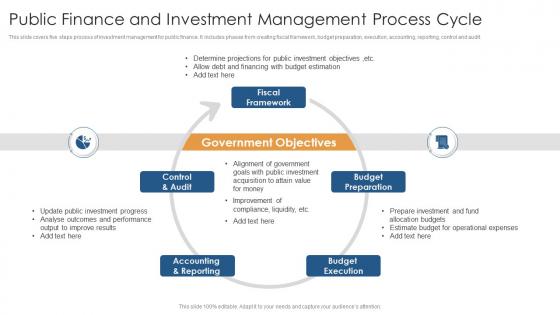
This slide covers five steps process of investment management for public finance. It includes phases from creating fiscal framework, budget preparation, execution, accounting, reporting, control and audit.
People who downloaded this PowerPoint presentation also viewed the following :
Public Finance And Investment Management Process Cycle with all 6 slides:
Use our Public Finance And Investment Management Process Cycle to effectively help you save your valuable time. They are readymade to fit into any presentation structure.





FAQs for Public Finance And Investment
Public finance components include revenue generation, expenditure management, debt administration, fiscal policy implementation, and budget allocation strategies. These elements streamline government operations by enhancing resource distribution, optimizing tax collection systems, and improving public service delivery, with many municipalities finding that strategic integration ultimately delivers greater fiscal transparency and operational efficiency.
Taxation policies significantly influence income distribution through progressive tax rates, wealth taxes, and redistributive mechanisms that transfer resources from higher to lower income brackets. While progressive systems can reduce inequality by funding social programs and public services, they also present challenges around economic growth and investment incentives, with many governments finding that strategic tax design ultimately delivers both revenue generation and more equitable income distribution.
Public finance enables governments to fund essential services like education and healthcare through tax revenues, bond issuances, and budget allocations that ensure equitable access across populations. These funding mechanisms streamline resource distribution to schools, hospitals, and clinics, while enhancing service quality and accessibility, ultimately delivering better educational outcomes and healthcare experiences for communities nationwide.
Public finance promotes sustainable economic development through strategic infrastructure investments, green technology funding, education and healthcare expenditures, regulatory frameworks that incentivize sustainable practices, and public-private partnerships. These mechanisms enable governments to address market failures, reduce income inequality, and foster long-term growth, with many developing nations finding that targeted public spending in renewable energy and digital infrastructure ultimately delivers enhanced competitiveness and economic resilience.
Public expenditure and economic growth in developing countries present both challenges and opportunities, with strategic infrastructure investments, education funding, and healthcare spending typically driving positive correlation. While excessive spending can strain budgets, many developing nations find that targeted public investment in critical sectors like transportation, utilities, and human capital development ultimately delivers enhanced productivity, job creation, and sustainable economic expansion.
Public debt implications include constrained fiscal flexibility, higher interest obligations, intergenerational burden transfer, crowding out of private investment, and potential inflationary pressures. These factors significantly influence government policy choices by limiting spending capacity, requiring strategic debt management, and affecting monetary policy coordination, with many economies finding that sustainable debt-to-GDP ratios ultimately enable continued public investment while maintaining investor confidence.
Public finance management in developed nations typically features advanced digital systems, comprehensive regulatory frameworks, transparent budgeting processes, and robust audit mechanisms. Developing countries often face challenges including limited technological infrastructure, capacity constraints, and weaker institutional frameworks, while increasingly adopting innovative approaches like mobile banking and digital payment systems, ultimately working toward enhanced fiscal transparency and improved service delivery.
Fiscal decentralization enhances public service delivery by transferring financial authority to local governments, enabling more responsive resource allocation, targeted community programs, and efficient service customization. Through localized budget control, municipalities and regional authorities streamline healthcare access, educational funding, and infrastructure development, while reducing bureaucratic delays, ultimately delivering faster services and improved citizen satisfaction across diverse geographic areas.
Public finance addresses climate change through green bonds, carbon pricing mechanisms, renewable energy subsidies, environmental taxes, and climate adaptation funding. These instruments enable governments to accelerate clean technology adoption, incentivize sustainable practices, and build climate resilience, with many municipalities and national governments finding that strategic environmental investments ultimately deliver both ecological benefits and long-term economic advantages.
Measuring public finance effectiveness faces challenges including defining appropriate metrics, establishing causal relationships between spending and outcomes, accounting for long-term impacts, and managing data quality issues across multiple agencies. These measurement complexities are compounded by political considerations and varying stakeholder expectations, with many governments finding that comprehensive evaluation frameworks require significant investment in data infrastructure and analytical capabilities, ultimately delivering better resource allocation and enhanced public accountability.
Taxation models influence compliance through perceived fairness, simplicity, and transparency, with progressive systems often encouraging participation while regressive models may reduce voluntary compliance. Countries implementing digital tax platforms, simplified filing processes, and clear benefit linkages find significantly higher compliance rates, while transparent allocation of tax revenues to visible public services enhances citizen engagement and voluntary participation.
Public finance significantly influences private sector investment through infrastructure development, regulatory frameworks, tax policies, and market stability measures. Strategic government spending on transportation, education, and healthcare creates enabling environments that attract private capital, while fiscal policies can either crowd out or crowd in private investment, with many economies finding that balanced public finance approaches ultimately enhance business confidence and accelerate sustainable economic growth.
Technology enhances public finance management through digital budgeting platforms, automated reporting systems, real-time expenditure tracking, blockchain-based transaction records, and AI-powered analytics for fraud detection. These solutions streamline government operations by reducing manual processes, enabling citizen access to spending data, and accelerating audit procedures, ultimately delivering greater accountability and more efficient resource allocation across public institutions.
International financial institutions like the World Bank, International Monetary Fund, and regional development banks significantly influence public finance policies through lending conditions, technical assistance, capacity building programs, and policy recommendations. These institutions shape fiscal frameworks, tax systems, and expenditure priorities across developing nations, with many countries finding that compliance with their guidelines enables access to capital markets, enhances fiscal credibility, and ultimately delivers improved economic stability and growth outcomes.
Public finance helps mitigate economic crisis effects through targeted social safety nets, unemployment benefits, healthcare subsidies, and emergency cash transfers. During downturns, governments strategically reallocate resources to vulnerable populations, with many countries finding that direct fiscal interventions, subsidized essential services, and expanded public programs ultimately deliver faster recovery and reduced inequality.
-
Editable, diversified, compatible with MS PPT and Google Slides, and on top of that finest graphics!! I mean in the words of the famous Ross Geller, “What more do you want!”
-
Impressive templates. Designing a presentation is fun now!