


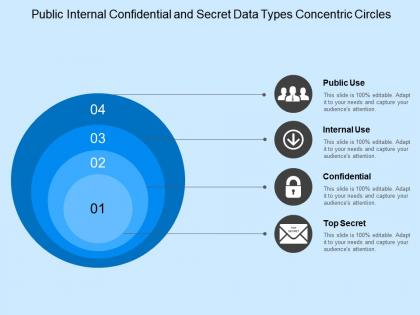
Public internal confidential and secret data types concentric circles




Try Before you Buy Download Free Sample Product
 Impress Your
 Audience
 100%
100% Editable
 Save Hours
 of Time


Call their bluff with our Public Internal Confidential And Secret Data Types Concentric Circles. Display capability for determined action.
People who downloaded this PowerPoint presentation also viewed the following :
Public internal confidential and secret data types concentric circles with all 5 slides:
Give them enough to be cheerful about with our Public Internal Confidential And Secret Data Types Concentric Circles. It will help heal their hearts.


FAQs for Public internal confidential and secret data
Data classification aims to organize information by sensitivity levels, establish appropriate security controls, ensure regulatory compliance, streamline access management, and optimize storage costs. These objectives enhance organizational efficiency by enabling automated data handling, reducing security risks, and facilitating compliance reporting, with many enterprises finding that strategic classification ultimately delivers better resource allocation and stronger data governance across their operations.
Machine learning enhances automated data classification accuracy by learning from patterns in training data, adapting to new data types, and continuously improving through feedback loops. These algorithms enable organizations to automatically categorize vast datasets with precision rates exceeding 95%, while reducing manual review time and ensuring consistent classification standards across departments.
Data classification methods include content-based analysis, context-based classification, user-based categorization, automated machine learning algorithms, and hybrid approaches combining multiple techniques. These methods enhance organizational security by identifying sensitive information, streamlining compliance processes, and enabling targeted protection strategies, with many financial services and healthcare institutions finding that automated classification significantly reduces manual oversight while improving data governance.
Data classification significantly enhances regulatory compliance by enabling organizations to identify, categorize, and protect sensitive information according to specific legal requirements like GDPR's personal data provisions and HIPAA's protected health information standards. Through automated classification systems, healthcare providers and financial institutions streamline audit processes, minimize compliance risks, and implement appropriate security controls, ultimately delivering faster regulatory reporting and reduced penalty exposure.
Metadata serves as the foundation for automated data classification by providing descriptive information about data creation dates, file types, access patterns, content structure, and ownership details. This contextual information enables classification systems to categorize data more accurately and efficiently, with many organizations finding that metadata-driven approaches significantly streamline compliance processes while reducing manual classification efforts.
Organizations establish effective data classification policies by defining clear categories based on sensitivity levels, implementing automated classification tools, establishing governance frameworks with defined roles, and creating comprehensive training programs. Through strategic combination of technology and process controls, companies streamline compliance requirements, enhance data protection, and minimize security risks, with many finding that well-structured policies ultimately deliver operational efficiency and competitive advantage.
Organizations face challenges including legacy system integration, employee resistance to new workflows, inconsistent classification standards, resource allocation complexities, and ongoing maintenance requirements. While these obstacles can initially slow implementation, many enterprises find that strategic phasing, comprehensive training programs, and automated classification tools ultimately streamline the process, delivering enhanced security and regulatory compliance.
Data classification improves information security by enabling targeted protection strategies, automated access controls, risk-based encryption policies, and compliance monitoring frameworks. Through systematic categorization of sensitive financial records, healthcare data, and intellectual property, organizations streamline security investments, reduce breach risks, and enhance regulatory compliance, ultimately delivering stronger protection with optimized resource allocation.
Data classification schemes for structured data rely on predefined categories, metadata tags, and database field attributes, while unstructured data requires content analysis, pattern recognition, and machine learning algorithms to identify sensitive information. Structured approaches work through automated rule-based systems and schema definitions, whereas unstructured classification leverages natural language processing and contextual analysis, with many organizations finding that hybrid approaches deliver comprehensive data governance and regulatory compliance across diverse information landscapes.
**INPUT**: What are some best practices for training employees on data classification protocols? **OUTPUT**: Best practices include regular hands-on workshops, clear visual examples of classification levels, role-specific scenarios, interactive assessments, and ongoing refresher sessions. These approaches enhance understanding by demonstrating real-world applications, providing immediate feedback on classification decisions, and ensuring consistent protocol adherence, ultimately delivering improved data security and regulatory compliance across organizations.
Data classification fundamentally shapes governance strategies by establishing clear data hierarchies, defining access controls, determining retention policies, and prioritizing security measures based on sensitivity levels. Through systematic classification frameworks, organizations streamline compliance efforts, enhance regulatory alignment, and optimize resource allocation, with many financial services and healthcare institutions finding that structured classification enables faster audit responses and significantly reduces governance overhead costs.
Data classification technologies include machine learning algorithms, natural language processing tools, automated discovery scanners, metadata analysis systems, and content inspection platforms. These technologies streamline classification by automatically identifying sensitive information, categorizing data based on content patterns, and applying consistent labeling policies across enterprise systems, ultimately reducing manual effort while enhancing data governance and compliance accuracy.
Business intelligence tools utilize classified data by aggregating information by sensitivity levels, applying role-based access controls, and generating targeted analytics dashboards for different organizational tiers. Through strategic data segmentation, executives access high-level strategic insights while department managers receive operational metrics, ultimately enabling faster, more informed decision-making while maintaining data governance and regulatory compliance across the enterprise.
Data classification's future in big data and cloud computing environments involves automated AI-driven categorization, real-time processing capabilities, and enhanced security protocols that adapt to distributed architectures. Organizations increasingly leverage machine learning algorithms to handle massive data volumes across hybrid cloud infrastructures, with financial services and healthcare sectors finding that intelligent classification systems deliver improved compliance, streamlined governance, and competitive advantages through faster, more accurate data insights.
Classification frameworks like ISO/IEC 27001 contribute to data management by establishing standardized security controls, risk assessment procedures, and governance protocols that ensure consistent data protection across organizations. These frameworks enable businesses to streamline compliance processes, minimize security vulnerabilities, and enhance operational transparency, with many financial services and healthcare institutions finding that systematic implementation ultimately delivers reduced regulatory risks and improved stakeholder confidence.
-
Best Representation of topics, really appreciable.
-
Good research work and creative work done on every template.