


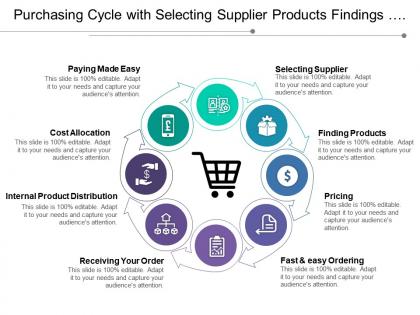
Purchasing cycle with selecting supplier products findings and receiving order




Try Before you Buy Download Free Sample Product
 Impress Your
 Audience
 100%
100% Editable
 Save Hours
 of Time


Create a carnival atmosphere wit our Purchasing Cycle With Selecting Supplier Products Findings And Receiving Order. Their color combos have a fabulous effect.
People who downloaded this PowerPoint presentation also viewed the following :
Purchasing cycle with selecting supplier products findings and receiving order with all 5 slides:
Folks become your advocates with our Purchasing Cycle With Selecting Supplier Products Findings And Receiving Order. They get galvanized into acting in your favor.
FAQs for Purchasing cycle with selecting supplier products findings
The key stages in the purchasing cycle include need recognition, supplier research, proposal evaluation, negotiation, purchase decision, and post-purchase review. These stages enable organizations to streamline procurement processes, minimize costs, and ensure strategic vendor relationships, with many companies finding that structured purchasing cycles enhance operational efficiency and deliver better supplier partnerships across manufacturing, retail, and service industries.
**INPUT**: How does the purchasing cycle differ across various industries? **OUTPUT**: The purchasing cycle varies significantly across industries in terms of complexity, duration, stakeholder involvement, and regulatory requirements. While healthcare organizations navigate lengthy approval processes for medical equipment with multiple compliance checkpoints, retail businesses often streamline procurement for seasonal inventory with faster vendor negotiations, and manufacturing companies balance cost optimization with quality assurance, ultimately requiring industry-specific strategies that enhance operational efficiency. [Word count: 60 words]
Market research provides critical insights into customer needs, competitor pricing, supplier capabilities, and market trends that inform purchasing decisions throughout the cycle. Through comprehensive market analysis, organizations enhance vendor selection, negotiate better contracts, and minimize procurement risks, while identifying cost-saving opportunities and emerging suppliers, ultimately delivering strategic sourcing advantages and improved operational efficiency.
Technology streamlines the purchasing cycle through automated procurement systems, AI-powered supplier selection, digital approval workflows, electronic invoicing, and real-time spend analytics. These solutions accelerate decision-making by eliminating manual processes, enhancing vendor comparisons, and providing instant budget visibility, with many organizations finding faster procurement cycles and significantly reduced administrative costs.
Common purchasing cycle challenges include budget constraints, lengthy approval processes, supplier evaluation difficulties, stakeholder alignment issues, and compliance requirements. These obstacles often result in delayed decisions, cost overruns, and suboptimal vendor selections, with many organizations finding that streamlined procurement workflows and automated approval systems significantly reduce cycle times while enhancing strategic sourcing outcomes.
Supplier relationship management streamlines the purchasing cycle by improving communication, enhancing contract negotiations, and reducing procurement lead times. Strong supplier partnerships enable organizations to secure better pricing, ensure consistent quality, and achieve faster delivery schedules, while many companies find that collaborative supplier relationships ultimately deliver cost savings and operational efficiency across their entire procurement process.
Essential metrics include cost savings achieved, supplier performance ratings, procurement cycle time, contract compliance rates, and purchase order accuracy percentages. These indicators streamline evaluation by tracking financial efficiency, vendor relationships, and process optimization, with many organizations finding that comprehensive metrics ultimately deliver enhanced procurement transparency and competitive purchasing advantages.
Consumer behavior analysis influences the purchasing cycle by identifying customer preferences, predicting buying patterns, and optimizing touchpoints throughout awareness, consideration, and decision phases. Through data analytics and behavioral tracking, retailers enhance product recommendations, personalize marketing messages, and streamline checkout processes, ultimately delivering faster conversions and improved customer experiences across all purchase stages.
Automated purchasing cycles deliver reduced processing times, enhanced accuracy, improved compliance tracking, better vendor management, and significant cost savings. These systems streamline operations by minimizing manual errors, accelerating approval workflows, and providing real-time visibility into spending patterns, with many organizations finding operational efficiency improvements of 30-50% while strengthening supplier relationships.
The purchasing cycle significantly affects budgeting and financial planning by determining cash flow timing, resource allocation requirements, and capital expenditure scheduling across different periods. Organizations must align their financial forecasts with procurement timelines, seasonal demand fluctuations, and supplier payment terms, with many companies finding that strategic purchasing cycle management ultimately delivers improved cost control and enhanced operational efficiency.
Current trends shaping the purchasing cycle include digital transformation, data-driven decision making, sustainability considerations, supplier relationship management, and automated procurement technologies. These developments streamline operations by reducing manual processes, enhancing transparency, and enabling real-time analytics, with many organizations finding that strategic procurement ultimately delivers cost savings and competitive advantage.
Businesses can leverage data to optimize their purchasing cycle by analyzing supplier performance metrics, tracking spending patterns, predicting demand fluctuations, and identifying cost-saving opportunities through automated procurement analytics. Through advanced data insights, organizations streamline vendor selection, reduce procurement costs, and enhance supply chain efficiency, with many companies finding that data-driven purchasing delivers faster order processing and stronger supplier relationships.
Negotiation serves as a critical bridge between vendor selection and contract finalization, enabling buyers to optimize pricing, terms, payment schedules, delivery timelines, and service level agreements. Through strategic negotiation, organizations secure better value propositions, risk mitigation clauses, and favorable conditions, with many procurement teams finding that effective negotiation delivers cost savings while strengthening long-term vendor partnerships.
Organizations ensure compliance throughout the purchasing cycle by implementing standardized procurement policies, conducting regular vendor audits, maintaining detailed documentation, and establishing clear approval hierarchies. Through automated compliance tracking systems, companies in sectors like healthcare and finance streamline regulatory adherence, minimize risk exposure, and enhance operational transparency, ultimately delivering consistent governance and competitive advantage in increasingly regulated markets.
Environmental considerations in the purchasing cycle include sustainable sourcing, carbon footprint assessment, waste reduction, energy-efficient products, and supplier environmental compliance standards. These considerations enable organizations to minimize environmental impact while reducing long-term costs, with many companies finding that green purchasing strategies ultimately deliver competitive advantage and enhanced brand reputation.
-
Easy to edit slides with easy to understand instructions.
-
Great designs, Easily Editable.