


Qa process stages agile quality assurance model it ppt powerpoint presentation gallery




Try Before you Buy Download Free Sample Product
 Impress Your
 Audience
 100%
100% Editable
 Save Hours
 of Time


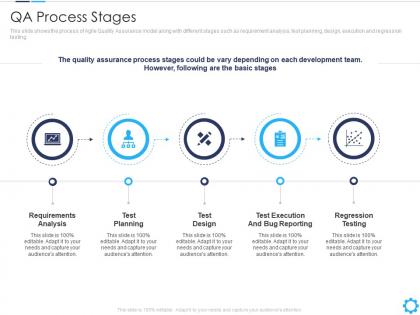
This slide shows the process of Agile Quality Assurance model along with different stages such as requirement analysis, test planning, design, execution and regression testing.
People who downloaded this PowerPoint presentation also viewed the following :
Qa process stages agile quality assurance model it ppt powerpoint presentation gallery with all 2 slides:
Use our QA Process Stages Agile Quality Assurance Model IT Ppt Powerpoint Presentation Gallery to effectively help you save your valuable time. They are readymade to fit into any presentation structure.
FAQs for Qa process stages agile quality assurance model it ppt
The key stages in a typical QA process include requirements analysis, test planning, test case design, test execution, and defect management. These stages work together by ensuring comprehensive coverage, identifying issues early, and maintaining quality standards throughout development, with many software organizations finding that structured QA processes ultimately reduce costs and accelerate delivery timelines.
The planning phase establishes foundational elements like scope definition, resource allocation, timeline development, and risk assessment that directly shape QA strategy effectiveness. Through comprehensive planning, organizations streamline testing processes, minimize costly defects, and ensure quality standards align with business objectives, with many software development teams finding that thorough planning reduces overall project costs by up to 40%.
Requirements analysis serves as the foundation for quality assurance by establishing clear, testable criteria that guide the entire QA process, ensuring alignment between stakeholder expectations and deliverable outcomes. Through systematic requirements review, QA teams can identify potential gaps, ambiguities, and conflicts early, ultimately reducing costly rework and accelerating delivery timelines across projects.
Teams effectively create test cases by analyzing requirements thoroughly, identifying user scenarios and edge cases, defining clear acceptance criteria, and mapping potential failure points across different system components. Through systematic approaches like boundary value analysis and equivalence partitioning, QA teams streamline coverage while reducing redundancy, with many organizations finding that collaborative test case reviews between developers, testers, and business analysts ultimately deliver more comprehensive testing strategies and faster defect detection.
Automated testing enhances QA by accelerating test execution, improving accuracy through consistent repeatable processes, and enabling continuous integration workflows. Through automated frameworks, organizations streamline regression testing, reduce manual effort costs, and deliver faster release cycles, with many software development teams finding that automation ultimately increases test coverage while minimizing human error risks.
Key QA lifecycle metrics include defect density, test coverage percentage, defect detection efficiency, test execution velocity, and mean time to resolution. These measurements enable organizations to streamline testing processes, enhance software quality, and accelerate release cycles, with many development teams finding that consistent metric tracking ultimately delivers improved customer satisfaction and reduced post-release maintenance costs.
Effective QA team communication requires structured protocols including daily standups, stage-gate reviews, shared documentation platforms, and clear escalation procedures throughout each testing phase. Through collaborative tools like Jira, Slack, and centralized test repositories, teams streamline information flow, minimize miscommunication risks, and maintain transparency, with many organizations finding that regular cross-functional meetings ultimately deliver faster issue resolution and improved product quality.
Common QA challenges include resource constraints, tight deadlines, evolving requirements, inadequate communication, and limited test environment availability. These obstacles can be mitigated by implementing automated testing frameworks, establishing clear documentation protocols, adopting agile methodologies, and creating dedicated testing environments, ultimately delivering faster release cycles and enhanced product quality.
Risk assessment fundamentally shapes QA processes by identifying critical failure points, prioritizing testing resources, and determining coverage depth across different system components. Through strategic risk analysis, QA teams streamline testing efforts, focus on high-impact vulnerabilities, and allocate resources more effectively, ultimately delivering faster releases while maintaining quality standards and minimizing potential business disruptions.
Manual testing involves human testers executing test cases, exploratory testing, usability validation, and ad-hoc scenarios across QA stages, while automated testing uses scripts for regression testing, load testing, unit testing, and repetitive validations. While manual testing excels in user experience evaluation and complex scenario analysis, automated testing streamlines continuous integration, accelerates release cycles, and enhances test coverage, with many software organizations finding that strategic combination of both approaches delivers optimal quality assurance and faster time-to-market.
Testing tasks are prioritized based on risk assessment, business impact, functionality criticality, and project deadlines, with high-risk areas and core features receiving immediate attention. Many organizations streamline this process by focusing on customer-facing functions first, critical security features second, and integration points third, ultimately delivering more reliable products while optimizing resource allocation and reducing time-to-market.
Essential QA management tools include test management platforms like TestRail or Qase, automated testing frameworks such as Selenium or Cypress, defect tracking systems like Jira, and reporting dashboards for real-time analytics. These technologies streamline workflow coordination, accelerate test execution cycles, and enhance stakeholder communication, with many software teams finding that integrated toolchains ultimately deliver faster release cycles and improved product quality.
QA teams can collaborate with development teams through early involvement in requirements analysis, shared responsibility for quality metrics, regular cross-functional meetings, and integrated testing approaches like pair programming. This strategic combination enables faster bug detection, streamlines release cycles, and enhances product reliability, with many organizations finding that collaborative workflows ultimately deliver higher-quality software and improved customer experiences.
Regression testing ensures that new code changes don't break existing functionality, maintaining software stability and user experience consistency throughout development cycles. This critical QA stage helps organizations like financial services and e-commerce platforms deliver reliable updates while minimizing costly post-release bugs, ultimately reducing maintenance costs and preserving customer trust in an increasingly competitive digital landscape.
User acceptance testing integrates effectively into the QA lifecycle through early requirement collaboration, continuous stakeholder engagement, and structured feedback loops throughout development phases. This strategic combination enables organizations to validate business requirements, reduce post-deployment defects, and accelerate release cycles, with many companies finding that integrated UAT ultimately delivers enhanced product quality and significantly improved user satisfaction.
-
Very unique, user-friendly presentation interface.
-
Innovative and Colorful designs.
-
Informative presentations that are easily editable.